
Long-Term Visit Pass vs Dependant’s Pass: Who Qualifies?
Compare Long-Term Visit Pass vs Dependant’s Pass in Singapore: eligibility, ICA and MOM routes, work rights, fees, timelines and renewal.
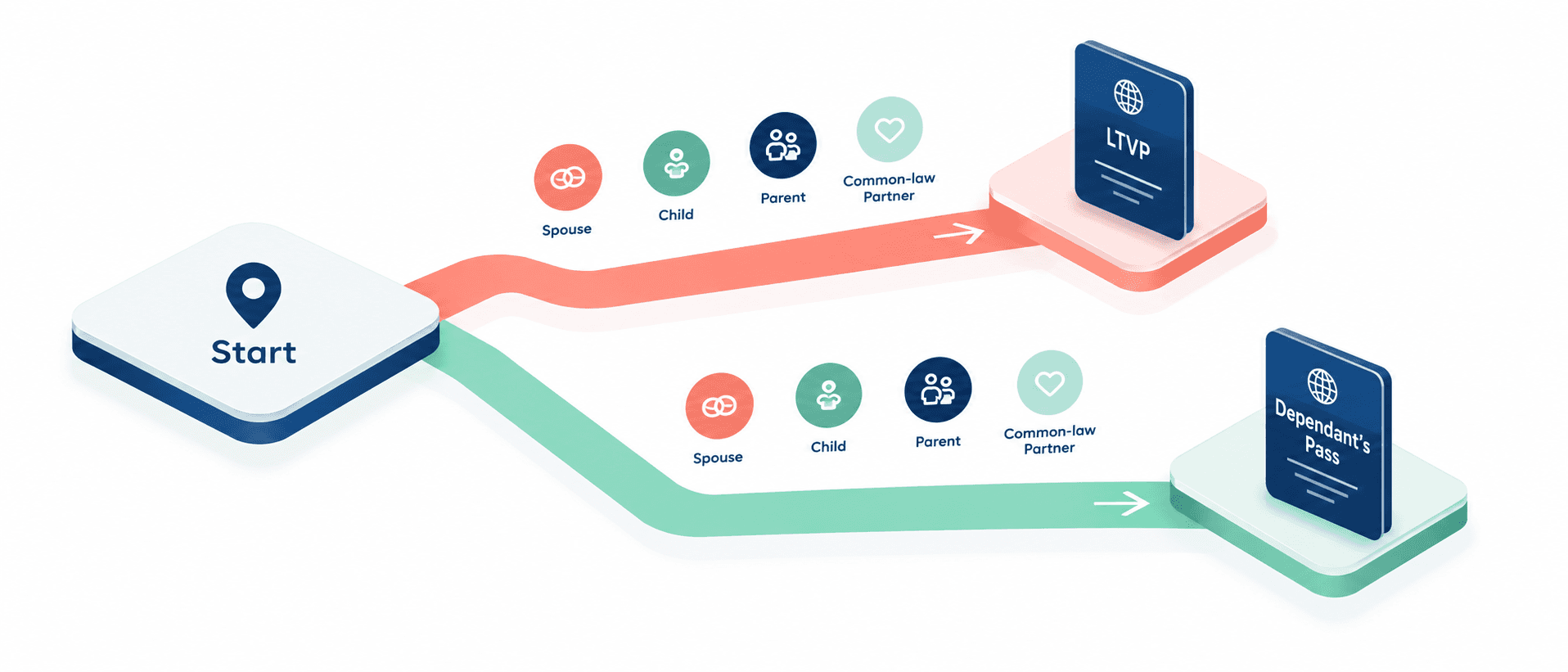
TLDR:
- A Dependant’s Pass is the MOM route for an eligible Employment Pass or S Pass holder’s legally married spouse or unmarried child under 21.[1]
- An MOM-issued Long-Term Visit Pass covers specified family relationships outside the standard Dependant’s Pass categories, including a common-law spouse, step-child, certain adult children with disabilities and, for higher-earning sponsors, parents.
- An ICA-issued Long-Term Visit Pass serves qualifying family ties to a Singapore Citizen or Singapore PR, including spouses, children and parents.[2]
- A family member cannot freely choose between the passes; the sponsor’s status and the relationship determine the intended route.
- Neither pass gives every holder an unrestricted right to work. The required work authorisation depends on the pass and issuing authority.[5]
Long-Term Visit Pass vs Dependant’s Pass is a choice determined by the sponsor’s immigration status and the family relationship: MOM’s Dependant’s Pass is intended primarily for the legally married spouse or unmarried child under 21 of an eligible Employment Pass or S Pass holder, while an LTVP serves other specified relationships or qualifying family members of Singapore Citizens and Singapore PRs.[1][2] The correct answer to “LTVP or DP for family?” therefore begins with who sponsors the applicant, whether the relationship is a legal marriage or another recognised family tie, and whether MOM or ICA controls the route.
What is the difference between an LTVP and a Dependant’s Pass?
The main difference between an LTVP and a Dependant’s Pass is the family relationship and the sponsor category each pass is designed to serve. MOM describes the Dependant’s Pass as the route for spouses and children of Employment Pass or S Pass holders.[1] The LTVP category is broader, but “LTVP” can refer to two distinct systems: an MOM-issued LTVP connected to an eligible work pass holder or an ICA-issued LTVP connected to qualifying family and residence circumstances.
A Dependant’s Pass normally fits a legally married spouse or an unmarried child under 21, including a legally adopted child, when the Employment Pass or S Pass sponsor meets MOM’s requirements.[1] An MOM-issued LTVP addresses specified relationships that fall outside those standard Dependant’s Pass categories, such as a common-law spouse, an unmarried step-child under 21, an unmarried adult child with a qualifying disability, or a parent where the sponsor meets the higher salary threshold.
An ICA-issued LTVP follows a different policy purpose. ICA lists eligible categories that include the spouse of a Singapore Citizen, the spouse of a Singapore PR, certain unmarried children, parents of Singapore Citizens or Singapore PRs, and several other defined circumstances.[2] A person comparing the passes must therefore distinguish an MOM-issued LTVP from an ICA-issued LTVP before comparing fees, work rights or procedures.
For related guidance, see Singapore LTVP Application Consultancy and Support.
Who qualifies for an LTVP or Dependant’s Pass?
The qualifying route depends on the sponsor’s status and the applicant’s exact relationship to that sponsor. The following grid identifies the usual policy route; every application remains subject to the prevailing criteria and approval by the relevant authority.[1][2]
| Sponsor and family relationship | Intended route | Issuing authority | Key boundary |
|---|---|---|---|
| Eligible Employment Pass or S Pass holder and legally married spouse | Dependant’s Pass | MOM | MOM requires the sponsor to satisfy the applicable salary and company-sponsorship requirements.[1] |
| Eligible Employment Pass or S Pass holder and unmarried child under 21, including a legally adopted child | Dependant’s Pass | MOM | The child must fall within MOM’s Dependant’s Pass relationship and age category.[1] |
| Eligible Employment Pass or S Pass holder and common-law spouse | Long-Term Visit Pass | MOM | The common-law relationship requires supporting evidence acceptable to MOM. |
| Eligible Employment Pass or S Pass holder and unmarried step-child under 21 | Long-Term Visit Pass | MOM | The step-child category sits outside the standard Dependant’s Pass child category. |
| Eligible Employment Pass or S Pass holder and unmarried adult child with a qualifying disability | Long-Term Visit Pass | MOM | Medical and relationship evidence will be central to the application. |
| Employment Pass or S Pass holder earning at least S$12,000 in fixed monthly salary and a parent | Long-Term Visit Pass | MOM | The higher parent-sponsorship salary threshold applies to this route. |
| Singapore Citizen or Singapore PR and foreign spouse | Long-Term Visit Pass | ICA | ICA assesses the application under its family-ties framework.[2] |
| Singapore Citizen or Singapore PR and qualifying unmarried child below 21 | Long-Term Visit Pass | ICA | ICA specifies the qualifying birth or legal-adoption relationship.[2] |
| Singapore Citizen or Singapore PR and parent | Long-Term Visit Pass | ICA | ICA states that parents-in-law are not eligible under the parent category.[2] |
How does the sponsor’s status decide between LTVP and DP?
The sponsor’s status identifies the authority and pass framework before any other comparison is made. An Employment Pass or S Pass holder generally works through the employer or appointed employment agent under MOM’s family-pass system. MOM states that the Dependant’s Pass allows spouses and children of Employment Pass or S Pass holders to join them in Singapore.[1]
A Singapore Citizen or Singapore PR sponsoring a foreign spouse does not use the Employment Pass or S Pass Dependant’s Pass framework. ICA lists spouses of Singapore Citizens and Singapore PRs among the foreign nationals eligible to apply for an LTVP.[2]
The word “LTVP” alone is therefore insufficient for planning. A family should record the proposed issuing authority as “MOM-issued LTVP” or “ICA-issued LTVP” because the eligible relationships, application channel, fees, processing benchmarks and work arrangements differ.
For related guidance, see Divorce Without Blame, But Not Without Immigration Consequences: What Foreign Spouses in Singapore Need to Know.
How do the LTVP and Dependant’s Pass compare?
The Dependant’s Pass and LTVP differ most sharply in intended relationships, issuing authority and work arrangements. MOM-issued family passes share several administrative features, while an ICA-issued LTVP follows ICA’s residence framework.[1][2]
| Comparison point | Dependant’s Pass | MOM-issued LTVP | ICA-issued LTVP |
|---|---|---|---|
| Issuing authority | MOM | MOM | ICA |
| Typical sponsor | Eligible Employment Pass or S Pass holder | Eligible Employment Pass or S Pass holder | Singapore Citizen, Singapore PR or another qualifying sponsor category |
| Core family relationships | Legally married spouse; unmarried child under 21, including a legally adopted child[1] | Common-law spouse; qualifying step-child; qualifying adult child with a disability; qualifying parent | Foreign spouse, qualifying child or parent of a Singapore Citizen or Singapore PR, plus other ICA-listed categories[2] |
| Application party | Main pass holder’s employer or appointed employment agent for the usual Employment Pass or S Pass route[3] | Main pass holder’s employer or appointed employment agent for the usual Employment Pass or S Pass route | Sponsor and applicant through ICA’s process[2][4] |
| Work position | A separate qualifying work pass is generally required for employment; eligible business owners may use the specific Letter of Consent route | A holder must obtain the applicable work authorisation | Eligible ICA-issued LTVP or LTVP+ holders may use the applicable Letter of Consent framework, subject to MOM’s conditions[5] |
| Validity | Tied to the main work pass or the approved requested duration, whichever is shorter | Tied to the main work pass or the approved requested duration, whichever is shorter | Granted and renewed by ICA according to the approved case |
| Renewal | Renewal depends on continuing sponsor and relationship eligibility | Renewal depends on continuing sponsor and relationship eligibility | ICA recommends submitting an LTVP renewal at least three months before expiry[4] |
| Conversion | No automatic conversion | No automatic conversion | No automatic conversion |
What do LTVP and Dependant’s Pass applications cost?
MOM-issued Dependant’s Pass and LTVP applications use a different fee schedule from ICA-issued LTVP applications. Applicants should verify the official fee immediately before filing because government charges can change.
| Route | Application fee | Issuance fee | Other possible fee |
|---|---|---|---|
| MOM Dependant’s Pass | S$105 for each application[3] | S$225 for each pass[3] | S$30 for a Multiple Journey Visa, if applicable[3] |
| MOM Long-Term Visit Pass | S$105 for each application | S$225 for each pass | S$30 for a Multiple Journey Visa, if applicable |
| ICA Long-Term Visit Pass | S$45 for each application[4] | S$60 for issuance[4] | S$30 for a Multiple Journey Visa, if applicable[4] |
Government fees do not include translation, notarisation, document procurement, medical examinations or professional assistance. E&H Immigration recommends budgeting separately for evidence preparation when civil-status documents were issued outside Singapore or are not in English.
How long do LTVP and Dependant’s Pass applications take?
MOM states that most Dependant’s Pass applications for dependants of Employment Pass and S Pass holders are processed within three weeks, while ICA states that most LTVP applications are processed within six weeks when the required documents are in order.[3][4] Some cases take longer, and those published periods are processing benchmarks rather than approval guarantees.
ICA states that an LTVP application by the foreign spouse of a Singapore Citizen can take up to six months. ICA also states that couples who completed the Pre-Marriage LTVP Assessment before marriage can receive a six-week processing time for the subsequent foreign-spouse LTVP application.[4]
An MOM-issued LTVP for an Employment Pass or S Pass holder’s dependant is generally processed within three weeks for most cases. Missing relationship evidence, inconsistent personal particulars or requests for additional documents can extend the practical timeline.
How do you apply for an LTVP or Dependant’s Pass?
The application process starts by identifying the correct authority and relationship category before documents or fees are submitted. A family should use the following sequence:
- Classify the sponsor. Record whether the sponsor is an Employment Pass holder, S Pass holder, Singapore Citizen or Singapore PR.
- Classify the relationship. Confirm whether the applicant is a legally married spouse, common-law spouse, biological or adopted child, step-child, adult child with a disability, or parent.
- Select the authority. Use MOM for the relevant family route tied to an Employment Pass or S Pass. Use ICA for the applicable family-ties route connected to a Singapore Citizen or Singapore PR.[1][2]
- Check sponsor eligibility. Confirm the sponsor’s pass type, fixed monthly salary, employer sponsorship and any relationship-specific threshold before filing.
- Prepare supporting evidence. Match names, dates, marital status and family relationships across passports, civil-status certificates and supporting declarations.
- Submit through the correct channel. The employer or appointed employment agent normally submits the Dependant’s Pass application for an Employment Pass or S Pass holder, while an ICA LTVP sponsor uses ICA’s application process.[3][4]
- Respond to document requests. Supply additional evidence within the stated deadline and keep the explanation consistent with the original application.
- Complete issuance formalities after approval. Pay the issuance charge, complete any medical or registration requirement and arrange the pass card as directed by MOM or ICA.[3][4]
Approval is not guaranteed. The correct route removes a preventable eligibility error, but the relevant authority still decides each application.
What documents are needed for LTVP and Dependant’s Pass applications?
Both routes require identity and relationship evidence, while the exact checklist changes with the sponsor and family category. A Dependant’s Pass application commonly requires the applicant’s passport particulars and the civil document proving a legal marriage, birth relationship or adoption. An MOM-issued LTVP may also require evidence supporting a common-law marriage, step-child relationship, custody arrangement, disability or parental relationship.
An ICA-issued LTVP application may require documents concerning the sponsor, applicant, marriage, children, employment, income and previous marital history, depending on the category. ICA requires persons added as applicants to review the application and provide their declarations through the prescribed login process.[4]
Documents not in English should follow the authority’s prevailing translation requirements. Names, dates of birth, passport numbers and relationship descriptions should remain consistent across every uploaded record. E&H Immigration recommends explaining genuine discrepancies directly instead of leaving the reviewing officer to infer why records differ.
For related guidance, see Singapore LTVP Application Guide: Eligibility, Documents and Process.
Can LTVP and Dependant’s Pass holders work in Singapore?
Neither an LTVP nor a Dependant’s Pass should be treated as a universal, unrestricted permission to work. A Dependant’s Pass holder seeking employment with an organisation generally needs the prospective employer to obtain an Employment Pass, S Pass or the applicable Work Permit. A separate Letter of Consent route exists for eligible Dependant’s Pass holders who own and operate a business.
An MOM-issued LTVP holder needs a job offer and the prospective employer must obtain an appropriate Employment Pass, S Pass or Work Permit. The candidate must meet the criteria for the selected work pass.
An eligible spouse or unmarried child of a Singapore Citizen or Singapore PR holding an ICA-issued LTVP or LTVP+ may work through the applicable Letter of Consent or Pre-approved Letter of Consent framework. The employer must obtain the required approval or complete the required notification before employment begins.[5]
The issuing authority shown on the LTVP matters. Advice that says simply “LTVP holders can work with an LOC” is overbroad because MOM-issued and ICA-issued LTVPs do not have identical work arrangements.
How do validity and renewal differ between LTVP and Dependant’s Pass?
A Dependant’s Pass and an MOM-issued LTVP are normally tied to the main work pass, while an ICA-issued LTVP follows the validity granted by ICA. MOM states that Dependant’s Pass validity is tied to the main work pass or the requested duration, whichever is shorter.[1] A cancellation or expiry of the main Employment Pass or S Pass can therefore affect the dependant’s continued stay.
ICA asks LTVP holders to submit renewal applications at least three months before the current pass expires. ICA states that the renewed pass begins from its issuance date and that unused validity on the existing LTVP is not carried forward.[4]
LTVP+ is a separate ICA enhancement for qualifying foreign spouses of Singapore Citizens; LTVP+ can provide a longer period of residence and additional benefits compared with a regular LTVP.[6] LTVP+ is not the alternative to a Dependant’s Pass for an Employment Pass or S Pass holder’s spouse.
For related guidance, see What is the difference between a Dependant’s Pass (DP) and an LTVP?.
Can a family member convert between an LTVP and a Dependant’s Pass?
An LTVP does not automatically convert into a Dependant’s Pass, and a Dependant’s Pass does not automatically convert into an LTVP. A change in marriage status, sponsor status or family circumstances may make a different route appropriate, but the family should treat the new route as a fresh application under the relevant authority’s criteria.[3][4]
A common-law spouse who later enters a legally recognised marriage may become eligible for the Dependant’s Pass framework if the Employment Pass or S Pass sponsor meets MOM’s requirements. A Dependant’s Pass holder whose spouse becomes a Singapore PR may instead need to assess the ICA family-ties route.
Pass cancellation and new-pass issuance should be coordinated carefully. A family should avoid creating a gap in lawful stay or cancelling an existing pass before understanding the new application’s approval and issuance conditions.
Why can an LTVP or Dependant’s Pass application be delayed or rejected?
Applications can encounter problems when the selected pass does not match the sponsor and relationship, the sponsor fails a threshold, or the evidence does not establish the claimed family tie. An application for a common-law partner under the Dependant’s Pass category, for example, conflicts with MOM’s legally married spouse category.[1]
Document inconsistencies can also trigger questions. Different name spellings, unexplained previous marriages, incomplete custody records, conflicting addresses or missing translations can make the relationship harder to verify.
A processing delay does not by itself indicate rejection. MOM and ICA may request additional information, and both authorities state that some cases take longer than their published general processing periods.[3][4] Approval is not guaranteed even when the formal category appears correct.
How would the choice work in a typical family?
A family should map each relative separately because one sponsor can have relatives who fall under different pass categories. Consider an illustrative Employment Pass holder earning S$9,000 in fixed monthly salary. The holder’s legally married spouse and unmarried 12-year-old biological child would ordinarily be assessed under the Dependant’s Pass route.[1]
The same Employment Pass holder’s common-law partner would instead fall within the MOM-issued LTVP relationship framework. The holder’s parent would not meet the S$12,000 fixed-monthly-salary threshold used for the MOM parent route.
A different result would apply if the sponsor were a Singapore Citizen rather than an Employment Pass holder. The foreign spouse would assess an ICA-issued LTVP because ICA, not MOM’s Dependant’s Pass framework, handles that family-ties route.[2]
This example illustrates route selection rather than an approval prediction. The authorities decide each application on its facts.
Which family pass should you choose?
The correct family pass is the one intended for the sponsor’s status and the applicant’s legally supported relationship. A family should not select an LTVP merely because the label sounds broader or select a Dependant’s Pass because the applicant depends financially on the sponsor.
Need help choosing the correct route? E&H Immigration can assess the sponsor’s status, family relationship and supporting records before an LTVP or Dependant’s Pass application is prepared. A route review can identify authority, eligibility and evidence issues before government fees are paid.
Not sure where you stand?
Get a personalised assessment of your Singapore PR, citizenship, or work pass options from E&H Immigration’s specialists.
What are the frequently asked questions about LTVP vs Dependant’s Pass?
Is a Dependant’s Pass the same as an LTVP?
A Dependant’s Pass is not the same as an LTVP. The Dependant’s Pass serves specified dependants of eligible work pass holders, while LTVP routes cover other defined relationships or qualifying ICA family categories.[1][2]
Should an Employment Pass holder apply for an LTVP or DP for a legally married spouse?
A Dependant’s Pass is ordinarily the intended route for the legally married spouse of an eligible Employment Pass holder who satisfies MOM’s requirements.[1]
Can an unmarried partner get a Dependant’s Pass?
An unmarried or common-law partner does not fall within MOM’s legally married spouse category for a Dependant’s Pass. An MOM-issued LTVP may be the relevant family route if the sponsor and relationship evidence meet the prevailing requirements.
Can a Dependant’s Pass holder work with a Letter of Consent?
A Dependant’s Pass holder generally needs an Employment Pass, S Pass or applicable Work Permit to work for an organisation. An eligible Dependant’s Pass holder who owns and operates a business may use the specific business-owner Letter of Consent route.
Can an ICA-issued LTVP holder work in Singapore?
An eligible ICA-issued LTVP or LTVP+ holder may work under the applicable Letter of Consent or Pre-approved Letter of Consent arrangement. The required approval or employer notification must be completed before work begins.[5]
Is an LTVP better than a Dependant’s Pass?
Neither pass is universally better. The sponsor’s status and family relationship determine which route fits, while work plans, validity and renewal consequences affect practical suitability.
Can parents of an Employment Pass holder get an LTVP?
Parents may fall within the MOM-issued LTVP route when the Employment Pass holder earns a fixed monthly salary of at least S$12,000 and satisfies the remaining requirements.
Can a foreign spouse of a Singapore PR apply for a Dependant’s Pass?
A foreign spouse of a Singapore PR normally assesses the ICA-issued LTVP route rather than MOM’s Dependant’s Pass framework. ICA expressly lists the spouse of a Singapore PR as an eligible LTVP applicant category.[2]
Sources & References
- Dependant’s Pass — Ministry of Manpower
- Long-Term Visit Pass — Immigration & Checkpoints Authority
- Apply for Dependant’s Pass — Ministry of Manpower
- Apply for Long-Term Visit Pass — Immigration & Checkpoints Authority
- Letter of Consent for LTVP Holders — Ministry of Manpower
- Long-Term Visit Pass Plus — Immigration & Checkpoints Authority