
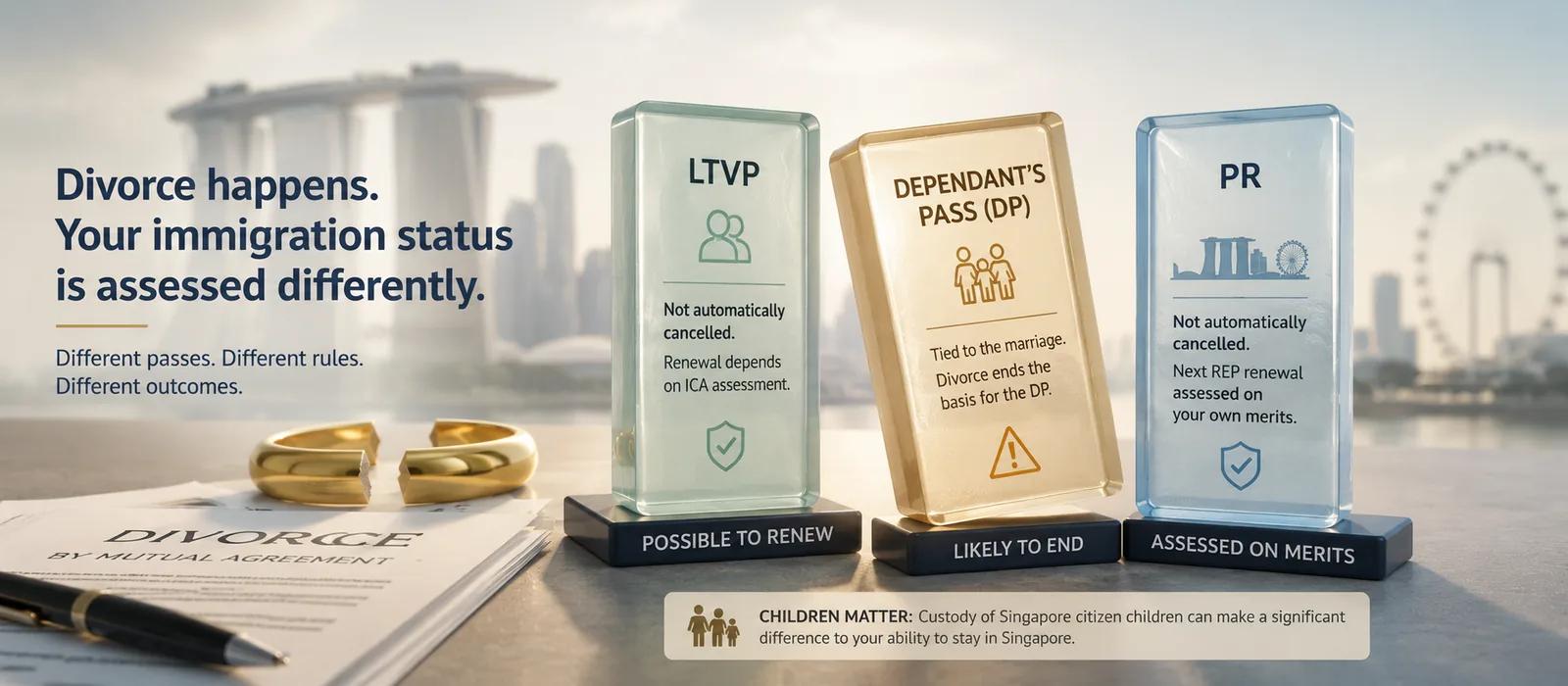
TL;DR — Direct Answer
Divorce does not automatically cancel a foreign spouse’s right to stay in Singapore — but it changes the basis of that right, and the outcome depends on the pass type, not on how amicable the divorce was.
- ICA-issued LTVP/LTVP+: Your Singaporean spouse cannot unilaterally cancel your LTVP without your consent — ICA’s own Terms & Conditions say so. But renewal after expiry is a separate question assessed by ICA.
- MOM-issued Dependant’s Pass: The pass is tied to the marriage. Once the marriage ends, the basis for the DP falls away; a Short-Term Visit Pass of up to 90 days may bridge the transition.
- Singapore PR: Existing PR is not automatically cancelled by divorce. But your next Re-Entry Permit renewal will be assessed on your own merits.
- Singapore citizen children change everything: ICA has stated it will generally renew the LTVP of a divorced foreign spouse who has custody of Singaporean children.
- Divorce by mutual agreement (available since 1 July 2024, used in 18.8% of civil divorces in 2025) may reduce conflict and improve cooperation on sponsorship — but it creates no special immigration entitlement.
Nearly one in five Singapore couples now divorce without assigning blame
Nearly one in five civil divorces in Singapore in 2025 was granted by divorce by mutual agreement (DMA) — a process introduced on 1 July 2024 that allows couples to establish the irretrievable breakdown of their marriage without accusing either party of adultery, desertion or unreasonable behaviour. Singapore recorded 7,242 divorces and annulments in 2025, a 1.9% decline from 2024.
DMA changes how a marriage can end. It does not change what happens next for a spouse whose right to live in Singapore is connected to that marriage.
For the foreign spouse holding a Long-Term Visit Pass, a Dependant’s Pass, a Letter of Consent to work, or a pending PR application, an amicable separation can still produce urgent and difficult immigration questions:
- Can my Singaporean spouse cancel my LTVP?
- Can I stay in Singapore while the divorce is ongoing?
- Does divorce cancel Singapore PR?
- Can my children remain in Singapore — and does custody help my case?
- What happens to my pending PR or citizenship application?
The answers depend far less on who was blamed for the marriage breakdown, and far more on:
- which authority issued your pass (ICA or MOM),
- whether the pass depends on the marriage or the sponsor,
- whether there are Singapore citizen or PR children, and
- whether you can qualify for an immigration status on your own merits.
This article works through each status in turn.
The one distinction that matters: the reason for divorce ≠ the immigration outcome
Quick Answer: The legal basis for ending the marriage (mutual agreement, unreasonable behaviour, adultery, separation) does not by itself determine whether ICA or MOM will allow the foreign spouse to remain. Immigration outcomes turn on pass type, sponsorship, children, employment and ties to Singapore.
Family law and immigration law run on separate tracks. The Family Justice Courts decide whether the marriage has irretrievably broken down and how children and assets are dealt with. ICA and MOM decide, separately and on different criteria, whether a foreign national may continue to live and work in Singapore.
The factors that actually drive the immigration assessment include:
| Factor | Why it matters |
|---|---|
| Pass type and issuing authority | ICA-issued LTVP/LTVP+ and MOM-issued DP follow entirely different rules on cancellation, renewal and transition |
| Sponsorship dependency | A pass sponsored by the spouse behaves differently from an independent EP, S Pass or PR |
| Singapore citizen or PR children | The single most influential factor for post-divorce LTVP renewal |
| Care and custody arrangements | ICA policy specifically references custody of Singaporean children |
| Stage of proceedings | ICA may facilitate continued stay during proceedings; the post-divorce position is assessed separately |
| Alternative sponsors | Another SC or PR may sponsor an LTVP, subject to ICA approval |
| Independent qualification | Ability to hold your own EP, S Pass, Work Permit or PR case |
| Records and conduct | Adverse immigration or criminal records weigh against renewal |
Keep this table in mind — every section below is an application of it.
Does divorce automatically cancel a foreign spouse’s right to stay in Singapore?
Quick Answer: Not automatically — but the position must be reviewed promptly, because the answer differs sharply between an ICA-issued LTVP, a MOM-issued Dependant’s Pass, and Singapore PR.
At-a-glance comparison
| ICA LTVP / LTVP+ (spouse of SC/PR) | MOM Dependant’s Pass (spouse of EP/S Pass holder) | Singapore PR | |
|---|---|---|---|
| Basis of status | Spousal relationship + local sponsor | Legal marriage to eligible work-pass holder | Personal status, granted to the individual |
| Can the spouse cancel it unilaterally? | No — ICA’s LTVP T&Cs require both the holder’s and the sponsor’s consent (though ICA retains discretion under the Immigration Regulations) | The sponsoring work-pass holder/employer arranges cancellation once the qualifying relationship ends | Not applicable — spouse has no power over PR status |
| Effect of final divorce | Renewal assessed by ICA; custody of SC children strongly favourable | Basis for pass falls away; cancellation expected | PR continues — not automatically cancelled |
| Bridge option | ICA may extend/renew during proceedings; STVP in some cases | STVP of up to 90 days may be requested on cancellation | Next REP renewal assessed on own merits |
| Work rights | Via LOC/PLOC tied to the LTVP — falls with the pass | DP holders need their own work pass to work | Unrestricted |
| Best protective factor | Custody/care of Singapore citizen children | Independent EP/S Pass eligibility | Ongoing economic and family ties for REP |
A. ICA-issued LTVP or LTVP+ — the myth of instant cancellation
An LTVP for the spouse of a Singapore citizen or PR is fundamentally based on the spousal relationship and normally requires the SC/PR spouse to act as sponsor.
But the most common fear — “my spouse can cancel my LTVP tomorrow” — is wrong. ICA’s published LTVP Terms & Conditions state that the local sponsor cannot unilaterally request ICA to cancel the LTVP without the holder’s consent; ICA requires both the holder’s and the sponsor’s consent to cancel — in a spousal LTVP, that means both you (the pass holder) and your Singaporean spouse (the sponsor). ICA has also confirmed publicly that both the holder and the sponsor must attend an interview at ICA for a cancellation request to be assessed.
Two important qualifications keep this honest:
- The same T&Cs state that notwithstanding the consent requirement, the LTVP may be cancelled at ICA’s discretion in accordance with the Immigration Regulations. The consent rule protects you from your spouse — not from ICA.
- Cancellation and non-renewal are different things. A spouse who cannot cancel your pass can still decline to sponsor its renewal. ICA has said it will consider mitigating factors for foreign spouses undergoing divorce proceedings whose Singaporean spouses choose not to renew their LTVP, and renewal under the sponsorship of another Singaporean or PR is possible, subject to ICA’s approval — but continued stay always remains subject to ICA’s assessment.
B. MOM-issued Dependant’s Pass — the pass that falls with the marriage
A Dependant’s Pass exists because its holder is the legally married spouse of an eligible EP or S Pass holder. Once the marriage ends, the qualifying relationship — and with it the basis for the pass — no longer exists. The sponsoring work-pass holder or employer will generally need to arrange cancellation.
Where the DP holder remains in Singapore, a Short-Term Visit Pass of up to 90 days may be requested at cancellation. That is transitional permission, not a plan.
The right time to plan is before the marriage formally ends. Realistic alternatives to evaluate:
- an independent Employment Pass or S Pass (test yourself against current COMPASS benchmarks — see our EP vs S Pass comparison);
- a Work Permit, where the sector and quota permit;
- an ICA-issued LTVP on another qualifying basis (e.g., parent of a citizen child);
- a Student’s Pass, where genuine study plans exist;
- PR on an independent basis, where the profile supports it;
- structured departure and re-entry planning if no new status is available.
C. Singapore Permanent Residence — the misconception worth killing
Divorce does not ordinarily cancel an existing Singapore PR. Once granted, PR is a personal immigration status belonging to the individual, not to the marriage.
What divorce does affect is the future:
- Re-Entry Permit renewal. ICA’s position is that REP renewal will be assessed on the person’s own merits where the person is divorced or undergoing divorce. A PR whose profile leaned heavily on family ties should strengthen independent economic and residential ties before the next REP falls due.
- Children who obtained PR as dependants — their status continues, but custody and relocation questions arise.
- Pending PR or citizenship applications — covered in detail below.
- Documentation. ICA’s PR checklists expressly contemplate applicants with previous marriages and may require divorce certificates, custody papers and an ex-spouse’s consent for minor applicants under joint custody.
The precise framing: an existing PR remains a PR unless the status is renounced, lost or otherwise dealt with under the applicable rules — but every future REP renewal and immigration application is separately assessed.
What if the couple has Singapore citizen children?
Quick Answer: Custody or care of Singapore citizen children is the single most favourable factor a divorced foreign spouse can have. ICA has stated it will generally renew the LTVP of divorced foreign spouses with custody of Singaporean children — but it is a strong factor, not a guarantee.
This is where published government positions are most concrete:
- ICA will typically facilitate the renewal of LTVPs for foreign spouses undergoing divorce proceedings until the end of the proceedings, if they have Singaporean children and a local sponsor supporting the application.
- ICA will generally renew foreign spouses’ LTVPs after divorce if they have custody of Singaporean children.
- In a written parliamentary reply on 7 May 2024, the Minister for Home Affairs and Law confirmed that Singapore’s policy is generally to allow divorced or widowed foreign spouses with custody of Singaporean children to remain.
Advocacy groups such as AWARE have called on ICA to go further — for example, by formally waiving the local sponsorship requirement where a foreign parent has Singaporean children but no available SC/PR sponsor. These are policy recommendations directed at government, not statements of ICA’s current practice, and should not be relied on as if they were.
Evidence that strengthens the application
| Category | Documents |
|---|---|
| Child’s status | Singapore citizenship certificate / birth certificate, PR records |
| Court orders | Interim judgment, final judgment, care and control / custody orders |
| Actual caregiving | Evidence the child ordinarily lives with you; school and medical records naming you; day-to-day correspondence |
| Stability | Employment letters, payslips, proof of accommodation |
| Financial arrangements | Maintenance orders and payment records |
| Co-parenting | Access arrangements for the other parent; social worker’s report where relevant |
The honest caveat, always: having care or custody of a Singapore citizen child may be a highly relevant factor, but every application remains subject to ICA’s case-by-case assessment. An adverse immigration or criminal record can outweigh it.
What if the foreign spouse has no Singapore citizen children?
Quick Answer: The position is more difficult but not hopeless. The strategy shifts from family ties to independent qualification — and timing becomes critical.
Work through this sequence:
- Is the existing pass still valid? A pass does not lapse merely because proceedings begin; check the expiry date first.
- Is another sponsor available? ICA’s LTVP Terms & Conditions state that sponsorship may be taken over by another Singapore Citizen or PR, subject to ICA’s approval — but not every SC/PR qualifies. ICA’s LTVP categories are tied to specific family relationships (spouse, parent, or child of the applicant), so in practice a new sponsor generally needs their own qualifying relationship to you — for example a new spouse, or a child who has since become an adult SC/PR. A willing SC/PR with no such relationship to you is unlikely to be accepted.
- Are there mitigating circumstances? ICA has said it will consider mitigating factors where the SC spouse declines to renew during proceedings. Government materials also indicate that where ongoing divorce or family-violence proceedings require the person’s presence in Singapore, ICA may issue or extend an STVP until the proceedings conclude in appropriate cases — discretionary, not an entitlement.
- Can you qualify for a work pass independently? An EP or S Pass in your own name is the cleanest long-term solution.
- Is there a viable independent PR case? Length of residence, employment, tax history and integration may support an application that no longer relies on the marriage.
- Do court proceedings require your physical presence? This supports STVP facilitation.
- Are there exceptional circumstances? Family violence, financial vulnerability or caregiving of a PR child are relevant.
The common failure mode is waiting until the pass is weeks from expiry. Every option above works better with months of runway.
Does divorce by mutual agreement help the immigration case?
Quick Answer: It may help practically — cooperation on sponsorship, cleaner documentation, less contradiction between agencies — but it creates no special immigration entitlement. “No blame” in court does not mean “no explanation required” at ICA.
Where an amicable divorce genuinely helps
| Practical benefit | Immigration effect |
|---|---|
| Spouse remains willing to sponsor LTVP renewal during proceedings | Directly supports ICA’s stated facilitation policy |
| Clear, agreed custody and access arrangements | Cleaner evidence for post-divorce LTVP renewal |
| Consent documents for children easier to obtain | Smoother PR/citizenship processing for minors under joint custody |
| No contradictory allegations filed in court | No discrepancies between court pleadings and ICA/MOM declarations |
| More time and goodwill | Runway to secure an independent pass before the spousal one ends |
Where it changes nothing
A mutual-agreement divorce does not erase:
- the end of the qualifying marital relationship;
- the sponsorship requirements attached to the pass;
- the obligation to keep personal particulars updated with ICA and MOM;
- the need to hold valid immigration permission at all times;
- discrepancies between previous and current applications;
- scrutiny of a marriage suspected of being entered into primarily for immigration benefit.
The line worth remembering: the Family Justice Courts stopped asking who was at fault; ICA never asked that question in the first place, and it is still asking all of its own.
What happens to a pending PR or citizenship application?
Quick Answer: A material change in marital status must not be concealed. Whether the application should proceed, be amended or be withdrawn depends on whether it was built on the marriage or on your independent profile.
If the application was filed as the spouse of a Singapore citizen, or as part of a family unit, separation or divorce may materially affect:
- the basis of the application (sponsored-spouse route vs independent route);
- the sponsor’s willingness to continue;
- declared household composition, addresses and finances;
- custody arrangements for child applicants — ICA checklists require divorce certificates, custody papers and, for minors under joint custody, the ex-spouse’s consent;
- whether the application can sensibly proceed in its existing form.
Concealing the change is the one clearly wrong move. An application approved on the basis of particulars that were no longer accurate creates a problem far more serious than the divorce itself.
The right move differs by profile: an applicant with a strong independent economic profile may be better off withdrawing and refiling on their own merits; a parent with care of a citizen child may have grounds to continue on an amended basis. Get case-specific advice before withdrawing, amending or submitting further documents. (See our PR eligibility guide and PR cover letter guide for the independent-profile route.)
Can the foreign spouse continue working during and after divorce?
Quick Answer: It depends entirely on what your work authorisation is attached to. Independent work passes survive divorce; marriage-linked arrangements (DP, LOC/PLOC on a spousal LTVP) fall with the underlying status.
| Your situation | Effect of divorce on work rights |
|---|---|
| Own EP / S Pass / Work Permit | Not dependent on the marriage — continues, though marital particulars should be updated where required |
| DP holder | The DP itself is marriage-linked; and DP holders generally need their own work pass to work anyway. Plan an independent pass |
| LTVP/LTVP+ holder working under LOC or PLOC | MOM permits ICA-issued LTVP/LTVP+ holders to work where the employer obtains the applicable Letter of Consent — but the LOC stands on the LTVP. If the LTVP is not renewed, the right to work goes with it |
The practical message: immigration status and work authorisation must be planned together. Losing the pass means losing the job authorisation built on it — and losing the job weakens the very profile you need for an independent pass or PR case. Do not wait until expiry.
Myth vs Reality
| Myth | Reality |
|---|---|
| “My spouse can immediately cancel my ICA-issued LTVP without me.” | ICA’s LTVP T&Cs require both the holder’s and the sponsor’s consent to cancel, and an ICA interview attended by both. But ICA retains its own discretion, and renewal after expiry is a separate question. |
| “An amicable divorce means my immigration status is safe.” | The absence of blame does not preserve a pass that depends on the marriage. |
| “Divorce automatically cancels PR.” | Existing PR is not ordinarily cancelled by divorce — but the next REP renewal is assessed on your own merits. |
| “Having a Singapore citizen child guarantees an LTVP.” | It is the strongest single factor — ICA generally renews where the foreign parent has custody — but approval is never automatic and adverse records count against you. |
| “I can stay until the divorce is finished.” | Only if you continue to hold a valid pass or are granted another valid facility (e.g., an STVP during proceedings, at ICA’s discretion). |
| “I should hide the separation until my PR is approved.” | Concealing a material change creates a far more serious problem than the divorce itself. |
Checklist: what to do before or during divorce proceedings
1. Audit your immigration status
- Who issued the pass — ICA or MOM?
- Expiry date?
- Who is the sponsor?
- What work authorisation do you hold, and what is it attached to?
- Is any PR, citizenship or renewal application pending?
2. Preserve documents
Passport and FIN records; current and previous passes; marriage certificate; children’s birth and citizenship certificates; divorce documents as they issue; custody and access orders; employment letters and payslips; proof of residence; tax and CPF records; school and medical records showing caregiving; all communications about sponsorship or renewal.
3. Never overstay
A pending divorce does not itself grant immigration permission. Every day of overstay is a serious offence that damages every future application.
4. Keep every account consistent
Statements in divorce pleadings, ICA applications, MOM declarations and court documents will eventually sit side by side. They must be factually accurate and consistent.
5. Build the independent route early
Employment, an independent pass, or a standalone PR case takes months to establish. Start before the spouse-dependent status ends, not after.
Facing a change in marital status?
Divorce and immigration are separate legal processes — but each can profoundly affect the other. Before your pass expires, your sponsor withdraws support, or you touch a pending PR or citizenship application, understand the immigration options actually available to you.
E&H Immigration Consultancy can review your current status, family circumstances, employment profile and supporting documents, and help you identify a practical immigration strategy for remaining in Singapore. We do not provide family-law representation — we work alongside your divorce process to protect the immigration side of it.