
Singapore's Retirement Age Is Now 64 — But Your Work Pass Decides Whether It Protects You
Why Statutory Re-Employment Protection to Age 69 Covers Citizens and PRs, Not EP or S Pass Holders
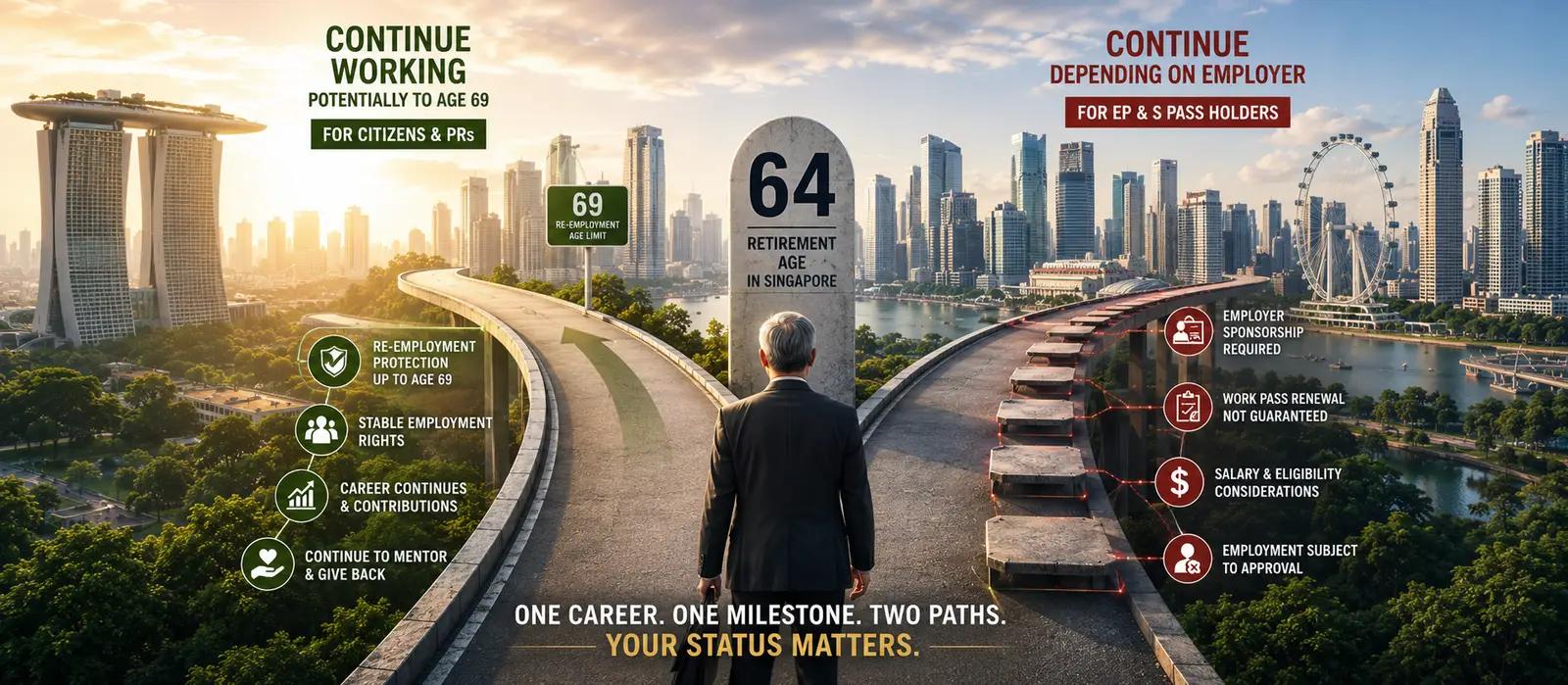
A Singapore Permanent Resident and an Employment Pass holder can work side by side for 20 years. Same title, similar salary, comparable contribution to the same employer.
Then they both turn 64 — and their legal position is no longer the same.
From 1 July 2026, Singapore’s statutory minimum retirement age rose from 63 to 64, and the re-employment age rose from 68 to 69. The Government remains on track to raise these to 65 and 70 by 2030. The stated aim is “productive longevity” — keeping people who are willing and able in the workforce for longer, and giving employers clarity to retain experienced staff.
Here is the detail most foreign professionals miss:
Singapore’s statutory retirement and re-employment protections apply to eligible Singapore Citizens and Permanent Residents — not to Employment Pass, S Pass or Work Permit holders.
This does not mean a foreigner must stop working at 64. It means their ability to keep working is governed by their employer’s willingness to retain them and their continued eligibility for a work pass — not by any statutory right. For anyone building a long-term career and life here, it is another example of how PR status affects far more than immigration convenience.
Key takeaways
- Singapore’s minimum retirement age is now 64; the re-employment age is now 69 (from 1 July 2026).
- Eligible employers must generally offer re-employment up to age 69 to qualifying employees.
- The statutory protection covers Singapore Citizens and Permanent Residents only.
- EP and S Pass holders may still work beyond 64, but have no statutory right to re-employment.
- Work Permit holders are subject to a separate maximum working age of 64, pegged to the local retirement age.
- Re-employment does not guarantee the same role, salary or terms.
- The target is a retirement age of 65 and re-employment age of 70 by 2030.
What changed on 1 July 2026?
Quick answer: The minimum retirement age went from 63 to 64, and the maximum re-employment age went from 68 to 69. Both are steps toward a planned 65 / 70 by 2030.
Singapore has been raising these ages in stages:
| Milestone | Before Jul 2022 | From Jul 2022 | From 1 Jul 2026 | Planned by 2030 |
|---|---|---|---|---|
| Minimum retirement age | 62 | 63 | 64 | 65 |
| Re-employment age | 67 | 68 | 69 | 70 |
The changes were made under the Retirement and Re-employment Act (RRA), with the Tripartite Guidelines on the Re-employment of Older Employees updated to match — including the ages at which the Employment Assistance Payment applies.
Does the new retirement age mean everyone must stop working at 64?
Quick answer: No. The retirement age is not a compulsory stop date. It mainly prevents an employer from dismissing a protected employee on the ground of age before that age.
When an eligible employee reaches 64, the employer must generally offer re-employment up to 69, provided the employee still meets the requirements. In practice:
- Before 64: an eligible employee should not be dismissed solely because of age.
- 64 to 69: an eligible employee should generally be offered re-employment — though the role and terms may change.
- At 69: the statutory re-employment obligation normally ends.
An employer may also adopt a higher contractual retirement age than the statutory minimum.
Who qualifies for re-employment?
Quick answer: Broadly, an employee must be a Citizen or PR, have satisfactory performance, and be medically fit. A minimum service condition applies to those hired at 55 or older.
According to the Ministry of Manpower, an employee generally must:
- Be a Singapore Citizen or Permanent Resident.
- Have satisfactory work performance, as assessed by the employer.
- Be medically fit to continue in a suitable role.
- If hired at age 55 or older, have served the employer at least two years before the minimum retirement age.
“Medically fit” is not limited to the employee’s existing job. Someone may be fit for another suitable role even if they can no longer perform every part of their original one.
PR vs Employment Pass: the difference that actually matters
Quick answer: A PR who qualifies gets statutory re-employment protection up to 69. An EP or S Pass holder does not — their continued work depends entirely on employer sponsorship and pass eligibility.
Consider two employees, both 64, both long-serving, both with satisfactory performance and medically fit:
- Employee A is a Singapore Permanent Resident.
- Employee B is an Employment Pass holder.
Employee A may qualify for statutory re-employment protection. Employee B does not — not by virtue of holding an EP.
| Issue | Singapore PR | EP / S Pass holder |
|---|---|---|
| Covered by statutory retirement age | Yes (subject to eligibility) | No |
| Statutory right to be considered for re-employment | Yes, if eligible | No |
| May continue working after 64 | Yes | Potentially yes |
| Continued employment depends on work-pass approval | No pass required | Yes |
| Employer may owe an EAP if unable to re-employ | Yes, if eligible | No statutory EAP |
| Employment certainty after 64 | Greater statutory protection | Depends on employer + pass |
For an EP or S Pass holder, turning 64 does not make continued employment illegal. But their stay and employment remain tied to the employer’s decision to keep sponsoring them, continued eligibility under the pass criteria, renewal or issuance of the pass, and prevailing manpower policy.
Because EP and S Pass qualifying salaries rise with age before hitting their maximum age-based thresholds, older foreign professionals must also keep clearing higher salary bars to renew — a pressure that builds well before 64. We unpack that mechanism, and where the real risk actually sits, in Why an Employment Pass Gets Riskier in Your 40s — and What PR Changes.
What about Work Permit holders?
Quick answer: Work Permit holders should not be lumped in with EP/S Pass holders here. Their maximum working age is 64 — pegged to the local retirement age.
From 1 July 2026, MOM’s sector rules generally allow a new Work Permit application up to age 62, while existing Work Permit holders can work up to a maximum age of 64. That ceiling is deliberately pegged to Singapore’s retirement age and applies across sectors including services, construction, manufacturing, marine shipyard and process.
One important recent change: the previous maximum-employment-period (duration) cap for Work Permit holders was scrapped from 1 July 2025. Workers can now be renewed indefinitely — but the age-64 ceiling still applies. So a Work Permit holder’s runway is now limited by age, not by tenure.
To summarise the three tracks:
- EP / S Pass holder — may keep working beyond 64 if the pass stays valid or renewable.
- Work Permit holder — separate maximum working age of 64 under prevailing rules.
- Citizen / PR — may qualify for statutory re-employment up to 69.
Does re-employment guarantee the same job and salary?
Quick answer: No. Re-employment guarantees continuity of employment, not of the same position, seniority or pay.
A common misconception is that re-employment locks in the existing role and salary to 69. It does not. An employer may offer:
- the same job with adjusted wages or benefits;
- a modified version of the existing job;
- redeployment to another suitable role;
- part-time employment;
- another mutually agreed arrangement; or
- a role with a different salary reflecting its duties.
Where the employee stays in the same job, any salary change should rest on reasonable factors — productivity, duties and responsibilities, the value of the role, the organisation’s wage structure, and the employee’s experience and competencies. The guidelines discourage cutting wages merely because someone reached retirement age, where there is no seniority-based element in the pay system. For senior roles, larger adjustments may be considered where leadership renewal or restructuring is involved.
When should employers begin re-employment discussions?
Quick answer: Early. MOM encourages identifying eligible employees and starting conversations at least six months ahead, with a formal offer at least three months before retirement.
Employers should generally:
- identify employees who may qualify;
- begin discussions at least six months before retirement age;
- discuss roles, training, salary and benefits;
- make an offer at least three months before retirement; and
- inform employees who do not qualify at least three months ahead.
Where an eligible employee does not want to continue, the guidelines advise getting written confirmation — this reduces later disputes about whether re-employment was offered or declined.
How long should a re-employment contract last?
Quick answer: Ideally a five-year contract up to the re-employment age, or a one-year contract renewable to 69.
The updated Tripartite Guidelines encourage a five-year re-employment contract, up to the prevailing re-employment age. Alternatively, employers may issue contracts of at least one year, renewable to 69, so long as the employee stays eligible.
If an employee simply keeps working past 64 with no new contract, they may be treated as re-employed on the same terms as before. The employer can then negotiate a formal agreement or redeploy the employee to a suitable role.
What happens if the employer cannot offer a suitable role?
Quick answer: The employer either transfers the re-employment obligation to another consenting employer, or — as a last resort — pays a one-off Employment Assistance Payment (EAP).
First, the employer should look for a suitable position internally. If none exists, there are two routes.
1. Transfer the re-employment obligation. The employer arranges for another employer to take over, with both the new employer and employee agreeing. The employee is not obliged to accept; if they decline, the original employer may still owe an EAP.
2. Provide an Employment Assistance Payment (EAP). A one-off payment to help an eligible employee while they look for other work. It is a last resort, not a substitute for a reasonable re-employment offer.
Regular EAP:
| EAP component | Amount |
|---|---|
| Salary multiple | 3.5 months’ salary |
| Minimum | S$6,250 |
| Maximum | S$14,750 |
For employees who have completed at least half of their applicable re-employment period, a stepped-down EAP may apply — for most in the main cohort, the halfway point is reached after 30 months of re-employment from age 64:
| Stepped-down EAP component | Amount |
|---|---|
| Salary multiple | 2 months’ salary |
| Minimum | S$4,000 |
| Maximum | S$8,500 |
Why this matters to foreign professionals considering PR
Most people weigh PR in terms of immediate benefits: employment no longer tied to a single sponsor, flexibility to change jobs, the ability to remain in Singapore between jobs, CPF access, family and residential stability, and a permanent future here.
The re-employment framework adds a longer-term consideration. An EP holder can spend most of a career here and still remain dependent on employer sponsorship late in life. A qualifying PR, by contrast, may gain statutory protection approaching retirement age — the right to be considered for re-employment, structured consultation, advance notice, the possibility of redesigned work, continued employment potentially to 69, and an EAP where re-employment cannot reasonably be offered.
This does not mean anyone should seek PR solely for re-employment protection, nor that PR guarantees work to 69 — the employee must still meet performance, medical-fitness and service requirements, and the role or terms may change. But it illustrates a broader principle: immigration status can affect not only whether you may live and work in Singapore today, but how securely you can keep participating in the workforce later in life.
Does being an older applicant prevent you from getting Singapore PR?
Quick answer: There is no published age cut-off that automatically bars an eligible foreign professional from applying. But eligibility to apply is not the same as likelihood of approval.
ICA lists several categories who may apply, including EP and S Pass holders. Applications are assessed individually, and older applicants in particular should present the full context of their profile — employment history and seniority, income and economic contribution, specialist or leadership capability, length and stability of residence, family ties, qualifications, tax history, industry relevance, and evidence of integration and long-term commitment.
For older applicants, the case often turns on showing why their contribution is likely to stay relevant over the longer term — scarce expertise, regional responsibility, training of locals, or work in an industry that needs experienced manpower.
What employers should do now
Don’t wait until an employee turns 64. Practical steps:
- Identify Citizens and PRs approaching 64.
- Check whether existing contracts still reference an outdated retirement age.
- Begin career and re-employment conversations at least six months ahead.
- Assess performance and medical fitness fairly and consistently.
- Consider job redesign, part-time work and alternative roles.
- Budget for possible salary adjustments or EAPs.
- Document all offers, discussions and decisions.
- Review the separate work-pass implications for older foreign employees.
The updated guidelines also encourage structured career planning from around age 45 and skills/training conversations from around 55 — successful re-employment planning starts years, not months, ahead.
Planning your long-term future in Singapore?
If you’re a foreign professional weighing whether — and when — to apply for Permanent Residence, the retirement and re-employment framework is one more reason the decision deserves a proper strategy rather than guesswork. Age, seniority, industry and timing all shape how an application is best presented.
E&H Consulting Group helps professionals and families navigate Singapore PR, citizenship and work-pass matters — including complex profiles and appeals. If you’d like a clear read on your position and options, arrange a consultation with our team.
Related Reading
- Singapore PR Application Guide
- Why Employment Passes Get Riskier With Age
- Retrenched? EP and S Pass Holders Applying for PR
- Timing Your PR or Citizenship Submission
Planning to work past 64 — or weighing PR against a work pass?
Book a consultation with E&H Immigration →
Our Singapore PR application service helps you plan your long-term status.
Frequently asked questions
Can an Employment Pass holder work after age 64?
Potentially, yes. The statutory retirement age does not by itself require an EP holder to stop at 64. Continued employment depends on employer sponsorship and the employee continuing to qualify for the relevant work pass.
Does an EP holder have a right to re-employment up to age 69?
No. Statutory re-employment eligibility applies to Singapore Citizens and Permanent Residents.
Can a Singapore PR be forced to retire at 64?
An eligible PR who meets the requirements should generally be offered re-employment up to 69. However, the new role and terms may differ from the previous arrangement.
Must re-employment be in the same position?
No. It may be the same job, a modified role, redeployment, part-time work or another mutually agreed arrangement.
Must the employer keep the same salary?
Not necessarily. Reasonable adjustments may be made based on duties, productivity, responsibilities, the value of the new role and the employer’s wage system.
What if the employer cannot find a suitable position?
The employer may transfer the obligation to another consenting employer, or offer a one-off Employment Assistance Payment (EAP).
Can Work Permit holders work until 69?
No. Under prevailing MOM sector rules, Work Permit holders may generally work only up to age 64.
What is the Employment Assistance Payment (EAP)?
A one-off payment — 3.5 months’ salary, subject to a minimum of S$6,250 and a maximum of S$14,750 — offered as a last resort when an eligible employee cannot be re-employed. A lower amount applies for those already re-employed for at least 30 months.
Final thoughts
Singapore is preparing for longer careers and a workforce that contributes into the late 60s. The higher retirement and re-employment ages reflect that shift — but they also draw a clear line between temporary work-pass status and permanent residence.
A foreign professional may be allowed to work here for many years. A Permanent Resident, however, forms part of the local resident workforce and may receive protections that do not extend to EP and S Pass holders. For anyone who genuinely intends to build a career, a family and a long-term future in Singapore, PR is not only about avoiding repeated pass renewals — it may also shape how securely they can keep working later in life.