
4,500 Retrenched: What Singapore Pass Holders Must Know
Singapore retrenchments hit 4,500 in 2Q 2026, a five-year high, even as employment grew. What job loss may mean for your EP, S Pass or pending PR application.
TL;DR
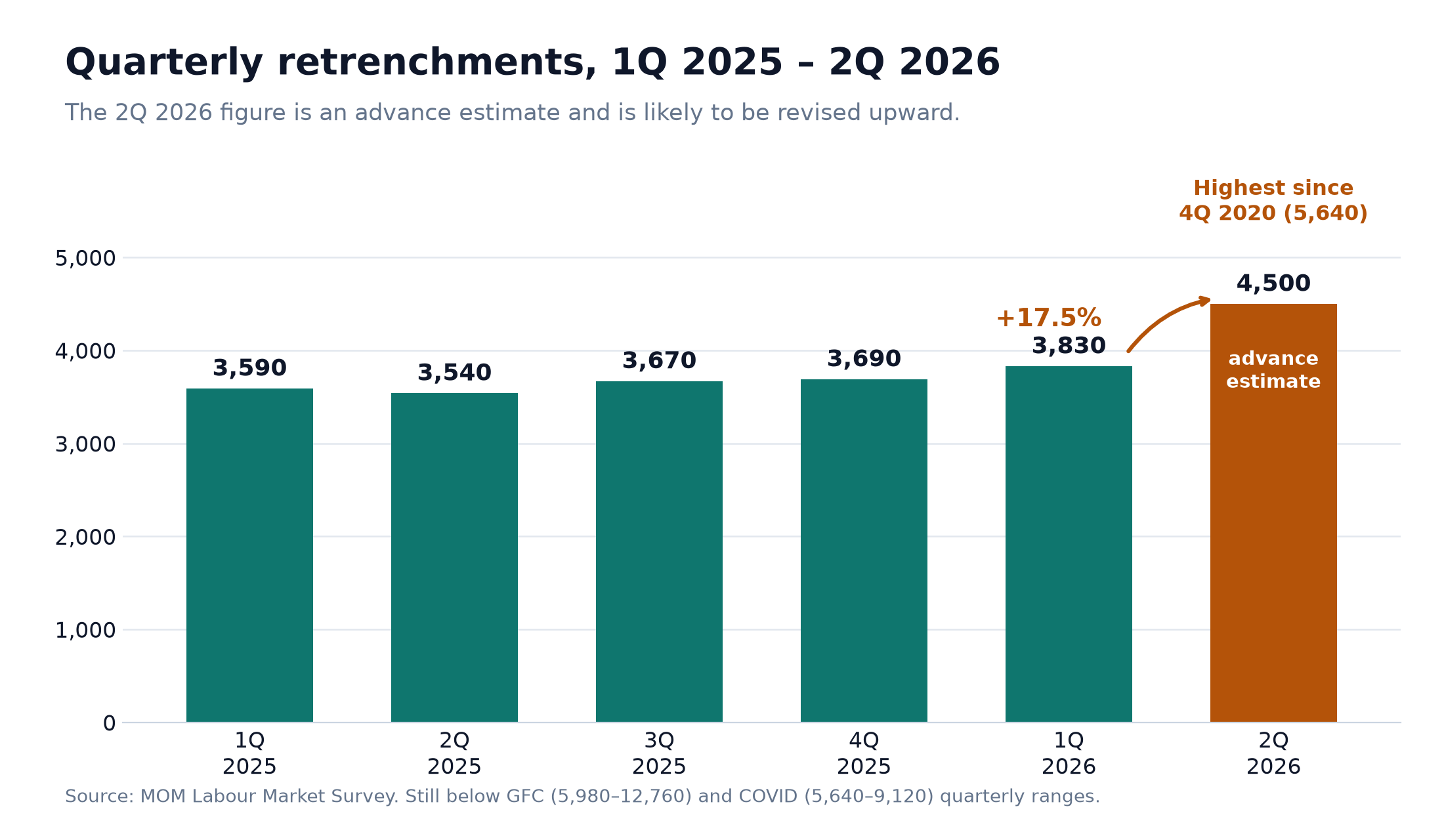
- Singapore recorded 4,500 retrenchments in the second quarter of 2026, up 17.5% from 3,830 in the first quarter.
- That is the highest quarterly figure since the fourth quarter of 2020 (5,640) — but still far below Global Financial Crisis and COVID-19 peaks.
- That 4,500 is an advance estimate, and it is probably an undercount. Every one of the last nine quarters has been revised upward once the full survey returns came in — nine out of nine. On the recent pattern the final figure lands nearer 4,600.
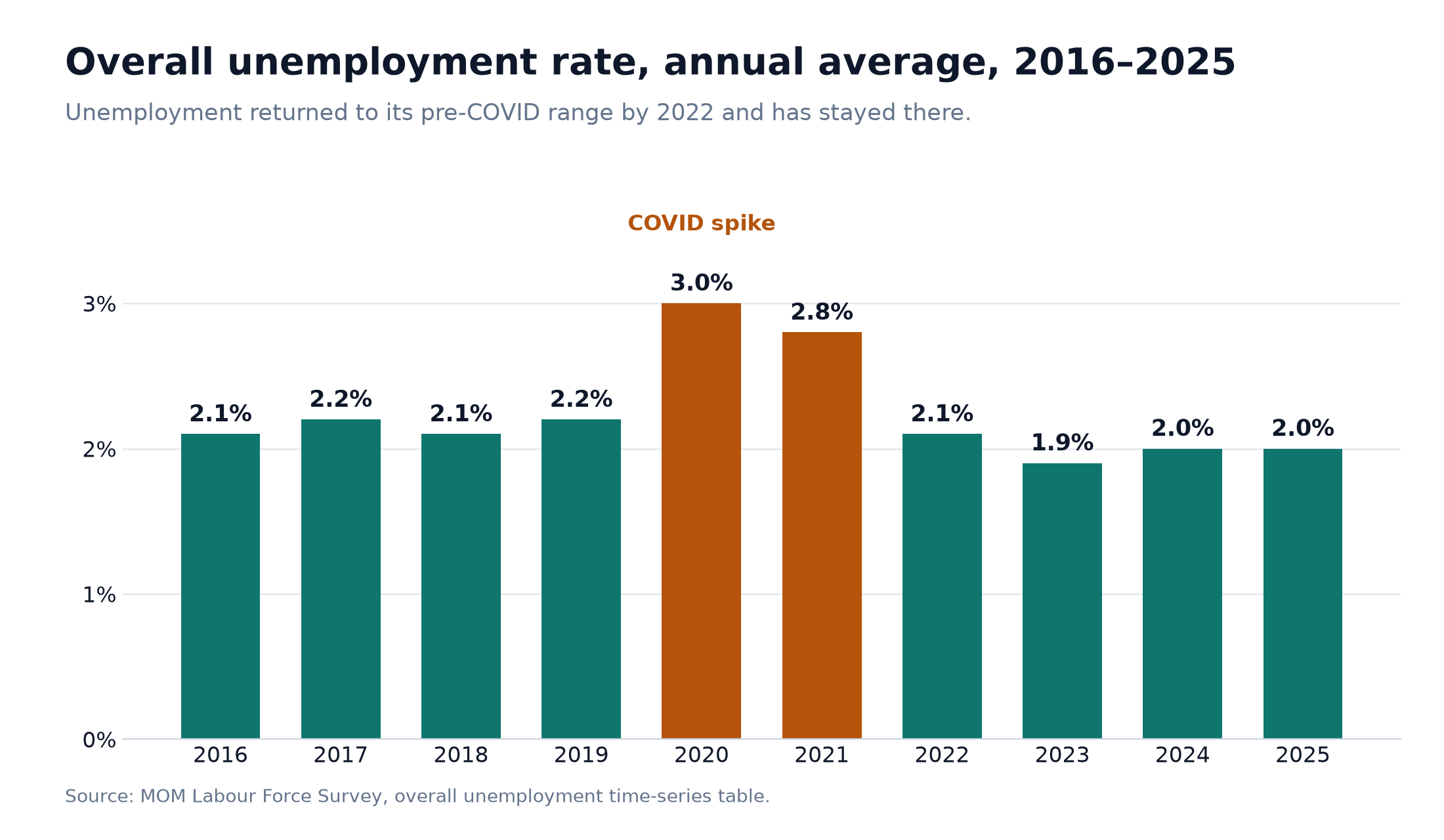
- The labour market is not collapsing: total employment grew by 10,700, a 19th straight quarter of growth, and overall unemployment stayed at 2.0% in June 2026.
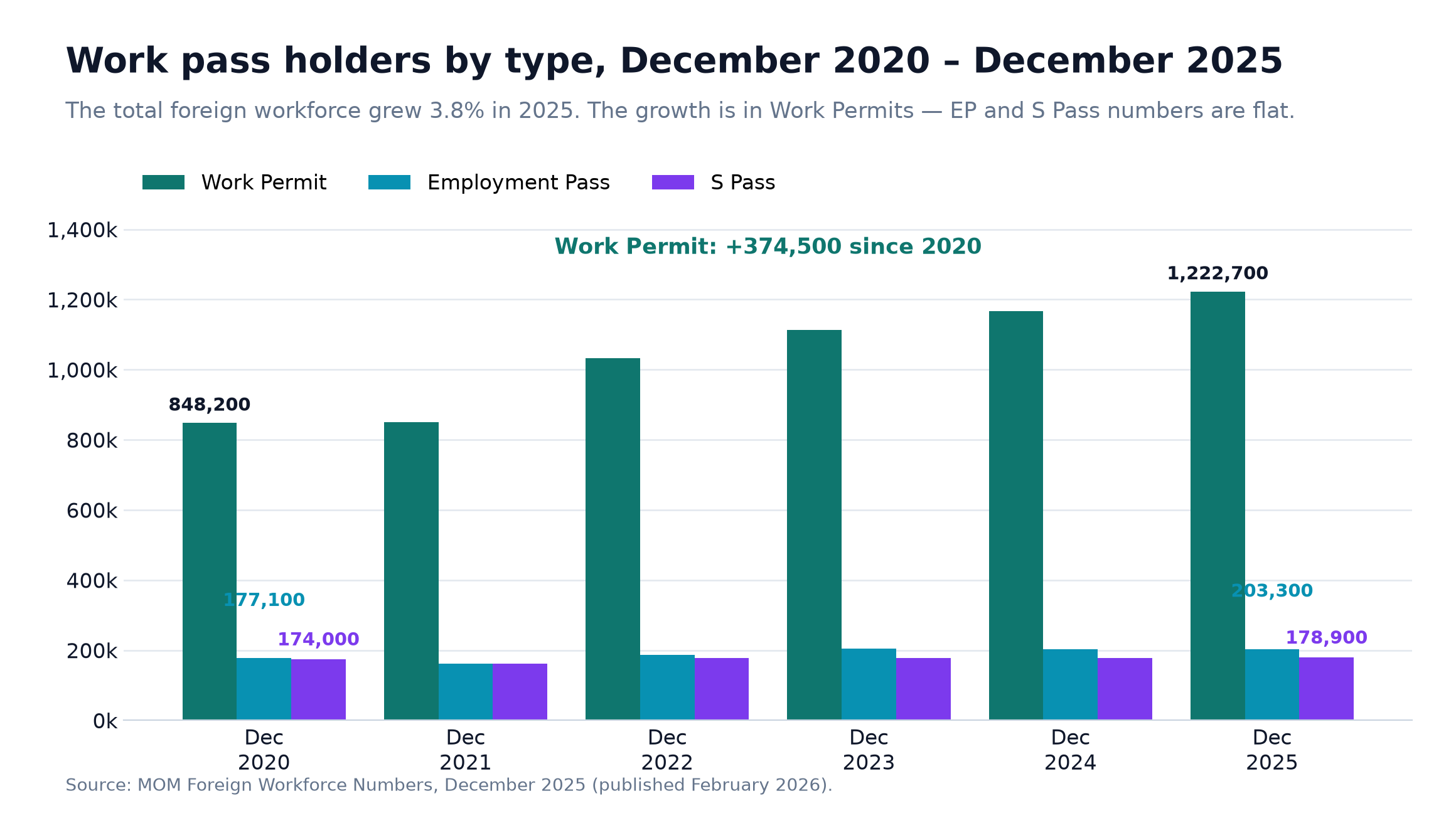
- Singapore’s foreign workforce is not shrinking. It grew 3.8% in 2025, to 1,635,700. The real squeeze is that Employment Pass and S Pass numbers are flat while Work Permit numbers rise — and restructuring is hitting professional roles.
- Every EP salary rise has two start dates — new applications first, renewals 6–12 months later. If you already hold an EP, the renewal date is the one that binds you.
- If you lose your job, your employer must cancel your work pass. You will need to check how long you may stay and find a new employer to sponsor a fresh pass.
- A job loss does not automatically cancel a pending permanent residence application, but it can materially weaken it.
Date note. Retrenchment, employment and unemployment figures are as of the Ministry of Manpower’s Labour Market Advance Release for the second quarter of 2026, published 31 July 2026. “Advance release” means it is a first, partial set of numbers; the full Labour Market Report, or LMR, is due in mid-September 2026. Advance figures are routinely revised, and since 2024 the revisions have been consistently upward — see the section below. Work pass holder counts are as of December 2025 (published February 2026) from MOM’s Foreign Workforce Numbers. Employment Pass qualifying salaries quoted are the rules in force from 2025. The advance release did not announce any changes to work pass rules.
Retrenchments rose — but Singapore’s labour market kept growing
Retrenchments reached 4,500 in the second quarter of 2026, up 17.5% from the 3,830 recorded in the first quarter.
That is the highest quarterly figure since the fourth quarter of 2020, when 5,640 workers were retrenched during the COVID-19 pandemic.
The incidence of retrenchment — how many workers were retrenched for every 1,000 employees — rose to 1.9, from 1.6 in the previous quarter.
These numbers deserve attention. They do not show a collapse.
Total employment grew by 10,700 in the quarter, up from +9,400 in the first quarter and broadly similar to +10,400 in the same quarter of 2025. It was the 19th consecutive quarter of employment growth, a run stretching back to the fourth quarter of 2021.
Unemployment stayed low in June 2026 (seasonally adjusted — meaning the usual month-to-month seasonal swings have been smoothed out so periods can be compared fairly):
- Overall unemployment: 2.0%
- Resident unemployment: 2.9%
- Citizen unemployment: 3.0%
Those are essentially unchanged from March 2026 (2.0% overall, 2.9% resident), when citizen unemployment stood at 3.1% before easing to 3.0% in June.
The 4,500 figure is almost certainly too low
Here is something that has gone unreported, and it changes how you should read the headline.
MOM publishes each quarter’s retrenchment count twice. First comes the Labour Market Advance Release, about four weeks after the quarter ends — a partial count, based on the employer survey returns received so far. Months later, the full Labour Market Report publishes a revised figure once the late returns are in.
The 4,500 everyone is quoting is the advance number. And advance numbers have a recent history of being too low.
We compared every advance figure against its final revised figure from the first quarter of 2020 to the first quarter of 2026 — 24 quarters, using MOM’s own time-series table:
| Period | Median revision | Quarters revised upward |
|---|---|---|
| 2020–2021 | +95 (+3.8%) | 5 of 8 |
| 2022–2023 | −10 (−0.3%) | 3 of 7 |
| 2024–2026 | +130 (+3.5%) | 9 of 9 |
Every single quarter since the start of 2024 has been revised upward. Nine in a row.
Two recent examples: the fourth quarter of 2025 was first published as 3,600, then revised to 3,690. The first quarter of 2026 was first published as 3,700, then revised to 3,830 — the very number the 17.5% rise is measured from.
Applying the recent median to the second quarter of 2026 suggests the final figure will land around 4,600, with the full Labour Market Report due in mid-September 2026.
What this means for you: the “five-year high” headline is, if anything, understated. It also means the quarter-on-quarter comparisons in the press are not strictly like-for-like — a revised 3,830 is being compared against an unrevised 4,500. The direction of the trend is real; the precision is not.
It is worth being clear about what this is and is not. It is not evidence that MOM is hiding anything — the revision process is published, routine and normal for survey-based statistics. What is notable is that the bias has been consistently in one direction since 2024, during a period of solid economic growth, which points to employer reporting lag rather than the business cycle. We tested whether weaker GDP explained the size of revisions; it does not. The apparent relationship disappears entirely once the single COVID quarter of 2020 is excluded.
How to read any retrenchment headline. Check whether the number comes from an advance release or a full report. If it is an advance figure from 2024 onwards, assume the true number is modestly higher.
What do the latest retrenchment numbers actually mean?
The Ministry of Manpower, or MOM, said the rise was concentrated in selected outward-oriented sectors — industries that depend heavily on overseas demand and global business conditions. Information and Communications (often shortened to info-comm) and Manufacturing were among them, and business restructuring was the main driver, not a broad downturn.
The sector split for the second quarter of 2026:
- Services: 3,500 retrenchments
- Manufacturing: 800
- Construction: 200
Recent announcements fit that pattern. GovTech retrenched 93 staff on 15 July 2026, 42 of them in their 40s, and Borneo Motors announced layoffs in early August 2026. These are restructuring decisions inside otherwise functioning sectors.
The latest quarterly total is also well below past crises:
- Global Financial Crisis (GFC, 2008–2009): quarterly retrenchments ranged from 5,980 to 12,760.
- COVID-19 period: quarterly retrenchments ranged from 5,640 to 9,120.
Forward-looking signs improved in June 2026, too. The share of firms expecting to hire rose from 40.6% to 43.9%. The share expecting to raise wages rose from 23.7% to 29.3%. The share expecting to retrench fell from 3.2% to 2.7%. All three remain below February 2026 levels, so the improvement is real but not a full recovery in sentiment.
Is Singapore’s work pass pool shrinking? No — here is what is really happening
It is not true that Singapore’s foreign workforce is shrinking. MOM’s Foreign Workforce Numbers show the total grew from 1,576,500 in December 2024 to 1,635,700 in December 2025 — an increase of 3.8% in one year.
What matters for professionals is that the growth was not spread evenly.
Employment Pass numbers have plateaued
The Employment Pass, or EP, is generally for foreign professionals, managers and executives. For related guidance, see Understanding the Employment Pass process.
There were 203,300 EP holders in December 2025 — slightly above the 202,100 in December 2024, but still below the December 2023 peak of 205,400. In other words: flat for three years.
S Pass numbers are roughly flat
The S Pass is generally for mid-skilled foreign employees.
There were 178,900 S Pass holders in December 2025, against 178,200 a year earlier.
Work Permit numbers are growing strongly
The Work Permit, or WP, covers workers in sectors such as construction and manufacturing, plus migrant domestic workers. For related guidance, see Comprehensive guide to work passes in Singapore.
Work Permit holders rose from 1,165,900 in December 2024 to 1,222,700 in December 2025. Other work pass types accounted for a further 30,800.
EP and S Pass numbers are stagnant even as retrenchments hit a five-year high
The overall foreign workforce is still growing, but the growth is concentrated in Work Permit sectors. EP and S Pass numbers are stagnant — at the same time as retrenchments hit a five-year high.
MOM’s own commentary points the same way. Second-quarter employment growth was driven primarily by non-residents, in Construction and Manufacturing, while resident employment grew more slowly and mainly in essential and public services. And in the first quarter of 2026, retrenchment incidence rose sharply among degree holders, while among workers aged 50–59 it rose from 2.8 to 3.1 per 1,000 resident employees.
So professionals, managers, executives and technicians — often shortened to PMETs — can feel real pressure from restructuring even while the total foreign workforce expands.
Why is the bar for getting a new pass still rising?
A flat EP or S Pass population does not mean current holders will lose their passes. It also does not mean renewal or re-employment is automatic. For related guidance, see Why Employment Pass applications get rejected (and how COMPASS is scored).
New EP applications must meet the applicable qualifying salary and pass the Complementarity Assessment Framework, or COMPASS — the points-based framework introduced in September 2023 that MOM uses to assess many EP applications.
From 2025, the EP qualifying salary is:
- S$5,600 for most sectors
- S$6,200 for financial services
These are minimum qualifying salaries for younger applicants, not a promise of approval, and the required salary rises with age. COMPASS points and other requirements also apply, and the figures are revised from time to time — always check MOM’s current thresholds before accepting an offer.
The bar has risen steeply over ten years. The EP qualifying salary has climbed from S$3,300 in 2016 to S$5,600 today — up 69.7%, and it is already set to reach S$6,000 on 1 January 2027.
The date that matters is not the one in the headlines
Every change to the qualifying salary has two start dates. It applies to new applications first, and to renewals six to twelve months later. Almost all coverage quotes the new-application date. If you already hold an EP, the renewal date is the one that affects you.
| Announced | New applications | Renewals | Qualifying salary |
|---|---|---|---|
| 26 Jul 2016 | 1 Jan 2017 | 1 Jul 2017 | S$3,300 → S$3,600 (+9.1%) |
| 3 Mar 2020 | 1 May 2020 | 1 May 2021 | S$3,600 → S$3,900 (+8.3%) |
| 27 Aug 2020 | 1 Sep 2020 | 1 May 2021 | S$3,900 → S$4,500 (+15.4%) |
| 4 Mar 2022 | 1 Sep 2022 | 1 Sep 2023 | S$4,500 → S$5,000 (+11.1%) |
| 4 Mar 2024 | 1 Jan 2025 | 1 Jan 2026 | S$5,000 → S$5,600 (+12.0%) |
| 3 Mar 2026 | 1 Jan 2027 | 1 Jan 2028 | S$5,600 → S$6,000 (+7.1%) |
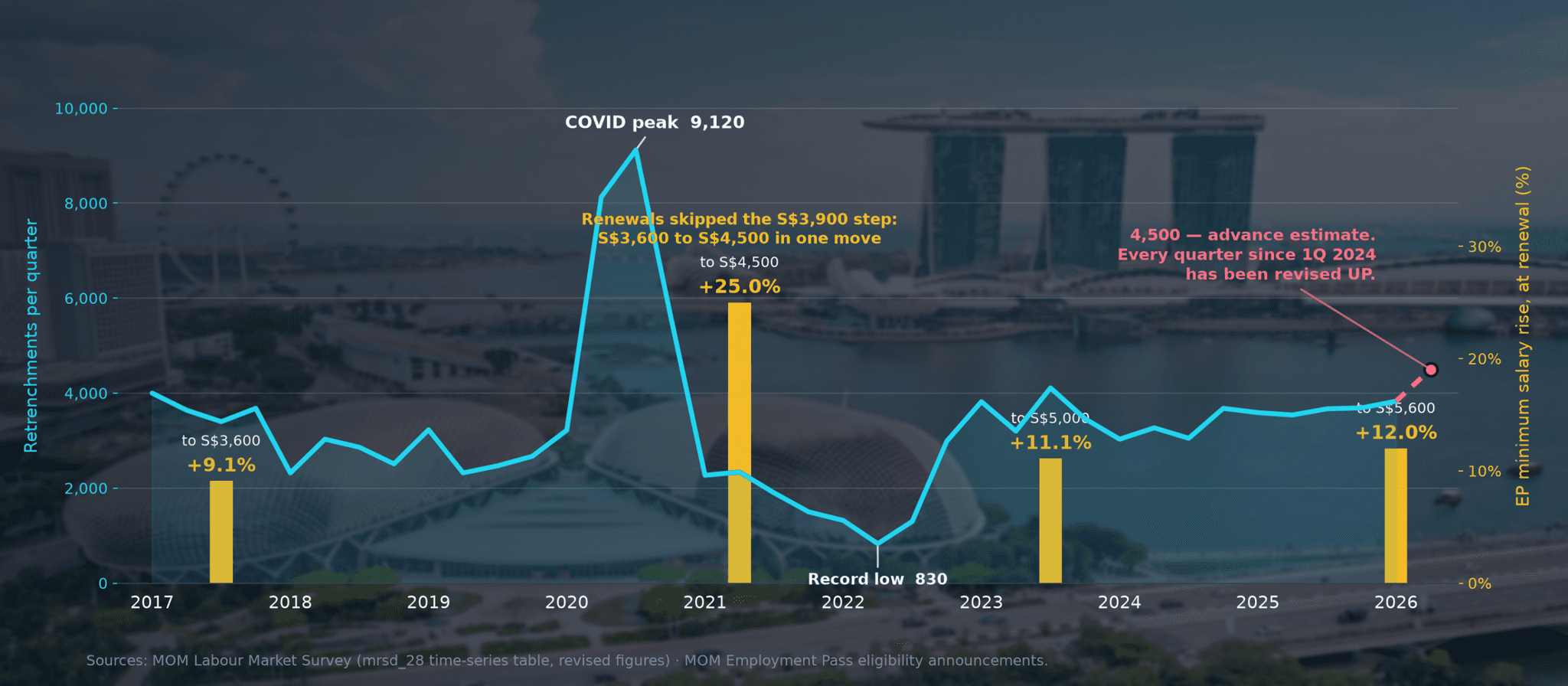
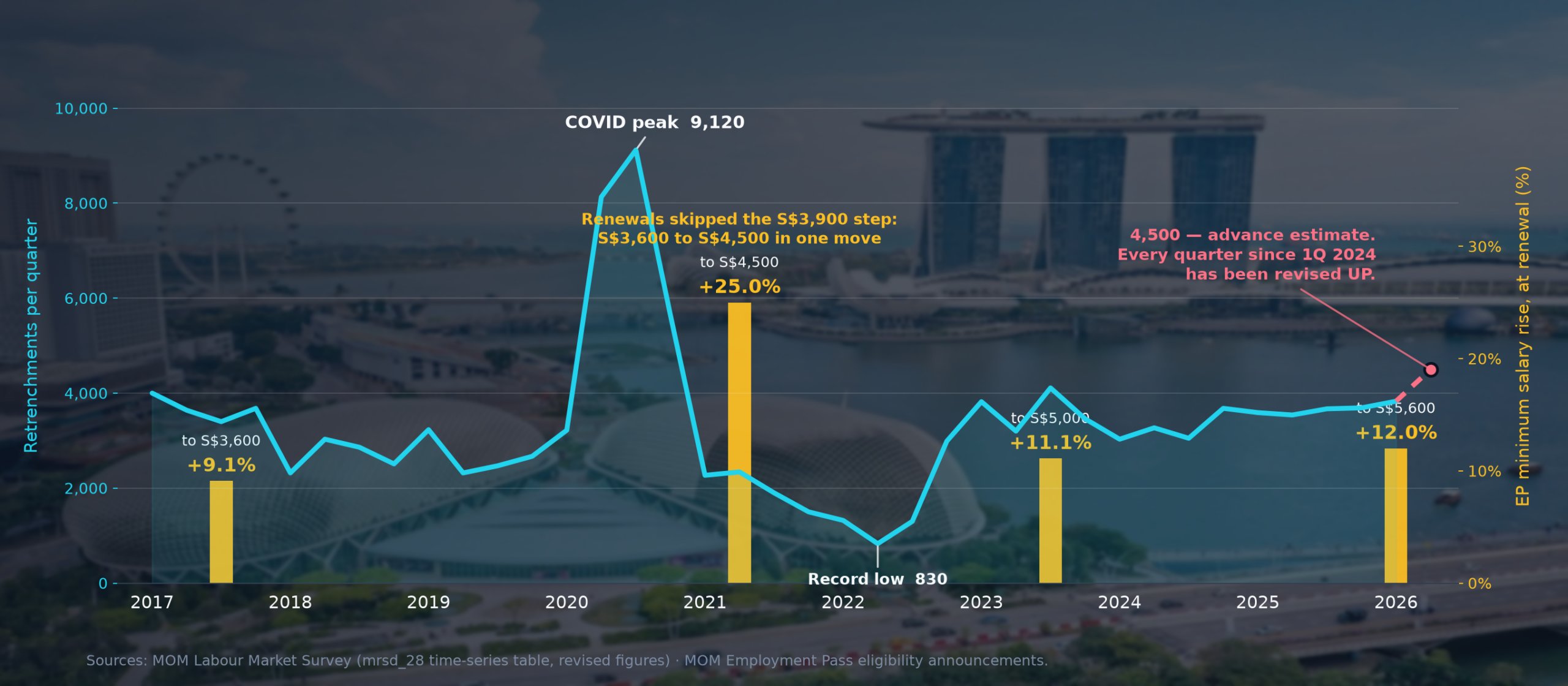
2020 is the only year Singapore has ever raised the EP qualifying salary twice — once in a routine March announcement pegged to local graduate wages, then again in August as the COVID labour-market response. Together that was +S$900, or +25%, in four months.
For existing pass holders the effect was even sharper than it looks. Because both 2020 changes shared the same renewal date, renewals skipped the S$3,900 step entirely: a holder renewing went from S$3,600 straight to S$4,500 in a single move on 1 May 2021.
That timing matters for reading the trend. On new-application dates, the 2020 tightening looks simultaneous with the retrenchment shock. On renewal dates, the +25% lands in the second quarter of 2021 — after the worst of the retrenchments (8,130 and 9,120 in the second and third quarters of 2020). The pattern is a lagged response: the shock comes first, the higher bar follows roughly a year later, once the pass holder comes up for renewal.
The S Pass qualifying salary has risen on a similar path, from S$2,200 in 2016 to S$3,300 for new applications from September 2025 — up 50.0%, and is set to reach S$3,600 on 1 January 2027.
Each step makes it more expensive to hire a PMET on an EP or S Pass, and raises the bar a retrenched holder must clear to re-enter. This is one structural reason — alongside restructuring — why EP and S Pass numbers have stayed flat even while the total foreign workforce grew: the growth has concentrated in Work Permit sectors, where qualifying salary rules do not apply in the same way. For related guidance, see Singapore ONE Pass guide.
Practical point: if your renewal falls due after 1 January 2026, you are assessed against S$5,600, not S$5,000 — even though the S$5,600 headline was published back in March 2024. Check your pass expiry date against the renewal column above, not the new-application column.
Retrenched? What happens to your EP or S Pass?
When your employment ends, your employer is responsible for cancelling your EP or S Pass. You cannot cancel it yourself, and you cannot keep working on it.
In common practice, once a pass is cancelled the holder may be granted a Short-Term Visit Pass, typically of around one month — not two — giving a limited window to settle affairs or line up a new job. A Short-Term Visit Pass does not allow you to work. For related guidance, see Common Singapore PR application mistakes.
The following is E&H’s practice guidance, not a quotation of statute. The exact cancellation process and permitted stay depend on MOM’s current rules and on your individual case, so check MOM’s work pass cancellation pages — or ask us — as soon as you receive notice. For related guidance, see PR Case Study: Approved on the 3rd Attempt.
- Confirm the cancellation date. Ask your employer in writing when the pass will be cancelled, and request a copy of the cancellation acknowledgement.
- Check how long you may remain. Do not assume your old pass expiry date still applies. Once a pass is cancelled, the expiry printed on it is no longer the operative date.
- Start job-hunting immediately. A new employer must submit a fresh application. Passes are not transferred between employers.
- Test the new role against current criteria. For an EP, that means the qualifying salary for your age and sector, plus COMPASS.
- Keep records. Save your termination letter, payslips, employment records, CPF or tax documents where applicable, and evidence of your job search.
Time out of work matters. A long gap can make it harder to show stable employment — which is relevant both to a new pass application and to any permanent residence plans.
Does retrenchment kill a pending PR application?
No — not automatically. Being retrenched does not cancel a pending Singapore permanent residence, or PR, application.
But it can materially weaken it. The Immigration and Checkpoints Authority, or ICA, does not publish a rulebook setting out how each job change or job loss is weighed. Based on E&H’s advisory experience, employment stability, income and current contribution to Singapore are important parts of the overall assessment — and a retrenchment changes all three at once.
There is also a practical trap: if your work pass is cancelled and you leave Singapore, your circumstances have changed in a way that the application no longer reflects.
If your application is already being processed, work through:
- How long you have been, or expect to be, out of work
- Whether you have secured a new role, and how quickly
- Whether that role is stable and consistent with your existing profile
- Whether your work pass remains valid
- Whether, when and how to update your circumstances
- Whether the application timing should be reconsidered
Do not assume silence is always safest. Equally, do not fire off an unplanned update without understanding how it lands against the rest of the file. This is a judgement call, and it is worth taking advice on.
How retrenchment affects existing PRs and the Re-Entry Permit
If you are already a PR, your status is not tied to one employer. But your Re-Entry Permit, or REP — the document that lets a PR travel in and out of Singapore and keeps PR status valid — must be renewed periodically, and ICA does not publish the criteria it applies. For related guidance, see ICA Refusals Rising: Offences That Trigger Bans.
In E&H’s experience, employment history, income and contribution over the whole period are relevant to REP renewal outcomes, so a long unemployment gap is not risk-free. Again, this is practice-based guidance, not statute. Check ICA’s current REP requirements for your case.
Illustrative scenario 1: EP holder in info-comm
Illustrative only — not an ICA or MOM rule, and not a prediction of any individual outcome.
Priya, 34, is an EP holder at an info-comm company, earning S$8,000 a month. Her role is cut in a June 2026 restructuring. Her PR application has been pending for seven months.
Her PR application does not end automatically. But her employment position has changed materially, so the file no longer matches reality.
Her sequence: confirm the EP cancellation date and her permitted stay; confirm which parts of her package are contractual (salary to termination date, notice pay, unused leave) versus discretionary; and start searching immediately.
Time is tighter than many expect. In common practice the cancelled pass is followed by a Short-Term Visit Pass of around one month — not two — so with a June layoff she may need to leave Singapore by July unless a new application is already in motion. Searching from abroad in August is possible, but typically harder: employers move faster on candidates who are in the country and can start soon.
In August she receives an offer at S$7,800 a month — comfortably above the S$5,600 EP qualifying salary for most sectors, though the new employer must still clear COMPASS and will apply for a fresh pass while she is outside Singapore. Only then does she decide, with advice, whether and how to update the pending PR application.
New employment may help demonstrate renewed stability. It does not guarantee PR approval — and time spent out of the country is part of the picture ICA weighs.
Illustrative scenario 2: S Pass holder in manufacturing
Illustrative only.
Ravi holds an S Pass at a precision manufacturing firm and is one of the 800 manufacturing retrenchments in the quarter. He has not yet applied for PR.
His employer must cancel the S Pass. A new employer must apply fresh, and the role must meet the S Pass qualifying salary in force at the time — check MOM for the current figure, as it has been rising in steps. Because his profile depends heavily on continuous employment, E&H would generally suggest he stabilise a new role first and revisit PR timing afterwards, rather than applying from a gap.
Can you reapply for a work pass after retrenchment?
Yes. Being retrenched does not, by itself, bar you from a future work pass.
But your old pass cannot be handed to a new employer. The new employer applies for a fresh pass, and the application is assessed on the new job, salary, employer and your profile under the framework in force at the time — for an EP, the qualifying salary and COMPASS.
Prepare documents that make the transition easy to understand:
- Retrenchment or termination letter
- Past employment records and reference letters
- Recent payslips and salary documents
- An updated CV with no unexplained gaps
- The new employment offer
- Qualifications and professional certifications
A complete application cannot guarantee approval. It can remove avoidable doubt.
What support is available if you are retrenched?
SkillsFuture Jobseeker Support
The SkillsFuture Jobseeker Support scheme provides up to S$6,000 over six months to eligible people who have become involuntarily unemployed — but it is not available to work pass holders. It is open only to Singapore Citizens aged 21 and above (from April 2025) and Permanent Residents aged 21 and above (from Q1 2026). The official scheme site states eligibility as “Singapore Citizen or Permanent Resident” only; non-residents, including Employment Pass, S Pass and Work Permit holders, do not qualify.
Further conditions apply, including prior income (average gross monthly income of up to S$5,000 in the past 12 months), an annual property value cap, involuntary unemployment, and at least six months of employment in Singapore in the past year. The scheme’s salary cap was raised by MPs during the Budget 2026 debate. If you are on a work pass, do not plan around this scheme — your practical support is your contractual entitlements, savings and a new job. Check the current criteria on MOM’s site if your status has changed.
Are retrenchment benefits compulsory?
No. Retrenchment benefits are not mandatory under Singapore law. They are generally discretionary, unless an entitlement is created by your employment contract, a collective agreement or another applicable arrangement.
As The Straits Times askST reported on 3 August 2026, employers commonly ask staff to sign a non-disclosure agreement, or NDA — a contract limiting what you may disclose — before releasing a discretionary payout.
What should not be made conditional on signing an NDA are your statutory and contractual entitlements, such as:
- Salary up to your termination date
- Contractual notice, or pay in lieu of notice
- Payment for unused leave, where applicable
There is also no mandated advance-notice period specific to retrenchment. NTUC has pushed for mandatory advance notification; under current MOM and Tripartite guidance it remains guidance rather than law. Your contract still governs your notice period.
If any of this is unclear, get employment-law advice before you sign.
What should you do in the first week after being retrenched?
1. Understand the package
Ask for a written breakdown: final salary, any retrenchment benefit, notice pay, unused leave, any conditions attached to a discretionary payment, and any NDA you are asked to sign. Do not sign on the spot.
2. Separate entitlements from goodwill
Read your contract. Contractual and statutory entitlements are yours regardless; a retrenchment benefit may not be.
3. Check your work pass timeline
Ask your employer when the pass will be cancelled, then verify with MOM: your cancellation status, how long you may remain, any Short-Term Visit Pass arrangement, what changes if you find a new employer, and how travel affects your position. Do not rely on hearsay about a “grace period”.
4. Review your PR position
Pending application? Assess whether and how to update it. Not yet applied? Consider waiting until new employment is stable.
5. Vet the next offer before accepting
Check salary, role and current pass criteria — for an EP, the qualifying salary for your age and sector plus COMPASS — before you sign.
6. Get a joined-up review
Job loss hits three things at once: your right to remain, your next pass application and your PR strategy. Fixing one in isolation can damage another.
Need a clear plan after retrenchment?
E&H Immigration Consultancy can review your work pass position, your pending or planned PR application, and your realistic options and timelines.
Book a consultation — or start with our Singapore PR eligibility criteria.
Not sure where you stand?
Get a personalised assessment of your Singapore PR, citizenship, or work pass options from E&H Immigration’s specialists.
Frequently Asked Questions
How long can I stay in Singapore after my Employment Pass is cancelled?
Your employer must cancel the Employment Pass when your employment ends. In common practice, the holder is granted a Short-Term Visit Pass of around one month — not two — giving a limited window to settle matters or secure a new job; it does not permit work. The exact permitted stay depends on MOM’s current rules and your circumstances, so verify with MOM. Do not assume the expiry date printed on your old pass still applies.
Can I transfer my Employment Pass to a new employer?
No. A new employer must submit a fresh Employment Pass application, assessed against the qualifying salary in force and the COMPASS points framework. Being retrenched does not, by itself, prevent a new application.
Will ICA reject my PR application if I lose my job?
Not automatically. The Immigration and Checkpoints Authority does not publish a rule stating that retrenchment cancels or rejects a pending permanent residence application. However, in E&H’s advisory experience employment stability and current contribution are important parts of the overall assessment, so a job loss can materially weaken an application.
Should I tell ICA that I have been retrenched?
It depends on your work pass status, how long you expect to be out of work, your new employment prospects and how far your application has progressed. ICA does not publish detailed guidance covering every situation, so take advice before deciding whether, when and how to update a pending application.
Is the 4,500 retrenchment figure final?
No. It is an advance estimate from MOM’s Labour Market Advance Release of 31 July 2026. The full Labour Market Report, due mid-September 2026, will publish a revised figure. Every quarter since the first quarter of 2024 has been revised upward — nine consecutive quarters — so the final number is likely to be modestly higher, in the region of 4,600.
When does a new EP qualifying salary apply to my renewal?
Later than the headline date. Each increase applies to new applications first and to renewals six to twelve months afterwards. The S$5,600 threshold announced in March 2024 applied to new applications from 1 January 2025 and to renewals from 1 January 2026. The next step, S$6,000, applies to new applications from 1 January 2027 and to renewals from 1 January 2028. Check your pass expiry date against the renewal date, not the new-application date.
Can I apply for Singapore PR while unemployed?
There is no published rule barring an unemployed person from applying. In practice, unemployment makes it harder to demonstrate current income and employment stability, which weigh in the assessment. For most profiles it is worth reviewing timing and applying after securing stable employment.
Is my employer required to pay retrenchment benefits?
No. Retrenchment benefits are not mandatory under Singapore law; they may be discretionary, or required by your employment contract or a collective agreement. Salary to your last day, contractual notice or notice pay, and payment for unused leave should be treated separately from any discretionary payout, and should not be conditional on signing an NDA.
Sources
- Ministry of Manpower — Labour Market Advance Release, Second Quarter 2026 (31 July 2026)
- Ministry of Manpower — Labour Market Advance Release 2Q 2026, PDF annex
- Ministry of Manpower — Foreign Workforce Numbers (December 2025, published February 2026)
- Ministry of Manpower — Unemployment Summary Table, Labour Force Survey (stats.mom.gov.sg)
- The Business Times — “Singapore retrenchments rise 17.5% in Q2 to highest since 2020” (31 July 2026)
- CNA — “Singapore retrenchments hit highest level in over five years in Q2, even as employment grows” (31 July 2026)
- The Straits Times, askST — non-disclosure agreements and retrenchment payouts (3 August 2026)
- CNA — GovTech and Borneo Motors layoffs (July–August 2026)
- SkillsFuture Jobseeker Support — official scheme site and eligibility: https://jobseekersupport.mycareersfuture.gov.sg/ (“Singapore Citizen or Permanent Resident” only)
- Ministry of Manpower — Factsheet on SkillsFuture Jobseeker Support scheme (Annex A, 2024 press release)
- Ministry of Manpower — Employment Pass eligibility (qualifying salary, current and upcoming): https://www.mom.gov.sg/passes-and-permits/employment-pass/eligibility
- Ministry of Manpower — S Pass eligibility (qualifying salary, current and upcoming): https://www.mom.gov.sg/passes-and-permits/s-pass/eligibility
- Ministry of Manpower — Retrenchment time-series table
mrsd_28_retrench_by_ind_and_occ_grp.xlsx(revised quarterly figures, 1998–2026): https://stats.mom.gov.sg/Pages/RetrenchmentTimeSeries.aspx - Ministry of Manpower — Labour Market Advance Releases, 1Q 2020 to 2Q 2026 (advance figures used for the revision analysis): https://stats.mom.gov.sg/iMAS_PdfLibrary/
- Ministry of Manpower — Labour Market Report 4Q 2025 (full-year 2025 retrenchments, 14,490)
- Department of Statistics Singapore — GDP in chained (2015) dollars, quarterly, table M015661: https://tablebuilder.singstat.gov.sg
- Ministry of Manpower, Committee of Supply 2020 (3 March 2020) and press statement of 27 August 2020 — the two Employment Pass qualifying-salary increases in 2020
- Ministry of Manpower, Committee of Supply 2026 (3 March 2026) — EP qualifying salary to S$6,000 from 1 January 2027, renewals from 1 January 2028
Note on the revision analysis. The advance-versus-final comparison covers 24 quarters, 1Q 2020 to 1Q 2026. The 2Q 2023 advance figure is excluded because MOM’s advance release for that quarter is published as an image-only PDF from which the figure cannot be reliably extracted. The 4Q 2020 advance figure is derived from the advance full-year total rather than stated directly. Neither affects the finding.
Disclaimer: This article is general information, not immigration or legal advice. Work pass cancellation mechanics, permitted-stay arrangements, qualifying salaries and scheme eligibility change over time — check MOM’s current requirements, and ICA’s for PR and Re-Entry Permit matters. Sections describing how job loss affects a pass or a PR application reflect E&H’s advisory practice and general observed practice, not published rules. Permanent residence and Re-Entry Permit decisions rest with ICA, and approval is never guaranteed.
By Tien Ho, Co-founder, E&H Immigration Consultancy.
Related reading
- Certified Translation for Singapore PR: What Does ICA Require?
- Singapore PR Minimum Salary: Why Income Trajectory Matters
- Singapore Citizenship: Pros and Cons Explained
- LTVP vs PR Singapore: Which Is Better?
- PR or Citizenship Rejected? What to Do Next
- Singapore PR Case Study: Application to Approval
- 5 Ways to Become a Singapore Permanent Resident
- Singapore ONE Pass Guide: Benefits & Eligibility
- PM Wong’s 2024 Rally: What It Means for Residents
- How Much PR Saves on Singapore School Fees
- ICA vs MOM LTVP Singapore: Key Differences
- Community Care Apartments at 55: The Citizenship Rule Every PR Should Know
- Major Changes to Singapore PR, Citizenship & LTVP