
Singapore Is Raising the Retirement Age to 65 in 2029: What PRs, Work Pass Holders and Employers Need to Know
Singapore raises its retirement age to 65 in 2029. Learn what the change means for PRs, EP and S Pass holders, employers, and PR applicants in Singapore.
TLDR:
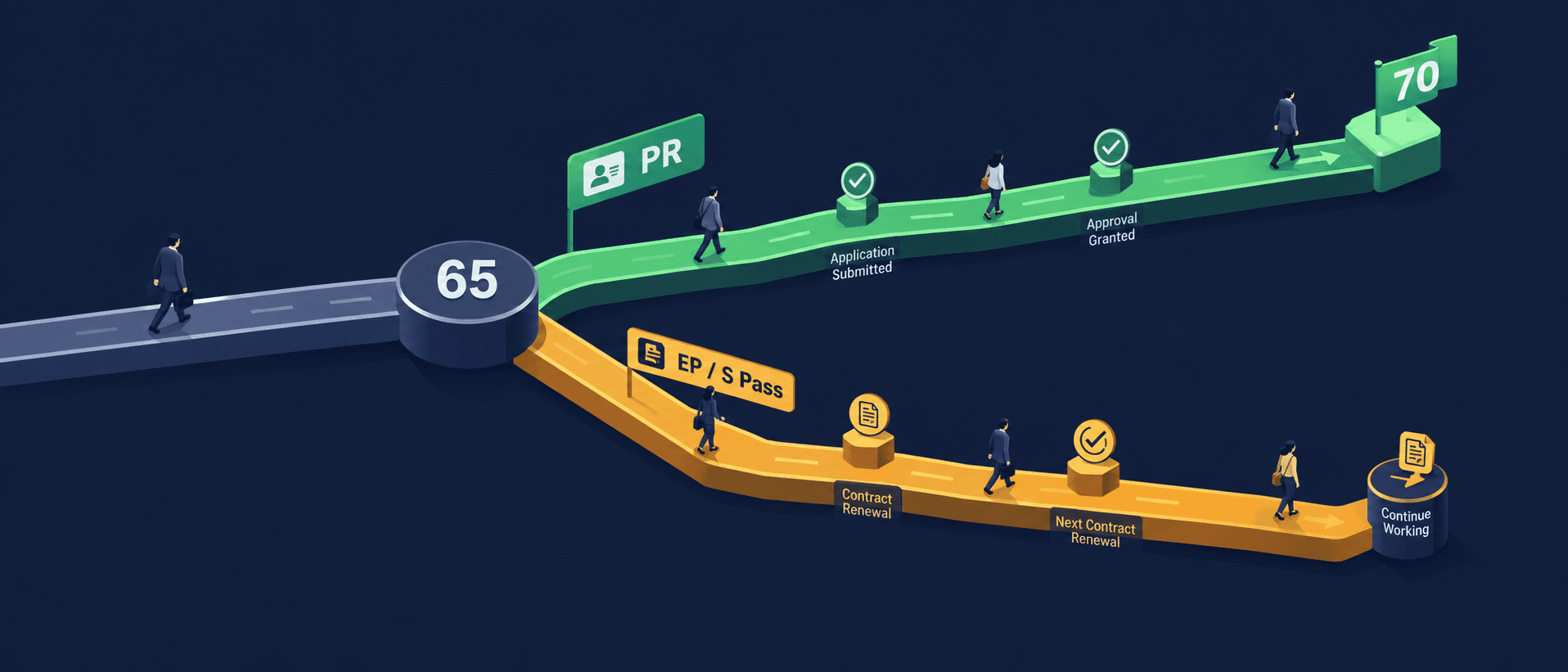
- Singapore will raise the Retirement Age from 64 to 65 on 1 January 2029.
- Singapore will raise the Re-employment Age from 69 to 70 on the same date.
- Eligible Singapore Permanent Resident employees will receive the new statutory protection.
- Employment Pass and S Pass holders will not receive a statutory right to work until 65 or be re-employed until 70.
- The change does not make a Singapore PR application easier or alter ICA’s assessment criteria.
- Employers should review contracts, re-employment processes and workforce plans before 2029.
Date note: This article explains the rules in force on 27 October 2026 and the changes taking effect on 1 January 2029. Population figures are as at June 2026, while birth and labour-force figures relate to calendar year 2025. Detailed rules for the Flexi-Load Programme, Re-employment Credit and revised Employment Assistance Payment are due in H1 2027, meaning the first half of 2027.
Singapore’s 2029 retirement age change raises the statutory Retirement Age from 64 to 65 and the Re-employment Age from 69 to 70 on 1 January 2029, after the Government accepted all six recommendations from the Tripartite Workgroup on Senior Employment on 26 October 2026.[1] The central immigration point is clear: eligible Singapore Permanent Resident employees receive this protection, but Employment Pass and S Pass holders do not.[2] Work pass holders can continue working after 65 only if their employment continues and the Ministry of Manpower approves the relevant pass.
By Tien Ho, Co-founder, E&H Immigration.
What exactly changed on 26 October 2026?
The Government brought forward the final increase in the Retirement Age and Re-employment Age by one year, from 2030 to 1 January 2029.
The Tripartite Workgroup on Senior Employment recommended raising the Retirement Age from 64 to 65 and the Re-employment Age from 69 to 70. The Government accepted all six of the workgroup’s recommendations on 26 October 2026.[1]
The previous increase had taken effect only months earlier. Singapore raised the Retirement Age from 63 to 64 and the Re-employment Age from 68 to 69 on 1 July 2026.[1]
The Retirement Age, or RA, is the age before which an employer cannot retire a protected employee because of age. The Re-employment Age, or REA, is the age up to which an employer must offer re-employment to an eligible employee, subject to the statutory conditions.[2]
Neither age forces an employee to continue working. An employee may choose to retire earlier, while an employer’s obligation depends on the employee meeting the re-employment conditions.[2]
E&H Immigration’s earlier guide to Singapore’s current retirement and re-employment rules explains the RA and REA framework in more detail. The article focuses on the accelerated 2029 change, its demographic background and the actions readers should take before it begins.
What does the retirement and re-employment timeline show?
The 2029 step completes the planned move to a Retirement Age of 65 and a Re-employment Age of 70 one year earlier than the previous schedule.
| Date | Retirement Age | Re-employment Age | What readers should know |
|---|---|---|---|
| 1 July 2026 | 64 | 69 | The 64 and 69 ages are in force now.[1] |
| 2028 | 64 | 69 | The new Re-employment Credit is scheduled to replace the Senior Employment Credit.[1] |
| 1 January 2029 | 65 | 70 | Eligible employees receive the higher statutory protection one year ahead of the previous 2030 schedule.[1] |
The Government also accepted several supporting measures. The Flexi-Load Programme will replace the Part-Time Re-employment Grant after that grant expires at the end of 2027. The new programme will cover workers aged 50 and above and support additional part-time or fractional roles.[1]
The current Part-Time Re-employment Grant has supported about 68,500 seniors and 7,800 employers. Support is capped at S$125,000 per company and S$2,500 per resident senior worker.[1]
The Re-employment Credit will begin in 2028 and replace the Senior Employment Credit. The current credit provides wage offsets of up to 7% for Singaporeans aged 60 and above who earn below S$4,000 a month; the replacement will have a higher wage ceiling.[1]
The Government will announce implementation details for the Flexi-Load Programme, Re-employment Credit and revised Employment Assistance Payment in H1 2027. Employers should avoid budgeting on assumptions that have not yet been confirmed.
Why did the Government bring the change forward?
An ageing workforce and fewer births help explain the case for moving early. The population figures support this interpretation; the Government has not identified a specific Population in Brief figure as the trigger.
Citizens aged 65 and above made up 21.4% of the citizen population in June 2026, compared with 20.7% in June 2025 and 13.7% in 2016.[3] More than one in four citizens is projected to be aged 65 and above by 2035.[4]
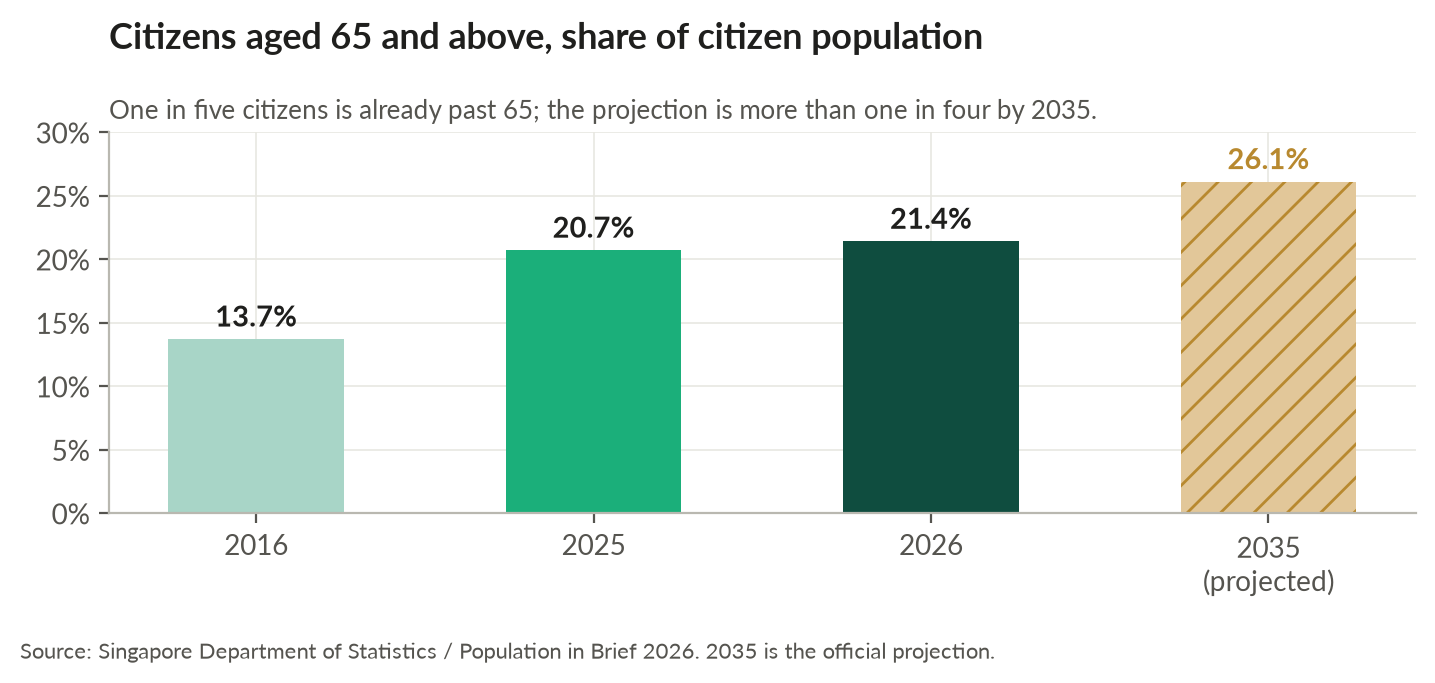
Source: Singapore Department of Statistics, Population in Brief 2026. The 2035 figure is the official projection.
The median age of citizens rose from 43.7 in June 2025 to 44.1 in June 2026.[3] Workers aged 50 and above represented about 40% of the labour force in 2025, up from about 34% in 2015.[1]
The old-age support ratio measures people aged 20 to 64 for every person aged 65 and above. The resident ratio fell from 5.4 in 2016 to 3.2 in 2026, while the citizen ratio fell from 4.7 to 2.8 over the same period.[3]
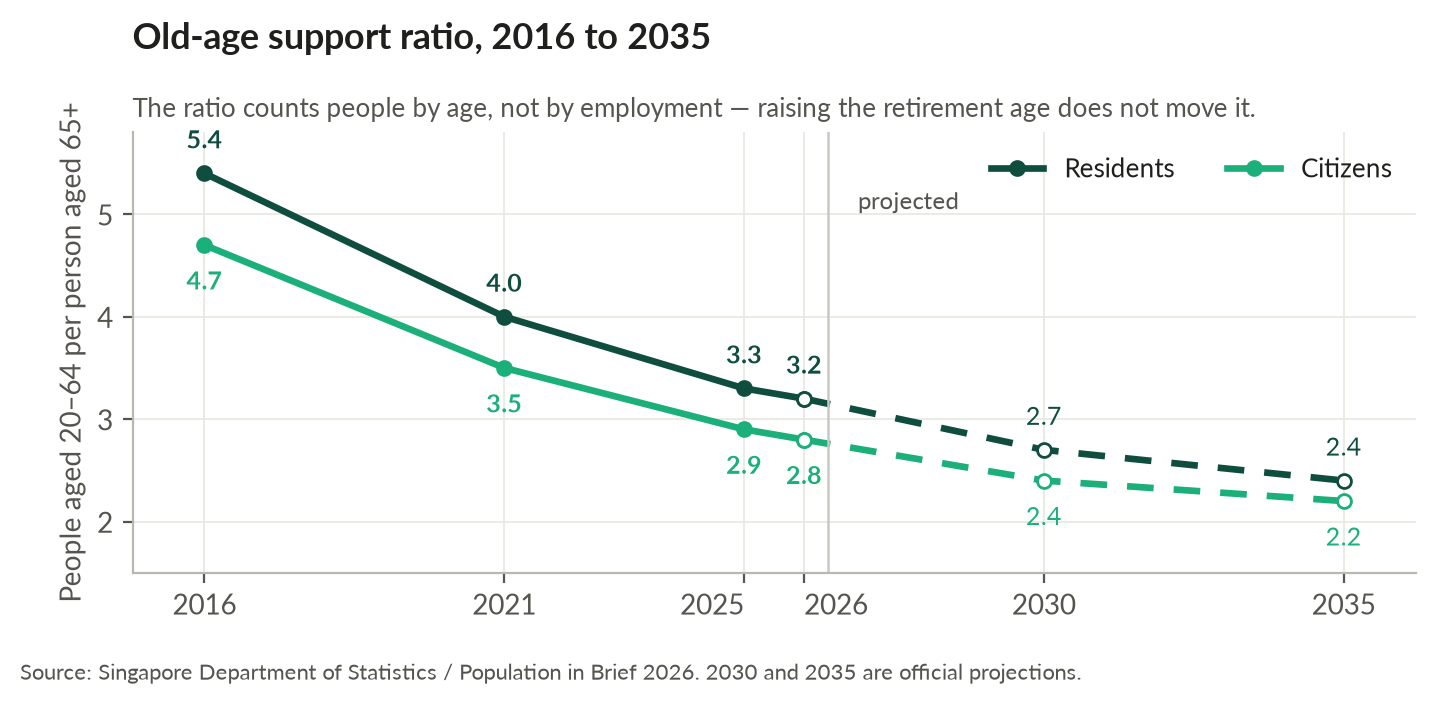
Source: Singapore Department of Statistics, Population in Brief 2026. 2030 and 2035 are official projections.
The retirement age increase does not improve the old-age support ratio itself. The ratio counts people by age, not whether they are employed. Senior employment can support workforce participation, but it does not change the demographic calculation.
Singapore recorded 26,071 citizen births in 2025, which was 10.8% lower than the 29,237 citizen births in 2024.[3] The average was 29,300 citizen births a year from 2021 to 2025, down from 32,500 a year from 2016 to 2020.[3]
The resident total fertility rate, or TFR, was 0.87 in 2025, down from 0.97 in 2024.[3] The 2025 rates were 0.70 for Chinese residents, 1.53 for Malay residents and 0.92 for Indian residents.[3]
Caregiving responsibilities are the leading reason people in their 50s are not working or looking for work. Flexible work is the leading initiative that could help them remain in the workforce.[1] The early policy move therefore combines a higher statutory age with support for more flexible jobs.
Does the new retirement age apply to Employment Pass and S Pass holders?
No. The statutory retirement and re-employment protection does not apply to Employment Pass or S Pass holders.
The Retirement and Re-employment Act, or RRA, protects eligible employees under rules framed around Singapore Citizens and Permanent Residents. A foreign employee holding an Employment Pass, or EP, or an S Pass has no statutory right to remain employed until 65 or receive re-employment until 70.[2]
A work pass holder’s ability to continue working depends on the employment contract and successful pass renewal. An employer also cannot rely on the RRA to say that a foreign employee must retire at 65. Ending the employment relationship remains a contractual and work-pass matter.[2]
Older foreign professionals also face age-adjusted qualifying salaries. The Employment Pass qualifying salary is S$5,600 a month at age 23 and rises progressively to S$10,700 at age 45 and above. The S Pass qualifying salary rises from S$3,300 at age 23 to S$4,800 at age 45 and above. Higher thresholds apply in Financial Services.[6][7]
For new applications from 1 January 2027, and renewals of passes expiring from 1 January 2028, the non-financial-sector EP minimum will rise to S$6,000, reaching S$11,500 at age 45 and above. The corresponding S Pass minimum will rise to S$3,600, reaching S$5,100 at age 45 and above. Check the applicable sector, age and renewal date rather than using today’s threshold for a 2029 plan.[6][7]
The higher salary thresholds create a separate commercial question for employers. A company comparing an older foreign professional with a resident senior worker must consider pass eligibility, salary cost, local re-employment duties and the new senior employment support measures.
How do the 2029 protections compare for PR and work pass holders?
Singapore Permanent Resident status creates a statutory senior-employment protection that an Employment Pass or S Pass does not provide.
| Employee status | Protection before age 65 from 1 January 2029 | Re-employment protection up to age 70 | Main condition for continued employment |
|---|---|---|---|
| Singapore Citizen | Yes, subject to the RRA | Yes, subject to eligibility | Employment and statutory eligibility |
| Singapore Permanent Resident | Yes, subject to the RRA | Yes, subject to eligibility | Employment and statutory eligibility |
| Employment Pass holder | No statutory RA or REA protection | No statutory right to re-employment | Contract and successful EP renewal |
| S Pass holder | No statutory RA or REA protection | No statutory right to re-employment | Contract and successful S Pass renewal |
The distinction concerns employment protection, not whether a foreigner may work after 65. An Employment Pass or S Pass holder can work after 65 if the employer continues the employment and the pass remains valid.
What changes for Singapore Permanent Resident employees?
From 1 January 2029, eligible Singapore Permanent Resident employees cannot be retired on age grounds before 65 and must receive a re-employment offer up to 70.
Singapore Permanent Resident, or PR, status therefore provides a concrete and dated advantage over Employment Pass and S Pass status. The advantage is a statutory floor for eligible employment, not a guarantee of a particular job, salary or role.[2]
An employer that cannot offer re-employment may have to provide an Employment Assistance Payment, or EAP, when the statutory conditions are met. The current EAP is 3.5 months’ salary, subject to a minimum of S$6,250 and a maximum of S$14,750.[1]
The Tripartite Workgroup recommended increasing the EAP amounts to reflect wage growth. Final revised amounts and implementation details are due in H1 2027.[1]
More than nine in ten eligible employees who wish to continue working are currently offered re-employment.[1] Approval of any individual arrangement still depends on the employee meeting the statutory eligibility conditions.
Does the retirement age increase make Singapore PR easier to obtain?
No. The 2029 retirement age increase does not change Singapore PR assessment criteria, quotas or any age limit for applying.
The Immigration & Checkpoints Authority, or ICA, assesses Singapore PR applications using factors that include age, qualifications, family ties, economic contribution, length of stay and integration.[5] No announced policy connects the 2029 retirement age change with easier PR approval.
An applicant in their 40s or 50s should treat the change as a settlement-planning issue. The change may affect the value of PR status after approval, but it does not improve the probability of approval by itself.
E&H Immigration would not present a longer possible working life as evidence that ICA has relaxed its standards. Approval is not guaranteed, and every application is assessed on its full circumstances.
Why does Singapore need both senior employment and immigration?
Senior employment retains experienced workers, while managed immigration helps replenish younger working-age cohorts. Singapore’s demographic plan uses both levers.
Singapore’s total population was 6.21 million in June 2026, an increase of 1.6% from June 2025.[3] The citizen population was 3.68 million, the PR population was stable at 0.55 million, and the non-resident population was 1.98 million.[3]
Population in Brief 2026 explains that immigration helps offset ageing and low births, supporting the citizen population over the long term.[3]
The report projects a broadly stable share of citizens aged 20–64 between 2030 and 2035. Fewer citizens will move into the 65+ group, while younger people, including newcomers through managed immigration, enter the working-age population.[3]
The PR population remains stable at around half a million, with most PRs aged between 25 and 59.[3] Singapore granted 25,094 new citizenships and 35,352 new PRs in 2025. The annual averages from 2021 to 2025 were 22,400 citizenships and 34,600 PRs, compared with 20,600 and 31,200 from 2016 to 2020.[3]
E&H Immigration analysis: Bringing the domestic senior-employment measure forward may strengthen the policy case for continued managed immigration. The Government has not stated that this political interpretation was the reason for accelerating the change.
What should employees, PR applicants and employers do before 2029?
Each group should plan around its actual immigration and employment status instead of assuming that age 65 or 70 creates an automatic right to work.
- Employment Pass or S Pass holder over 55: Start renewal planning early. Check the employment contract for retirement and termination clauses. Compare the current salary with the age-adjusted qualifying salary. Remember that the employer has no statutory duty to employ a work pass holder until 65 or re-employ that person until 70.[2]
- Singapore Permanent Resident approaching 65: Confirm whether the RRA eligibility conditions are met. Discuss re-employment before the statutory deadline. Ask how any new role could affect duties, hours and pay. Review the EAP rules if the employer says suitable re-employment is unavailable.[2]
- Singapore PR applicant in their 40s or 50s: Keep the application focused on qualifications, family ties, economic contribution, length of stay and integration. Do not claim that the 2029 change improves approval odds.[5]
- Employer with older foreign and PR staff: Separate the two groups in the compliance review. Audit PR employment contracts and re-employment procedures for the 2029 obligations. Review foreign employees through contract, salary and pass-renewal rules rather than the RRA.[2]
- Employer planning senior roles: Monitor the H1 2027 announcements on the Flexi-Load Programme, revised EAP and Re-employment Credit. The workgroup consulted more than 1,000 stakeholders, while 30 organisations tested solutions that helped more than 1,600 senior workers.[1]
- Family or caregiving planner: Model income, care and housing needs across a longer possible working life. A Long-Term Visit Pass, or LTVP, does not itself provide unrestricted employment rights; an LTVP holder needs the appropriate work authorisation, which may be a Letter of Consent for an eligible holder or a work pass.
Which sources and related reading should readers use?
Readers should rely on current Ministry of Manpower, population and immigration sources because implementation details will continue to develop before 2029.
Related reading
Sources
- Ministry of Manpower press release on the Tripartite Workgroup recommendations, 26 October 2026.[1]
- Ministry of Manpower guidance on the Retirement and Re-employment Act and re-employment eligibility.[2]
- National Population and Talent Division, Population in Brief 2026.[3]
- National Population and Talent Division guidance on longevity.[4]
- Immigration & Checkpoints Authority guidance on Permanent Residence.[5]
Disclaimer: This article provides general information and does not constitute legal or immigration advice. Employment and immigration outcomes depend on the applicable rules and individual facts. Employers and employees should check the final implementation details when the Government publishes them in H1 2027.
Do you need help planning your Singapore PR pathway?
E&H Immigration can assess how your age, work history, family profile, economic contribution and long-term plans fit into a Singapore PR strategy.
Speak with E&H Immigration before treating the 2029 employment change as an immigration advantage. A careful review can separate the benefits available after obtaining PR from the factors ICA considers when deciding an application.
Not sure where you stand?
Get a personalised assessment of your Singapore PR, citizenship, or work pass options from E&H Immigration’s specialists.
What are the frequently asked questions about Singapore’s retirement age in 2029?
Does Singapore’s retirement age apply to foreigners?
No. The statutory Retirement Age and Re-employment Age protection applies to eligible Singapore Citizens and Permanent Residents, not Employment Pass or S Pass holders.[2]
Can foreigners work after 65 in Singapore?
Yes. An Employment Pass or S Pass holder can work after 65 if the employment continues and the Ministry of Manpower approves the pass. Age 65 creates neither an automatic right to continue nor an automatic requirement to retire.
What is the retirement age for Employment Pass holders?
No statutory Retirement Age under the RRA applies to Employment Pass holders. Continued employment depends on the contract, the employer and successful pass renewal.[2]
Can my employer retire me at 65 if I am a PR?
Yes, age-based retirement may occur at 65 from 1 January 2029, but an eligible PR employee must then receive a re-employment offer up to age 70. The offer remains subject to the statutory eligibility conditions.[2]
Does the retirement age increase affect my PR application?
No. The increase does not change ICA’s PR criteria, quotas or any age limit for applying. ICA continues to consider factors including age, qualifications, family ties, economic contribution, length of stay and integration.[5]
What is the difference between retirement age and re-employment age?
The Retirement Age prevents an employer from retiring a protected employee on age grounds before the stated age. The Re-employment Age sets the upper age until which an employer must offer re-employment to an eligible employee.[2]
Do I have to keep working until 70?
No. The law does not compel an employee to continue working. Age 70 marks the end of the statutory re-employment period from 1 January 2029, not a mandatory retirement date.[2]
What happens if my employer cannot re-employ me?
An eligible employee may receive an Employment Assistance Payment when the employer cannot offer suitable re-employment and the statutory conditions are met. The current payment is 3.5 months’ salary, with a minimum of S$6,250 and a maximum of S$14,750; revised amounts are due to be announced in H1 2027.[1]
Sources & References
- Tripartite Workgroup Recommends Six Measures to Build Age-Friendly Jobs and Multi-Generational Workplaces — Ministry of Manpower
- Retirement and Re-employment Act and Re-employment Eligibility — Ministry of Manpower
- Population in Brief 2026 — National Population and Talent Division
- Longevity – Population Trends — National Population and Talent Division
- Permanent Residence — Immigration & Checkpoints Authority
- Eligibility for Employment Pass — Ministry of Manpower
- Eligibility for S Pass — Ministry of Manpower