
Can a Work Permit Holder Apply for PR in Singapore?
A Work Permit holder can apply for Singapore PR through marriage to a Singapore Citizen or PR — but MOM approval is required before the marriage. Full process explained.
TLDR
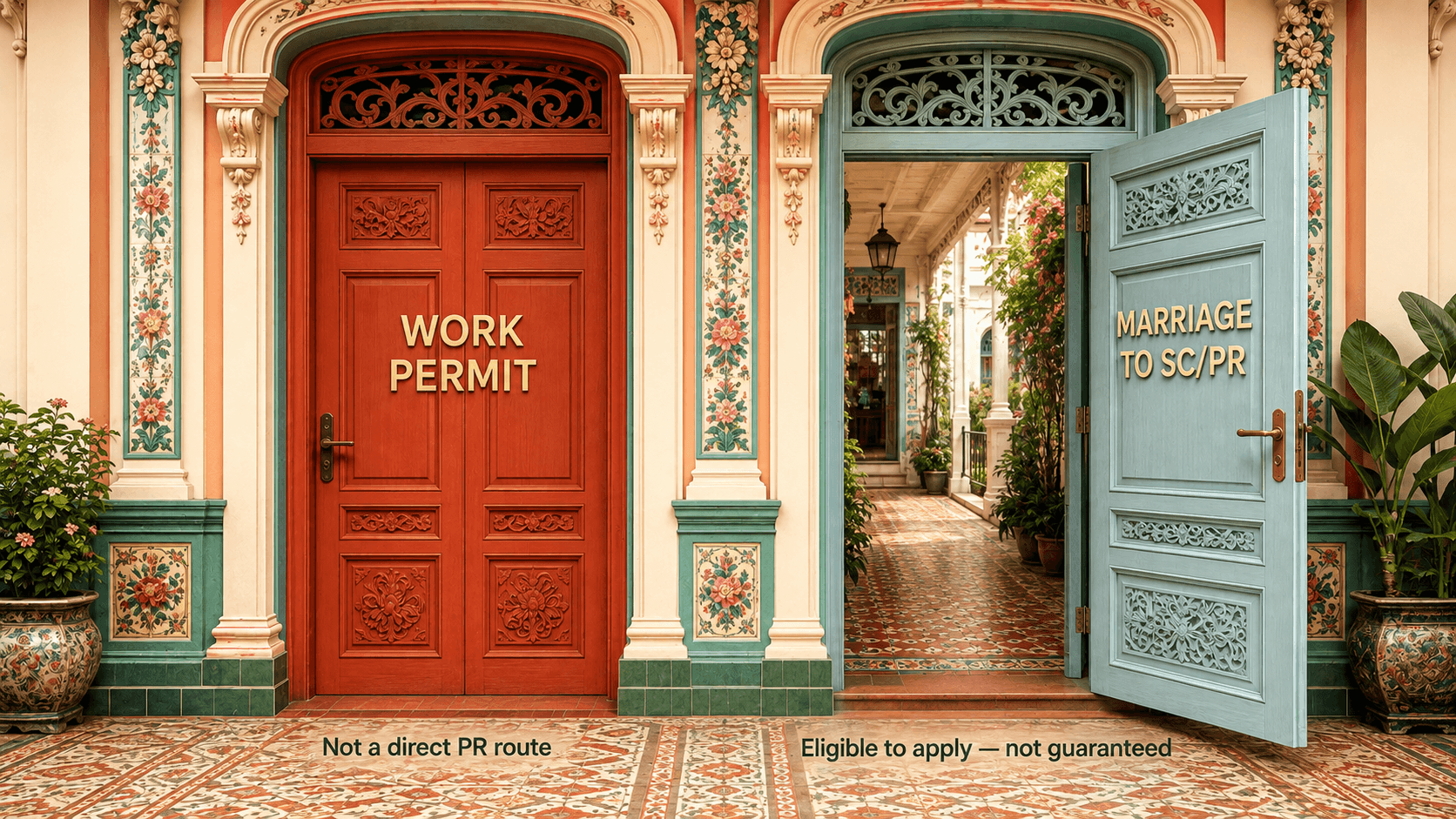
– A Work Permit holder can submit a Singapore PR application — but the Work Permit itself is not a qualifying basis. ICA’s employment-based PR scheme names Employment Pass and S Pass holders.
– A Work Permit holder who legally marries a Singapore Citizen or Singapore PR applies under ICA’s spouse scheme. This is a full ICA scheme, not a workaround.
– A current or former Work Permit holder must get MOM’s approval before marrying a Singapore Citizen or PR, in Singapore or overseas, in any form of marriage.
– An LTVP is not a legal prerequisite to a spouse-sponsored PR application. An LTVP is a strategic step that secures the foreign spouse’s stay and strengthens the profile.
– A Work Permit holder who upgrades to an S Pass or Employment Pass opens a second, independent PR route. In E&H Immigration Consultancy’s casework, the spouse route has tended to be the stronger of the two.
– Eligibility is not approval. ICA assesses every spouse-sponsored application on the couple’s combined profile.
Does a Work Permit qualify the holder for Singapore PR?
A Work Permit holder can submit a Singapore PR application, but the Work Permit itself is not a qualifying basis.
ICA runs several separate PR schemes. The employment-based scheme covers Employment Pass and S Pass holders. A Work Permit does not fall within that scheme, so a Work Permit holder cannot qualify by pointing to the pass alone.
The distinction matters. A Work Permit holder is not barred from the PR process. A Work Permit holder simply needs a different qualifying basis, and marriage to a Singapore Citizen or Singapore PR provides one.
Example. Ravi holds a Work Permit in the construction sector and has worked in Singapore for seven years. Ravi married a Singapore Citizen in 2023 with MOM’s approval. Ravi’s wife sponsors a spouse-scheme PR application through ICA’s e-Service. Ravi applies while still holding the Work Permit. The Work Permit is not what makes Ravi eligible. The marriage is.
Does the Work Permit still matter to the PR outcome?
Yes. The Work Permit does not determine eligibility, but it does affect the assessment.
ICA reviews the applicant’s full immigration and employment history. Income, occupation, employment stability and length of residence all feed the assessment of a spouse-sponsored application.
A Work Permit therefore sits in a specific position: neutral on whether the couple can apply, relevant to how strong the application is. Couples who understand this distinction prepare differently. Couples who treat the marriage certificate as the whole case tend to submit thin applications.
Which PR route applies to a Work Permit holder?
| Situation | Qualifying PR route | Work Permit is the basis? |
|---|---|---|
| Work Permit holder married to a Singapore Citizen | Spouse scheme, sponsored by the citizen spouse | No — the marriage is |
| Work Permit holder married to a Singapore PR | Spouse scheme, sponsored by the PR spouse | No — the marriage is |
| Work Permit holder, unmarried | No qualifying route on the Work Permit alone | No route |
| Former Work Permit holder now on S Pass or EP | Employment-based scheme | Yes — the S Pass or EP is |
| Former Work Permit holder now on S Pass or EP, and married to an SC or PR | Either route may apply | Depends on which route is stronger |
| Unmarried child under 21 of a Singapore Citizen or PR | Child scheme | No |
Example. Mei Lin entered Singapore on a Work Permit in 2019 and moved to an S Pass in 2024. Mei Lin also married a Singapore PR in 2025. Mei Lin now has two possible routes and should choose based on which profile is stronger, not on which came first.
Must a Work Permit holder get MOM’s approval before marrying?
Yes. A current or former Work Permit holder must obtain approval from the Ministry of Manpower before marrying a Singapore Citizen or Singapore PR.
The requirement applies:
- In Singapore and overseas
- To civil, religious and customary marriages
- While the Work Permit is valid and after it has expired
MOM requires approval if the person currently holds a Work Permit, including a Training Work Permit, or previously held a Work Permit as their last work pass in Singapore. MOM takes about four weeks to process the application and notifies the applicant by email.
Approval is not required if the person now holds an Employment Pass or S Pass, previously held an Employment Pass or S Pass as their last work pass in Singapore, or has since become a Singapore Citizen or Singapore PR.
MOM also restricts pregnancy. A Work Permit holder may only become pregnant and give birth in Singapore if already married, with MOM’s approval, to a Singapore Citizen or Singapore PR. This restriction continues after the Work Permit expires.
What happens if the couple marries without MOM’s approval?
Marrying without the required approval breaches the Work Permit conditions.
MOM states the consequences: the person’s privilege to work in Singapore can be withdrawn, and the person may be prevented from entering Singapore for a period of time.
An overseas marriage is not automatically invalid because MOM’s prior approval was not obtained. The marriage may be legally valid and still constitute a breach of the Work Permit conditions. These are two separate questions, and couples frequently conflate them.
Example. Nurul held a Work Permit until 2022, returned home, and married a Singapore Citizen overseas in 2024 without applying to MOM. The couple discovered the requirement two years later when preparing an LTVP application. Because the Work Permit was Nurul’s last Singapore work pass, the approval requirement still applied. The couple’s position is recoverable, but it needs to be addressed directly with MOM rather than left to surface inside an LTVP or PR assessment.
Couples in this position should not conceal the marriage or submit inaccurate information. Inconsistent disclosure creates a more serious problem than the original omission.
Does MOM’s approval to marry mean PR will be approved?
No. MOM’s approval to marry and ICA’s immigration decisions are separate.
MOM’s approval permits the marriage without breaching the Work Permit condition. MOM’s approval does not grant or promise a Long-Term Visit Pass, LTVP+, Permanent Residence or citizenship. ICA assesses each application independently under its own criteria.
Is it easier to get Singapore PR through a spouse than through a work pass?
In E&H Immigration Consultancy’s casework, spouse-sponsored applications have tended to succeed more readily than comparable applications filed on a work pass alone.
ICA publishes no approval rates for any scheme, so no consultancy can state a probability.
What E&H Immigration Consultancy can report is the pattern across the applications E&H Immigration Consultancy has handled: an applicant sponsored by a Singapore Citizen or Singapore PR spouse has generally faced a lower bar than an applicant of similar age, income and residence applying under the employment-based scheme.
The likely reason is structural rather than mysterious. A spouse-sponsored application presents a Singaporean family unit with a resident sponsor, dependants, a shared household and a demonstrable reason to remain in Singapore permanently. An employment-based application presents an individual whose ties rest largely on a job that can end. Family ties are a category of evidence a work pass cannot replicate at any salary level.
Two qualifications belong with this observation. First, the two groups are not like-for-like. Applicants who apply through a spouse differ from applicants who apply through a work pass in ways beyond the route itself, so part of the pattern may reflect who applies rather than the route taken. Second, the pattern describes a tendency, not a rule. E&H Immigration Consultancy has seen spouse-sponsored applications rejected, most often where the marriage was recent, the household income was unstable, or the application was submitted with little beyond the marriage certificate.
The practical implication for a Work Permit holder is direct. A Work Permit holder married to a Singapore Citizen or Singapore PR should not assume that upgrading to an S Pass or Employment Pass first will produce a better result. The spouse route is frequently the stronger of the two, and the upgrade is a separate decision that should be made on its own merits.
Is a spouse-sponsored PR application easier if the sponsor is a Singapore Citizen?
Both a Singapore Citizen and a Singapore PR can sponsor a legally married foreign spouse. A citizen sponsor represents a more direct family tie to Singapore.
ICA does not publish approval rates or a scoring formula, so no couple should treat a citizen sponsor as a guarantee. ICA assesses holistically, and the relevant factors include:
- The length and stability of the marriage
- The sponsor’s employment, income and CPF record
- The household’s ability to support itself
- The applicant’s employment, education and qualifications
- The applicant’s length of residence in Singapore
- The couple’s children and wider family profile
- The applicant’s conduct and immigration history
- Evidence the family intends to build a long-term future in Singapore
Where the sponsor is a Singapore PR, ICA may also weigh the sponsor’s own profile, including how long the sponsor has held PR status.
Should the foreign spouse apply for an LTVP first?
An LTVP is not a legal prerequisite to a spouse-sponsored PR application. An LTVP is usually the practical next step after marriage.
A Work Permit holder married to a Singapore Citizen or PR may file for PR directly. Many couples still apply for an LTVP first, for two reasons. An LTVP secures the foreign spouse’s right to remain in Singapore independently of the employer. An LTVP or LTVP+ record also evidences settled family life, which strengthens a later PR submission.
An eligible LTVP or LTVP+ holder may work in Singapore under the applicable Letter of Consent arrangements.
Couples planning to marry a Singapore Citizen should complete ICA’s Pre-Marriage Long-Term Visit Pass Assessment before the marriage. The assessment indicates whether the foreign spouse is likely to qualify for an LTVP, and an eligible couple receives a Letter of LTVP Eligibility valid for one year, which shortens LTVP processing considerably. The pre-marriage assessment does not replace MOM’s separate approval to marry.
Can the couple apply for PR immediately after the marriage?
Eligibility begins at the legally recognised marriage. ICA publishes no minimum period of marriage before a spouse-sponsored application may be submitted.
Being eligible to apply and being ready to apply are different questions. A very recent marriage offers limited evidence of an established family unit. Depending on circumstances, a couple may be better served by first building a record through cohabitation in Singapore, stable household income, an LTVP or LTVP+, and a demonstrable marital history.
Example. Two couples marry in the same month. The first submits a PR application six weeks later, with a marriage certificate and little else. The second waits, obtains an LTVP, establishes two years of joint residence and stable income, then submits. Both were eligible on day one. The second submitted a case.
What is the correct sequence?
- Confirm the pass history. Establish whether the foreign partner currently holds, or last held, a Work Permit.
- Apply to MOM for permission to marry. Obtain written approval before solemnisation or registration.
- Complete the Pre-Marriage LTVP Assessment, where the intended spouse is a Singapore Citizen.
- Register the marriage only after MOM’s approval is granted.
- Apply for the appropriate immigration status. Consider an LTVP, a spouse-sponsored PR application, or both in sequence.
- Time the PR application deliberately. An established marriage and a stable household profile carry more weight than an application filed at the first moment of eligibility.
Common mistakes
- Assuming an overseas marriage avoids MOM’s rules. The approval requirement covers marriages solemnised outside Singapore.
- Assuming the rule ends when the Work Permit expires. The requirement follows the person if the Work Permit was their last Singapore work pass.
- Treating the Work Permit as an absolute bar to PR. A Work Permit holder married to a Singapore Citizen or PR has a qualifying route.
- Treating marriage as a guaranteed route to PR. Marriage establishes eligibility for sponsorship, not approval.
- Filing at the first moment of eligibility. A thin application invites a rejection that the couple then has to overcome.
- Disclosing incompletely. Previous work passes, overseas marriages and immigration history should be disclosed accurately and consistently.
Speak to E&H Immigration Consultancy
E&H Immigration Consultancy advises couples on marriage approval, LTVP and Singapore PR applications where one partner holds or previously held a Work Permit. E&H Immigration Consultancy can assess:
- Whether MOM’s permission to marry is required in your circumstances
- The documents needed for the MOM application
- Whether an LTVP or a PR application is the more appropriate next step
- The strengths and weaknesses of your combined profile as a couple
- The right timing and supporting evidence for a spouse-sponsored PR application
Couples who have already married without MOM’s prior approval should raise the matter promptly rather than waiting for an LTVP or PR application to expose it.
Want structured advice on the Work Permit to PR route?
E&H Immigration Consultancy can review your pass history, check whether MOM’s approval to marry is required, and map the strongest route for your couple profile. We do not promise approval — no one honestly can.
Book a consultation with E&H Immigration Consultancy.
Not sure where you stand?
Get a personalised assessment of your Singapore PR, citizenship, or work pass options from E&H Immigration’s specialists.
Frequently asked questions
Can a Work Permit holder apply for Singapore PR?
A Work Permit holder can apply for Singapore PR when a qualifying route applies, most commonly marriage to a Singapore Citizen or Singapore PR. The Work Permit itself is not a qualifying basis, because ICA’s employment-based scheme covers Employment Pass and S Pass holders.
Does a Work Permit holder need to convert to an LTVP before applying for PR?
No. A Work Permit holder married to a Singapore Citizen or PR may be sponsored for PR while still holding the Work Permit. An LTVP is a strategic step, not a legal prerequisite.
Does a former Work Permit holder need MOM’s approval to marry a Singaporean?
Yes, if the Work Permit was the person’s last work pass in Singapore. Approval is not required if the person now holds, or last held, an Employment Pass or S Pass, or has become a Singapore Citizen or PR.
How long does MOM take to decide an application for permission to marry?
MOM takes about four weeks and notifies the applicant by email.
Is the marriage valid if the couple married overseas without MOM’s approval?
An overseas marriage is not automatically invalid. The absence of MOM’s approval may still breach the Work Permit conditions, which is a separate matter that should be addressed with MOM directly.
Can a Work Permit holder have a child in Singapore?
A Work Permit holder may only become pregnant and give birth in Singapore if already married, with MOM’s approval, to a Singapore Citizen or Singapore PR. The restriction continues after the Work Permit expires.
Is the spouse route easier than applying on an Employment Pass or S Pass?
ICA publishes no approval rates for any scheme. In E&H Immigration Consultancy’s casework, spouse-sponsored applications have tended to succeed more readily than comparable applications filed on a work pass alone, because family ties present evidence a work pass cannot replicate. A Work Permit holder married to a Singapore Citizen or PR should not assume that upgrading to an S Pass or Employment Pass first improves the outcome.
Is a Singapore Citizen sponsor better than a Singapore PR sponsor?
A Singapore Citizen sponsor represents a more direct family tie. Both can sponsor a legally married foreign spouse, and ICA publishes no approval rates for either.
How long must a couple be married before applying for PR?
ICA publishes no minimum period. A longer, better-evidenced marriage generally presents a stronger case than a recent one.
Related reading
- Singapore PR for the Spouse of a Singapore Citizen
- Singapore PR Application Guide
- Eligibility Criteria for Singapore PR: A Complete Overview
- Singapore Long-Term Visit Pass (LTVP) Guide
- LTVP vs LTVP+
- Letter of Consent for Dependants’ Pass Holders
Sources
Disclaimer: This article provides general information and does not constitute legal advice. MOM and ICA assess every application individually under the prevailing rules and policies, which change. Always check MOM’s and ICA’s current requirements before applying or making decisions based on your status.
By Tien Ho, Co-founder, E&H Immigration. Available in English, Mandarin and Malay.