
Second directorship in Singapore: when do you need an LOC?
An Employment Pass covers only your named employer. A directorship in another company needs an LOC first — related firms, unrelated ones, and the steps.

TLDR:
- An Employment Pass covers work for the employer named on the pass, and nothing else.
- A directorship in another company is work under the Companies Act, whether the seat is executive or non-executive.
- An Employment Pass holder needs a Letter of Consent (LOC) for secondary directorship before doing any directorship work.
- The company making the appointment applies for the LOC, and MOM’s service standard is within 5 weeks.
- Related companies are generally approved; unrelated companies need support from a sector government agency.
- Being registered as a director at ACRA is not permission to act.
Date note: Rules in this guide are in force as at 27 November 2026. The requirements below were checked against MOM’s current published guidance on that date.
An Employment Pass in Singapore covers work for one employer only: the company named on the pass. An Employment Pass holder who takes a board seat at any other company, executive or non-executive, carries out directorship duties under the Companies Act, and MOM treats those duties as work, so a Letter of Consent (LOC) is required before any directorship work begins [1][2]. The appointing company applies for the LOC, MOM’s service standard is within 5 weeks, and the directorship should be registered with the Accounting and Corporate Regulatory Authority (ACRA) only after approval [1].
Can an Employment Pass holder be a director of another company?
It depends on the company and on the role. If the second company is related to your employer by corporate shareholding, MOM generally grants the LOC and the appointment can proceed once it is approved [1][3]. If the company is unrelated, a sector government agency assesses the application and the LOC may be granted only if that agency supports it [3]. A separate operating job needs its own assessment. An LOC is not permission to take an unrestricted second job [11].
The short answer fits in three steps, and the order matters.
- The board offers the seat, or passes a resolution to appoint you.
- The appointing company applies for the LOC, after your primary employer confirms it has no objection [1].
- Only after approval does the company register the directorship with ACRA, and only then do you begin duties [1].
Two opposite mistakes are common. Some holders believe a second directorship is impossible on an Employment Pass, which is wrong for related companies. Others believe a non-executive or nominee seat sits outside the work pass system, which MOM’s factsheet expressly rules out for these appointments [2].
What if you are already registered as a director?
ACRA registration alone does not let you carry out directorship duties. Wait for an LOC before attending board meetings or signing resolutions for the second company. If duties have already begun, get advice promptly on the circumstances and any action required. A person whose LOC is refused must resign from the secondary directorship [9].
Why do people assume a non-executive director needs no work pass?
A non-executive director is still a director. The label describes the board role, not the immigration position, and MOM’s guidance covers executive and non-executive appointments alike [2].
MOM’s factsheet states that when Employment Pass holders undertake directorship appointments, executive or non-executive, they are required to discharge directorship duties under the Companies Act, and that this constitutes a form of work for which a work pass is required [2]. The LOC obligation follows from the duties, not from the job title.
A nominee director is also a director. A nominee appointment still carries the duties of a director under the Companies Act [2]. Directorship duties take time, judgment and legal responsibility, which is why MOM treats the appointment as work.
The practical test is simple. Ask whether you will do anything as a director: attend board meetings, vote, sign resolutions, review accounts or advise management. An affirmative answer means an LOC is needed before the first of those acts [1][2].
Does the second company have to be related to my employer?
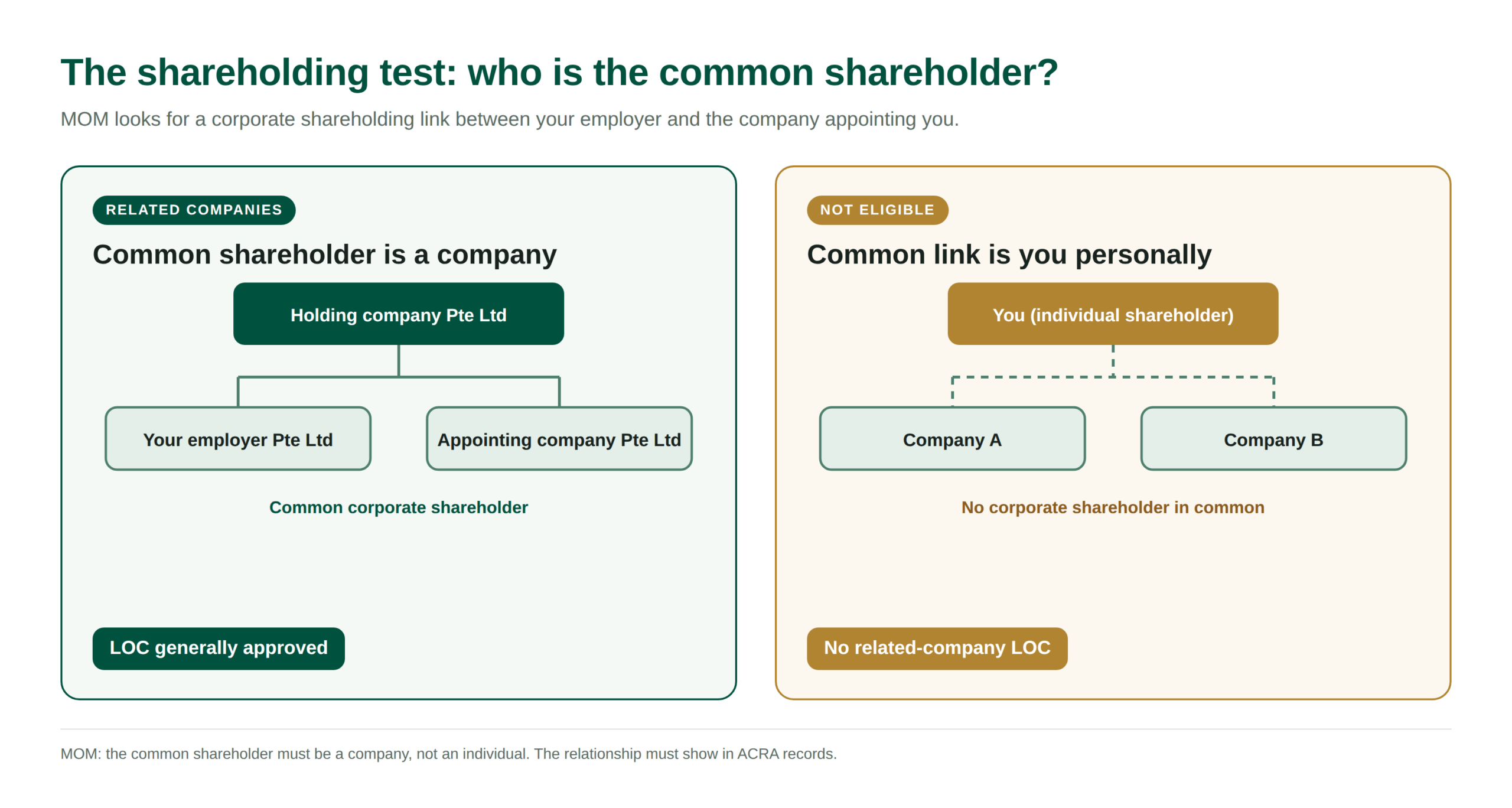
MOM generally grants the LOC where the two companies are related by corporate shareholding, and that relationship must be reflected in ACRA records [1].
| Structure | Published guidance | Deciding fact |
|---|---|---|
| Parent company of your employer | Generally approved | Direct shareholding link between the two companies [1] |
| Subsidiary of your employer | Generally approved | Direct shareholding link in the opposite direction [1] |
| Sister company under a common parent | Generally approved | Common corporate shareholder [4] |
| Company linked to your employer only through you as an individual shareholder | Not eligible | The common shareholder must be a company, not a person [4] |
| Unrelated company in the same industry | Assessed case by case | A sector government agency must support the application [3] |
Indirect relationships count. MOM’s factsheet describes related companies as including the holding company of the primary employer, subsidiaries of that holding company, and direct or indirect subsidiaries [2]. A three-tier group structure can therefore qualify even where the two employing companies never contract with each other.
The application must show the chain. The appointing company provides an organisation chart explaining how it relates to the Employment Pass holder’s primary employer [2]. Check that the chart matches the corporate shareholding records.
MOM also looks at purpose. The secondary directorship should relate to the holder’s primary employment, which is why a group appointment usually reads as a natural extension of the day job and a random outside board seat does not [1].
Who applies for the secondary directorship LOC, and how long does it take?
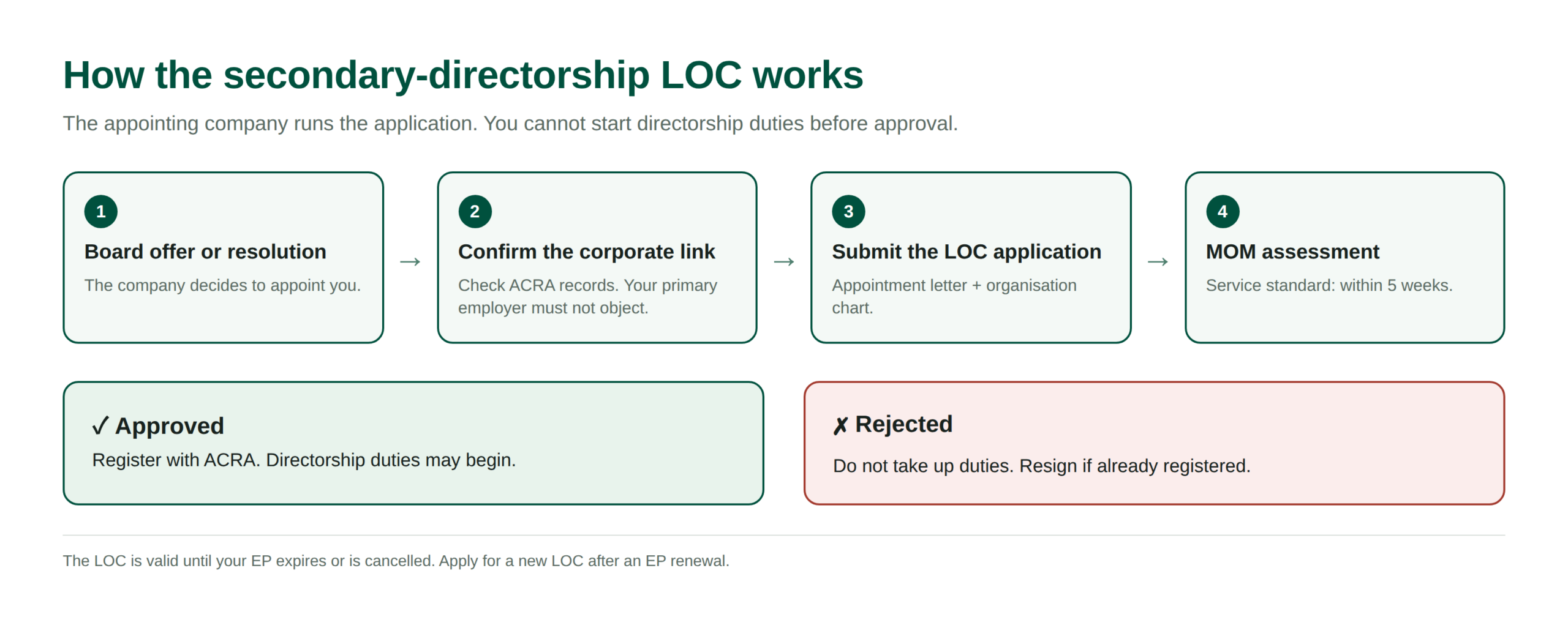
The company making the appointment applies, not the Employment Pass holder, and MOM’s service standard is within 5 weeks [1].
- Confirm the corporate relationship. Check the shareholding chain against ACRA records before anything is drafted [1].
- Obtain the primary employer’s no-objection. The appointing company must ensure the Employment Pass holder’s employer has no objections to the appointment [1]. Raise the appointment with your primary employer early; do not assume silence is consent.
- Pass the board resolution. The appointing company resolves to appoint the director, subject to MOM approval.
- Prepare the appointment letter. The Employment Pass holder’s appointment letter to take up the directorship is the document MOM lists for the application [1].
- Attach the organisation chart. A related-company application needs a chart explaining the relationship with the primary employer [2].
- Submit the LOC application. The appointing company applies to MOM through its secondary directorship application route [1].
- Wait for the outcome. MOM states a service standard of within 5 weeks [1].
- Register with ACRA after approval. The directorship position is registered only once the LOC is granted [1].
- Track the expiry date. The LOC is valid up to the expiry or cancellation date of the current Employment Pass, and a new LOC is needed after a successful Employment Pass renewal [1].
The Employment Pass holder cannot apply on their own behalf, because the application belongs to the company that wants them on its board. Human resources and company secretarial teams should treat the LOC as a prerequisite in the appointment timetable, alongside the ACRA filing.
Where do I submit, and is there an application fee?
Use the secondary-directorship application form linked from MOM’s page [1]. MOM’s public overview does not list an application fee. Check the current form and distinguish government charges from any company-secretarial or advisory fees. The overview gives a processing time of within 5 weeks without specifying a separate complete-application clock [1]. Allow time for document preparation and follow-up questions.
What happens at EP renewal or a change of employer?
The LOC ends when the current EP expires or is cancelled. Apply for a new LOC after successful EP renewal [1]. Do not assume a pending renewal extends the old LOC. A change of primary employer also needs a fresh assessment of the corporate relationship and directorship permission. Confirm the transition with MOM before continuing duties.
What happens if the second company is unrelated to my employer?
MOM refers the application to a sector government agency: a government body that regulates or promotes the industry, and the LOC may be granted only if that agency supports it [3].
Employees of fund managers licensed by the Monetary Authority of Singapore (MAS) may take on directorships for their investment vehicles, because MAS supports that arrangement [3]. The published example concerns investment vehicles; check a proposed outside appointment separately.
An unrelated-company appointment is subject to assessment; agency support does not guarantee approval. MOM’s guidance is that the Employment Pass holder must obtain the LOC before carrying out directorship responsibilities, and that if the application is unsuccessful the person has to resign as a director [9]. Accepting the seat first and applying afterwards puts the pass at risk during the period when duties are already being performed.
Applicants who submitted wrong information, such as an incorrect Foreign Identification Number (FIN) or company Unique Entity Number (UEN), or who have new evidence, can submit another request [10]. MOM accepts a further request with new information supporting an appeal or corrections to an earlier submission [10].
What if you want to run the second company, not just sit on its board?
A secondary-directorship LOC covers an approved directorship. It does not give unrestricted permission to run a second business alongside your existing employment [1][11].
A board appointment and day-to-day work are different questions. Before taking an operating role at another company, ask MOM to confirm the permissions needed. Do not assume that being a shareholder or having an LOC authorises every task at that company.
If you intend to move your main employment to the new company, the new employer must apply for a new Employment Pass. MOM says the existing EP need not be cancelled before the application is made [12]. The application is assessed on its merits. Applying for a new EP is not permission to work two jobs at once [11].
A founder may instead need to assess the EntrePass or Overseas Networks and Expertise Pass (ONE Pass) route, depending on the proposed business and personal eligibility. Read our company incorporation and Employment Pass guide and founder residency service. Get the pass position confirmed before starting work.
Can an Employment Pass holder own shares in another company?
Yes. MOM allows an Employment Pass holder to own shares in a Singapore-registered company, and shareholding does not require an LOC [5].
Shares and board seats are separate questions. A shareholding is an investment, and MOM’s position is that an Employment Pass holder may hold shares in a Singapore-registered company [5]. A directorship is a set of duties, and those duties need the LOC.
Shareholding also does not create the corporate link that supports a related-company LOC. Where the only connection between the two companies is the Employment Pass holder’s personal shareholding, MOM’s position is that the holder is not eligible for the LOC, because the common shareholder must be a company [4].
The distinction between ownership and directorship catches founders who hold 100% of a new company and assume that ownership implies permission to direct it. Ownership of the shares is permitted. Acting as its director while on an Employment Pass for another employer is the part that needs authorisation.
What about Dependant’s Pass, LTVP, S Pass and Work Permit holders?
Other pass types follow different rules. The EP secondary-directorship LOC does not transfer to another pass category [1][6][7][8].
A Dependant’s Pass (DP) holder who wants to operate a business can consider the separate business-owner LOC. For the company-director route, at least 30% shareholding is a minimum requirement. Other eligibility and renewal conditions also apply [6]. Read our DP Letter of Consent guide.
Eligible holders of an Immigration & Checkpoints Authority (ICA) Long-Term Visit Pass (LTVP/LTVP+) can consider a Pre-approved Letter of Consent (PLOC). The route is for spouses and unmarried children under 21 of Singapore citizens or Permanent Residents [7]. Applicants can request a PLOC during the LTVP application or renewal. A PLOC does not permit self-employment [7].
S Pass and Work Permit holders cannot own or manage a business in Singapore or register as its directors, partners, sole proprietors or company secretaries. MOM warns that a breach leads to work-pass revocation and an employment ban [8]. An offer of a registered directorship therefore needs to be declined while the person holds either pass. Any change of pass must first meet the new pass requirements.
What do these rules look like in practice?
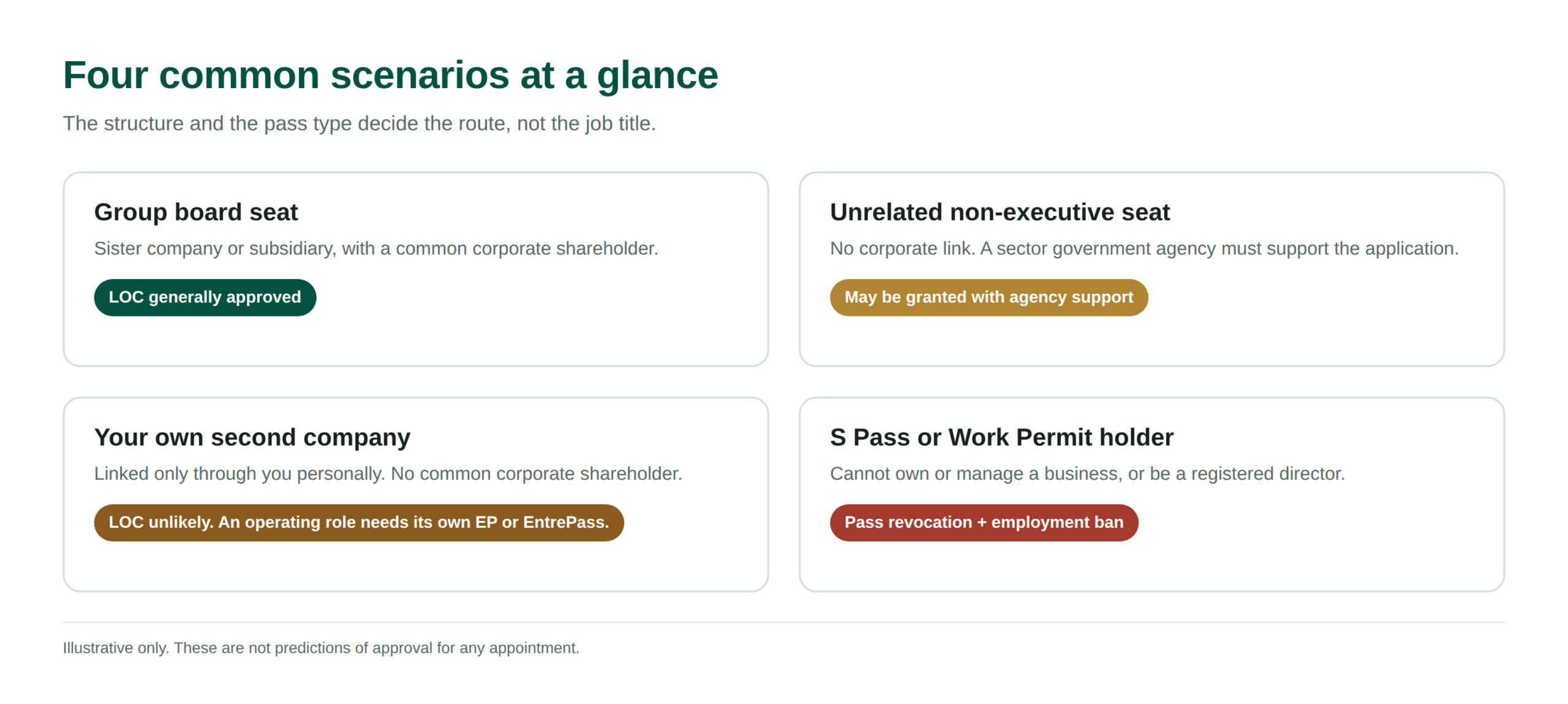
The following examples are illustrative. They are not client cases or predictions of approval.
A group-company board seat. An EP holder at Company B is offered a seat at Company C. A holding company owns both B and C. The appointment supports the holder’s primary job. The corporate relationship may fit MOM’s related-company framework, but the appointing company still needs an LOC before duties begin [1][2].
A friend’s startup. An EP holder receives an offer of a non-executive seat at an unrelated startup. The title does not remove the LOC requirement. The application needs sector-agency assessment and support [3]. Make the appointment conditional on approval and avoid duties before the LOC is granted. A person already registered must resign if refused [9].
A second founder venture. An EP holder personally owns two companies, but no company shareholder links them. Personal ownership alone does not meet the corporate-shareholding test [4]. Day-to-day work in the new venture also needs separate assessment [11].
An S Pass holder offered a board seat. An S Pass holder is offered a registered directorship at the employer. The pass does not allow a registered directorship [8]. A senior job title and a registered company office are different; check the proposed duties and pass requirements before changing the role.
What should you check before signing the board resolution?
Eight checks cover most of the risk, with a ninth for unusual structures. Complete the checks before announcing the appointment.
- Confirm the shareholding chain between the appointing company and your primary employer, and confirm it is visible in ACRA records [1].
- Identify the common shareholder and confirm it is a company rather than you personally [4].
- Confirm no-objection from your primary employer before the application is filed [1].
- Check the role is genuinely a board role and confirm any operating duties separately with MOM [11].
- Confirm the appointment letter exists and matches the directorship being applied for [1].
- Prepare the organisation chart if the companies are related [2].
- Diarise the Employment Pass expiry date, because the LOC ends with the pass and a renewal needs a fresh LOC [1].
- Sequence ACRA registration after approval, so the public record does not show a directorship that MOM has not authorised [1].
A ninth check is worth adding for anyone with an unusual structure: read the outcome as MOM writes it. Related-company approvals are described as generally granted, and unrelated-company applications as possibly granted with sector agency support [1][3]. Neither wording supports an assumption of approval.
Who wrote this guide and how was it checked?
By Tien Ho, Co-founder, E&H Immigration Consultancy.
MOM’s current secondary-directorship guidance, factsheet and relevant FAQs were checked on 27 November 2026. The numbered references below identify the sources for each policy claim.
This guide explains published guidance. It does not guarantee approval or replace advice on a particular appointment. Check MOM’s current requirements and the terms of the actual LOC before acting.
How can E&H Immigration Consultancy help with a second directorship?
Request a Case Review E&H Immigration Consultancy can assess the proposed shareholding structure and directorship, help prepare the LOC application with the company secretary, and assess the pass requirements for an operating role. Request an Employment Pass case review before accepting duties at another company.
Not sure where you stand?
Get a personalised assessment of your Singapore PR, citizenship, or work pass options from E&H Immigration’s specialists.
What are the frequently asked questions about second directorships on an Employment Pass?
Can an EP holder be a director of another company?
An Employment Pass holder can be a director of another company only after MOM grants an LOC for the secondary directorship [3]. The appointing company applies, and the directorship is registered with ACRA after approval [1].
Do non-executive directors need a Letter of Consent?
A non-executive director needs a Letter of Consent because MOM treats directorship duties under the Companies Act as work, whether the appointment is executive or non-executive [2]. The title does not change the requirement.
Can I be a director of two companies on an Employment Pass?
An Employment Pass holder can be a director of two companies where the second company is related by corporate shareholding and the LOC is granted [1]. A directorship at an unrelated company depends on support from a sector government agency [3].
Does my own shareholding count as the common corporate shareholder?
Personal shareholding does not count, because MOM requires the common shareholder to be a company [4]. Two companies linked only through the Employment Pass holder as an individual are not eligible for the LOC [4].
When can I start directorship duties?
Directorship duties can start only after the LOC is approved [9]. If the application is unsuccessful, the person has to resign as a director [9].
What happens if the LOC is rejected?
A rejected application means the appointment cannot proceed. A person already registered as a director must resign [9]. A further request can include new information supporting an appeal or corrections to an earlier submission [10].
Can an S Pass holder be a director?
An S Pass holder cannot be registered as a company director or own or manage a business in Singapore. MOM warns that a breach leads to work-pass revocation and an employment ban [8]. Any change of pass must first meet the new pass requirements.
Does a Dependant’s Pass holder need an LOC to run a company?
A Dependant’s Pass holder needs a Letter of Consent for Dependant’s Pass business owners to operate a business, and eligibility depends on the shareholding and role conditions being met [6].
What documents are needed for the secondary-directorship LOC?
MOM lists the EP holder’s appointment letter. A related-company application also needs an organisation chart showing the corporate relationship [1][2]. The appointing company must ensure the primary employer has no objection [1]. Check the current application form for any further information required.
Can I act as a director while the application is pending?
An EP holder must obtain the LOC before carrying out directorship responsibilities. ACRA registration alone is insufficient. A person already registered must resign if the LOC is refused [9].
Can I work for both companies after getting the LOC?
An LOC allows the approved secondary directorship. The LOC does not authorise unrestricted work for two employers [11]. Confirm any other role with MOM before starting [1][11].
Sources & References
- Taking up secondary directorship — Ministry of Manpower (MOM)
- Factsheet: EP holders taking up Secondary Directorship Appointments — Ministry of Manpower (MOM)
- Can EP holders be registered as directors in another company apart from the company their pass is approved under? — Ministry of Manpower (MOM)
- Why was my LOC application for secondary directorship rejected due to no common corporate shareholding relationship? — Ministry of Manpower (MOM)
- Can an Employment Pass holder be a shareholder of a Singapore-registered company? — Ministry of Manpower (MOM)
- Letter of Consent for Dependant’s Pass Business Owners — Ministry of Manpower (MOM)
- Pre-approved Letter of Consent — Ministry of Manpower (MOM)
- Can S Pass or Work Permit holders be registered as company directors or secretaries? — Ministry of Manpower (MOM)
- Can directorship duties begin before an LOC is granted? — Ministry of Manpower (MOM)
- How do I appeal if my secondary directorship request is rejected or contains wrong information? — Ministry of Manpower (MOM)
- Can a work pass holder work in multiple jobs? — Ministry of Manpower (MOM)
- What if I want to change jobs while I am on an EP? — Ministry of Manpower (MOM)