
Population in Brief 2026: Who Got Singapore PR and Citizenship, and What It Means for You
Singapore granted 35,352 PRs and 25,094 citizenships in 2025. What the age, region and ethnic data mean for your PR or citizenship application in 2026.
TLDR:
- Singapore granted 35,352 new permanent residencies and 25,094 citizenships in 2025.[1]
- Citizenship grants rose 10.2% and reached their highest level since the immigration framework was tightened in late 2009.[1]
- Applicants aged 21 to 40 received 64.7% of new permanent residencies, while the over-40 group received 10.9%.[1]
- Other Asian countries gained permanent residence and citizenship places, but their permanent residence total remained below 2023.[1]
- More PRs are now becoming citizens, and the 25,000–30,000 target leaves room for about 4,900 more citizenships a year, so eligible PRs face a favourable window.[1][6]
- Western PRs rarely convert to citizenship (about 26 citizenships per 100 PR grants, against about 80 for Other Asia), largely because their passports and home economies already rival Singapore’s.[1][7][8]
- Singapore plans to grant 25,000 to 30,000 citizenships and about 40,000 permanent residencies annually over the next five years.[6]
- The Immigration & Checkpoints Authority (ICA) does not publish approval rates or grants by nationality, ethnicity or marital status.
Date note: Population figures are measured at end-June 2026. Permanent residence grants, citizenship grants, marriages and births cover calendar year 2025. The intake targets were announced in February 2026 for the following five years.[1][6]
Population in Brief 2026 is Singapore’s official annual population report, and it shows that Singapore granted 35,352 new permanent residencies and 25,094 citizenships in 2025.[1] The results point to higher future intake, a strong preference for younger permanent residents and a partial recovery for applicants from Other Asian countries. Population in Brief 2026 was released on 25 September 2026 by the National Population and Talent Division, working with the Department of Statistics Singapore, Ministry of Home Affairs, Immigration and Checkpoints Authority and Ministry of Manpower.[1]
By Tien Ho, Co-founder, E&H Immigration.
Citizenship grants hit their highest level since 2009, and the PR target means about 4,600 more places a year
Singapore made 25,094 people citizens in 2025, up 10.2%, while PR grants barely moved at 35,352. The bigger news for applicants is what comes next: the Government plans about 40,000 new PRs a year, roughly 4,600 more places than in 2025.[1][6]
Permanent residence, or PR, grants rose by 0.2% from 35,264 in 2024 to 35,352 in 2025.[1] Citizenship grants excluding citizenship by descent rose by 10.2% from 22,766 to 25,094.[1]
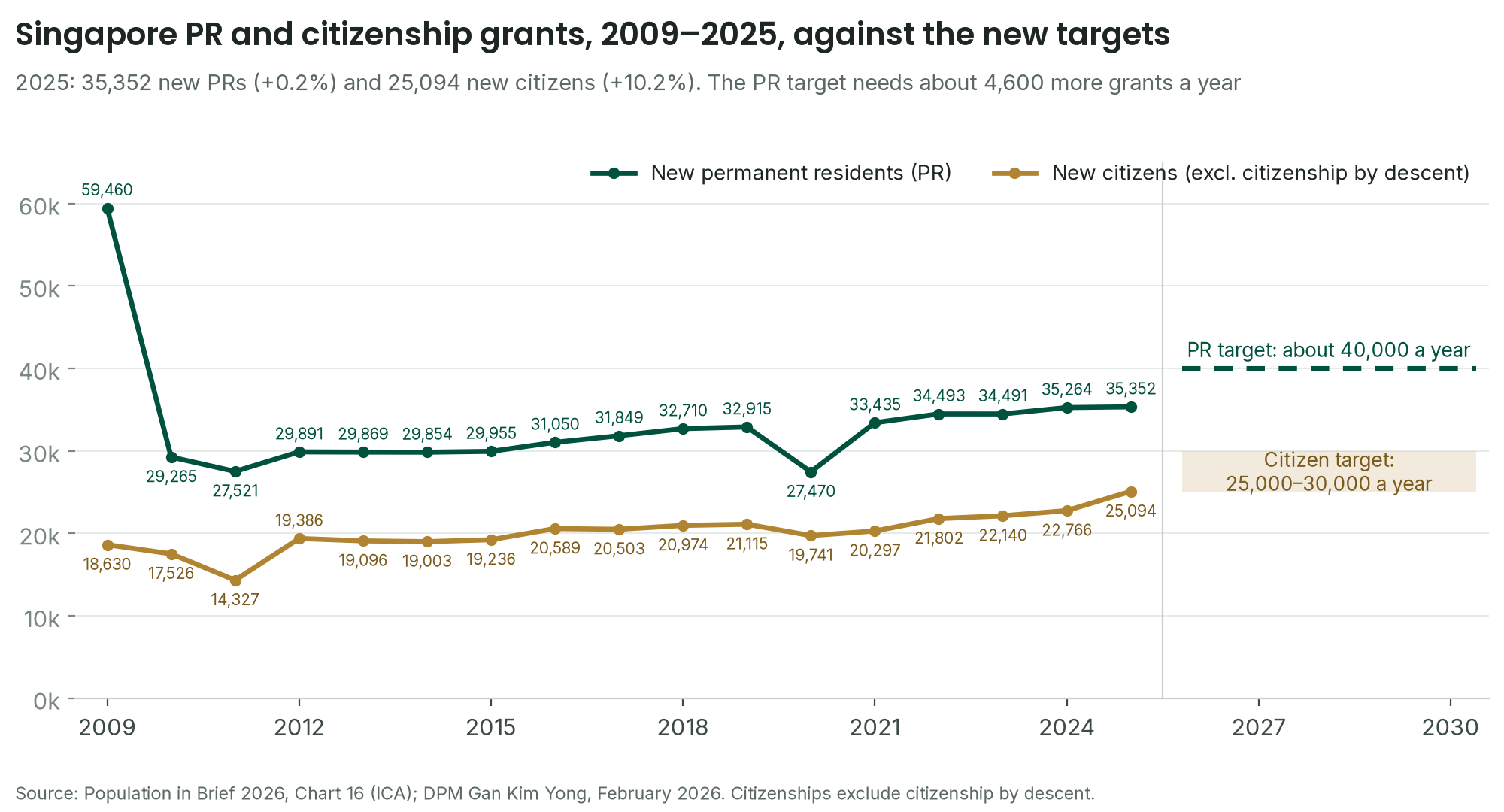
The 25,094 citizenship total was the highest since the immigration framework was tightened in late 2009.[1] The increase of 2,328 was the largest one-year rise since 2012.[1] The 2021–2025 annual averages were 22,400 citizenships and 34,600 permanent residencies, compared with 20,600 citizenships and 31,200 permanent residencies in 2016–2020.[1]
Readers should not compare the 23,472 citizenships printed for 2023 in Population in Brief 2024 directly with the 25,094 figure for 2025. The older 23,472 total included 1,332 children who acquired citizenship by descent, while reports from 2025 onward exclude citizenship by descent from the main grant series.[1][2][3] The comparable 2023 total is 22,140.[1]
Singapore separately granted citizenship by descent to 1,646 children born overseas to Singaporean parents in 2025, the highest figure in the 2015–2025 series.[1]
Deputy Prime Minister Gan Kim Yong said Singapore expects to take in between 25,000 and 30,000 new citizens annually over the next five years and about 40,000 new permanent residents annually.[6] The PR target is about 13% above the 2025 level and represents roughly 4,600 additional grants a year.[1][6] The 2025 citizenship total already sits at the bottom of the planned citizenship range.[1][6]
PR is a waiting room, not a destination. All new adult citizens come from the PR pool.[1] Singapore’s PR population rose only from 543,800 in June 2025 to 546,600 in June 2026 despite about 35,000 grants.[1] E&H Immigration estimates that roughly 32,000 to 36,000 people leave PR status each year, including about 18,000 who became citizens in 2025. The estimate compares calendar-year grant data with June-to-June population data, so it should be treated as a range rather than an official count.[1]
Today’s PR surge is becoming a citizenship wave. PR grants stepped up after Covid, from 27,470 in 2020 to between 33,000 and 35,500 a year from 2021 onwards.[1] Many of those PRs are now reaching the stage where they apply for citizenship. Citizenship grants rose 10.2% in 2025, and grants to the 31–40 age group, which received the most citizenships, rose 21.1%.[1][2] ICA does not publish how long PRs wait before becoming citizens, so the link between the two is E&H Immigration’s reading of the data.
The citizenship target of 25,000 to 30,000 a year leaves room for up to about 4,900 more citizenships a year than the 25,094 granted in 2025.[1][6] The PR target of about 40,000 a year will also make the pool of PRs eligible for citizenship larger in later years.
What this means for you: if you are a PR who already meets the citizenship criteria, the next few years look like a favourable window. Grants are rising, the target allows for more, and waiting brings no obvious advantage.
Two in three new PRs were aged 21 to 40, so age matters far more at the PR stage than for citizenship
If you are aged 21 to 40, you belong to the group that received almost two in three new PRs in 2025. Over-40s received just 10.9% of PR grants, but did much better at the citizenship stage, where they received 26.7%.[1]
The Immigration and Checkpoints Authority, or ICA, does not publish application counts or approval rates. The following figures describe people who received status, not each group’s chance of approval.
| Profile | PR 2023 | PR 2024 | PR 2025 | Citizen 2023 | Citizen 2024 | Citizen 2025 |
|---|---|---|---|---|---|---|
| Total | 34,491 | 35,264 | 35,352 | 22,140 | 22,766 | 25,094 [1][2][3] |
| Aged 20 and under | 24.7% (8,519) |
24.8% (8,745) |
24.5% (8,661) |
32.0% (7,094) |
29.9% (6,807) |
28.3% (7,102) [1][2][3] |
| Aged 21–30 | 29.2% (10,071) |
32.6% (11,496) |
32.5% (11,489) |
12.5% (2,770) |
14.3% (3,256) |
13.7% (3,438) [1][2][3] |
| Aged 31–40 | 33.6% (11,589) |
31.4% (11,073) |
32.2% (11,383) |
27.8% (6,150) |
28.5% (6,488) |
31.3% (7,854) [1][2][3] |
| Aged over 40 | 12.5% (4,311) |
11.3% (3,985) |
10.9% (3,853) |
27.7% (6,126) |
27.4% (6,238) |
26.7% (6,700) [1][2][3] |
| Southeast Asian origin | 56.8% (19,591) |
63.9% (22,534) |
61.6% (21,777) |
69.2%* | 64.3% (14,639) |
62.1% (15,583) [1][2][3] |
| Other Asian origin | 35.8% (12,348) |
29.6% (10,438) |
31.6% (11,171) |
25.4%* | 32.8% (7,467) |
35.4% (8,883) [1][2][3] |
| Rest of world | 7.4% (2,552) |
6.5% (2,292) |
6.8% (2,404) |
5.4%* | 2.9% (660) |
2.5% (627) [1][2][3] |
| Post-secondary education or higher, aged 20+ | 82.8% | 85.5% | 84.7% | 77.2%* | 81.1% | 83.2% [1][2][3] |
*The 2023 citizenship age figures have been restated by E&H Immigration to exclude 1,332 citizenship-by-descent cases. The marked 2023 region and education shares were printed in Population in Brief 2024 and include descent cases, so comparisons require care.[1][3]
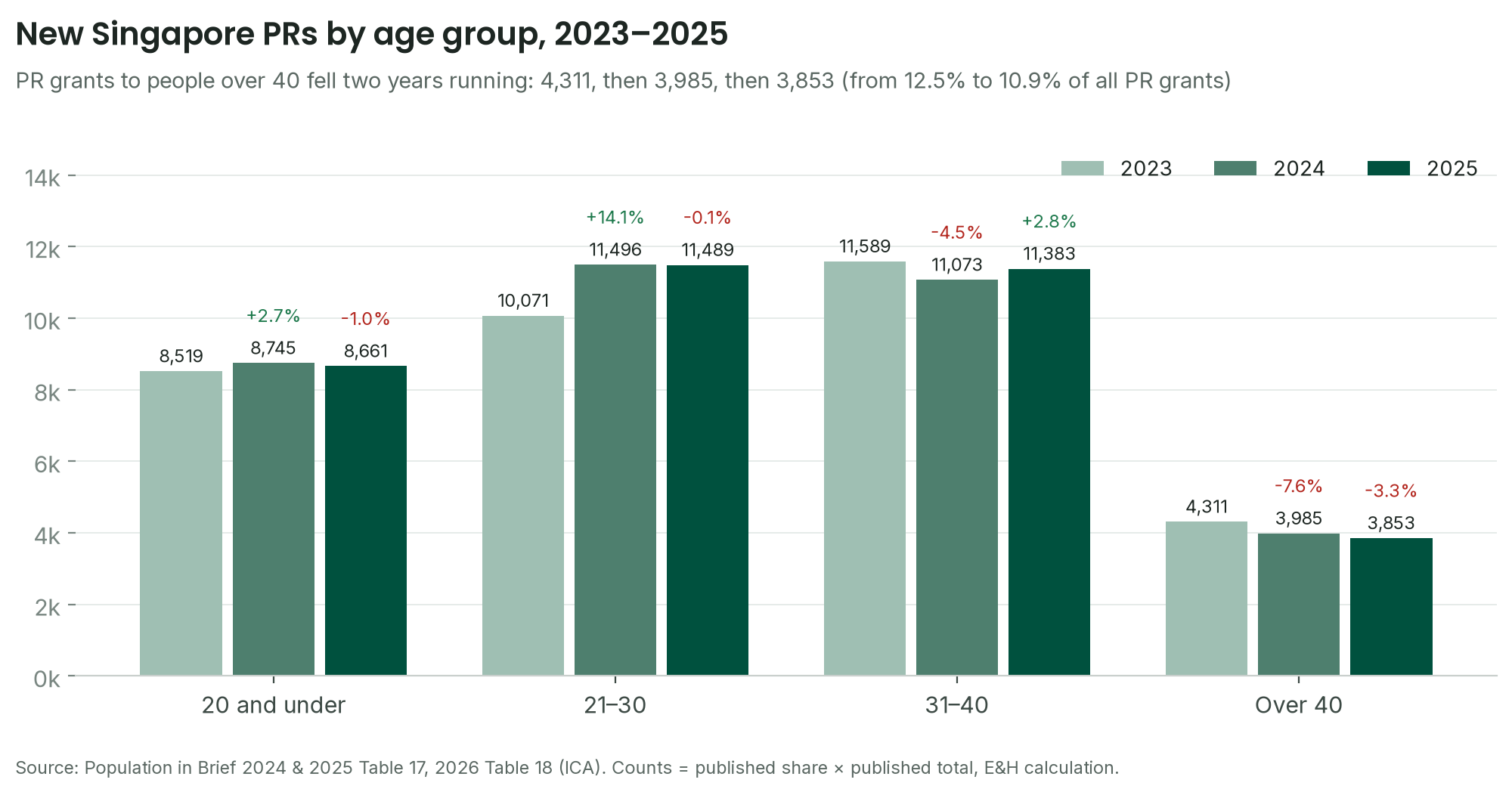
Applicants aged 21 to 40 received 64.7% of new permanent residencies in 2025.[1] The over-40 share fell for two consecutive years, from 12.5% in 2023 to 10.9% in 2025, while the count fell from 4,311 to 3,853.[1][2][3]
Citizenship tells a different story. People over 40 received 26.7% of citizenships but only 10.9% of permanent residencies in 2025.[1]
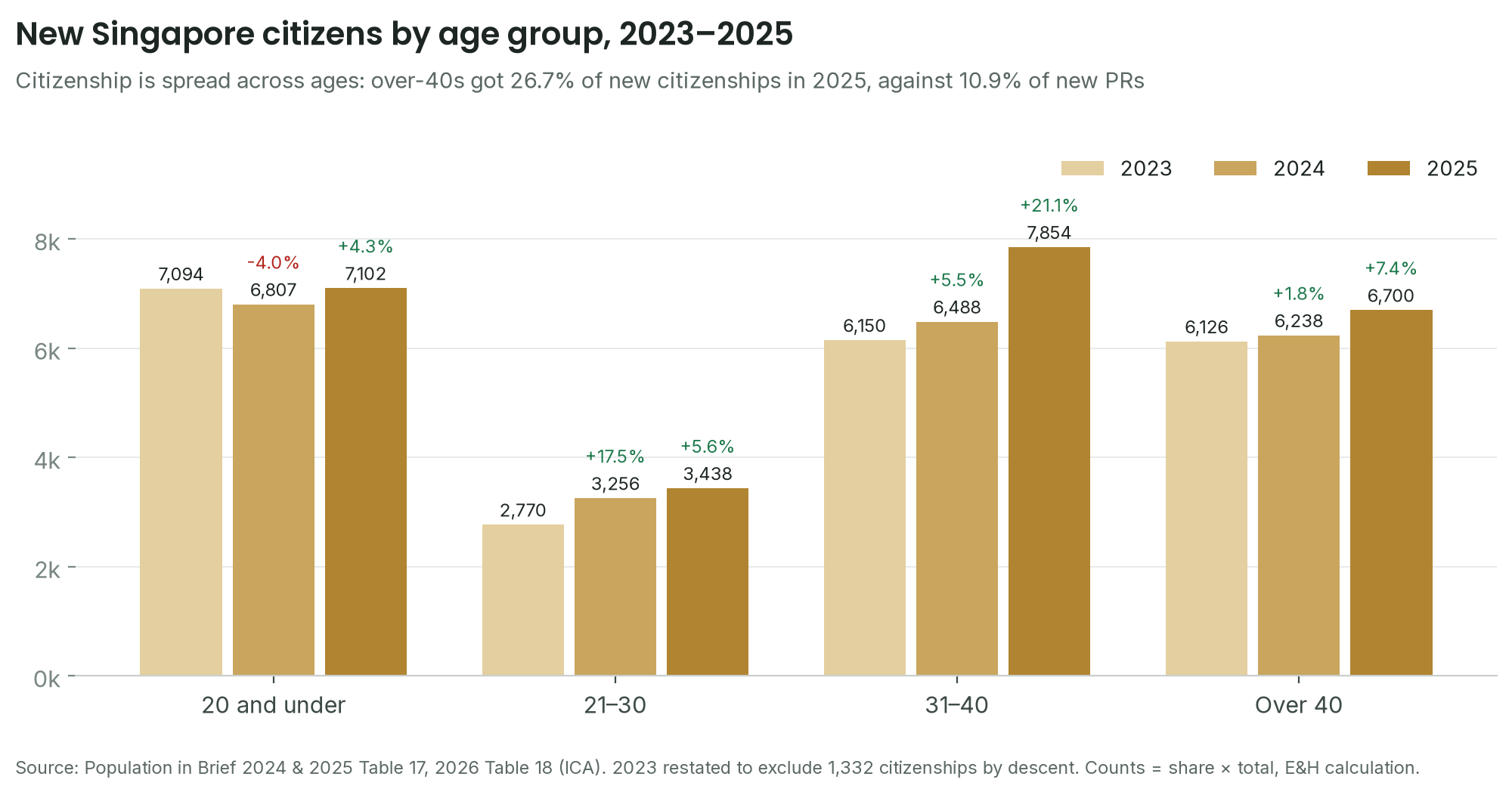
PR and citizenship work as one pipeline, not two separate queues. Singapore picks its PRs young: 64.7% of new PRs in 2025 were aged 21 to 40.[1] Almost every adult who becomes a citizen is already a PR who has lived in Singapore for years, so citizenship grants peak later in life. The 31–40 group received 7,854 citizenships in 2025, up 21.1% in one year, while people in their twenties received only 13.7% of citizenships most likely because many of them became PRs only recently.[1][2]
E&H Immigration reads this as a built-in progression. The Government admits PRs while they are young and have a long working life ahead, then grants citizenship once they have settled, raised children here and chosen to commit. By the time most PRs apply for citizenship they are older, more integrated and easier to assess, so age counts for much less at that stage. ICA does not publish approval rates by age, so this is our interpretation of who receives status, not an official rule.
What this means for you:
- Under 40 and not yet a PR: this is the stage where age works in your favour, so avoid unnecessary delay.
- Over 40 and not yet a PR: fewer places go to your age group each year, falling from 4,311 in 2023 to 3,853 in 2025.[1][3] Expect a harder application, and lead with what younger applicants cannot show: seniority, income, skills in short supply, family ties to Singaporeans and a long Singapore track record.
- Already a PR in your 40s or 50s: age is much less of a barrier at the citizenship stage. Years in Singapore, family here and commitment carry more weight.
Children received a substantial share of grants. People aged 20 or under accounted for 8,661 new permanent residencies and 7,102 citizenships in 2025, or about 15,800 grants combined.[1] The combined number should not be read as 15,800 different children entering the system because a child can receive PR first and citizenship in a later year.
Education remained an important feature of the grant profile. Among recipients aged 20 or older, 84.7% of new permanent residents and 83.2% of new citizens had post-secondary education or higher in 2025.[1]
Education is tested hardest at the PR stage. New PRs and new citizens have almost the same education profile: 84.7% against 83.2% with post-secondary education or higher.[1] Citizens come from PRs who have already passed that filter, so E&H Immigration reads this to mean education and skills matter most when you apply for PR. At the citizenship stage, the questions shift to how long you have lived here, your family in Singapore and your commitment. The 2023 citizen figure includes citizenship by descent, so it is not used here as a trend.
Applicants from China, India and the rest of Other Asia won back ground in 2025, while Southeast Asians lost 757 PR places
Applicants from Other Asian countries, which include China and India, received 733 more PR places and 1,416 more citizenships in 2025 than in 2024. Southeast Asians are still the largest group, but they received 757 fewer PR places while gaining 944 citizenships.[1][2]
| Region of origin | PR 2024 | PR 2025 | Change | Citizenship 2024 | Citizenship 2025 | Change |
|---|---|---|---|---|---|---|
| Southeast Asia | 22,534 | 21,777 | −3.4% (−757) |
14,639 | 15,583 | +6.4% (+944) [1][2] |
| Other Asian countries | 10,438 | 11,171 | +7.0% (+733) |
7,467 | 8,883 | +19.0% (+1,416) [1][2] |
| Others, or rest of world | 2,292 | 2,404 | +112 | 660 | 627 | −33 [1][2] |
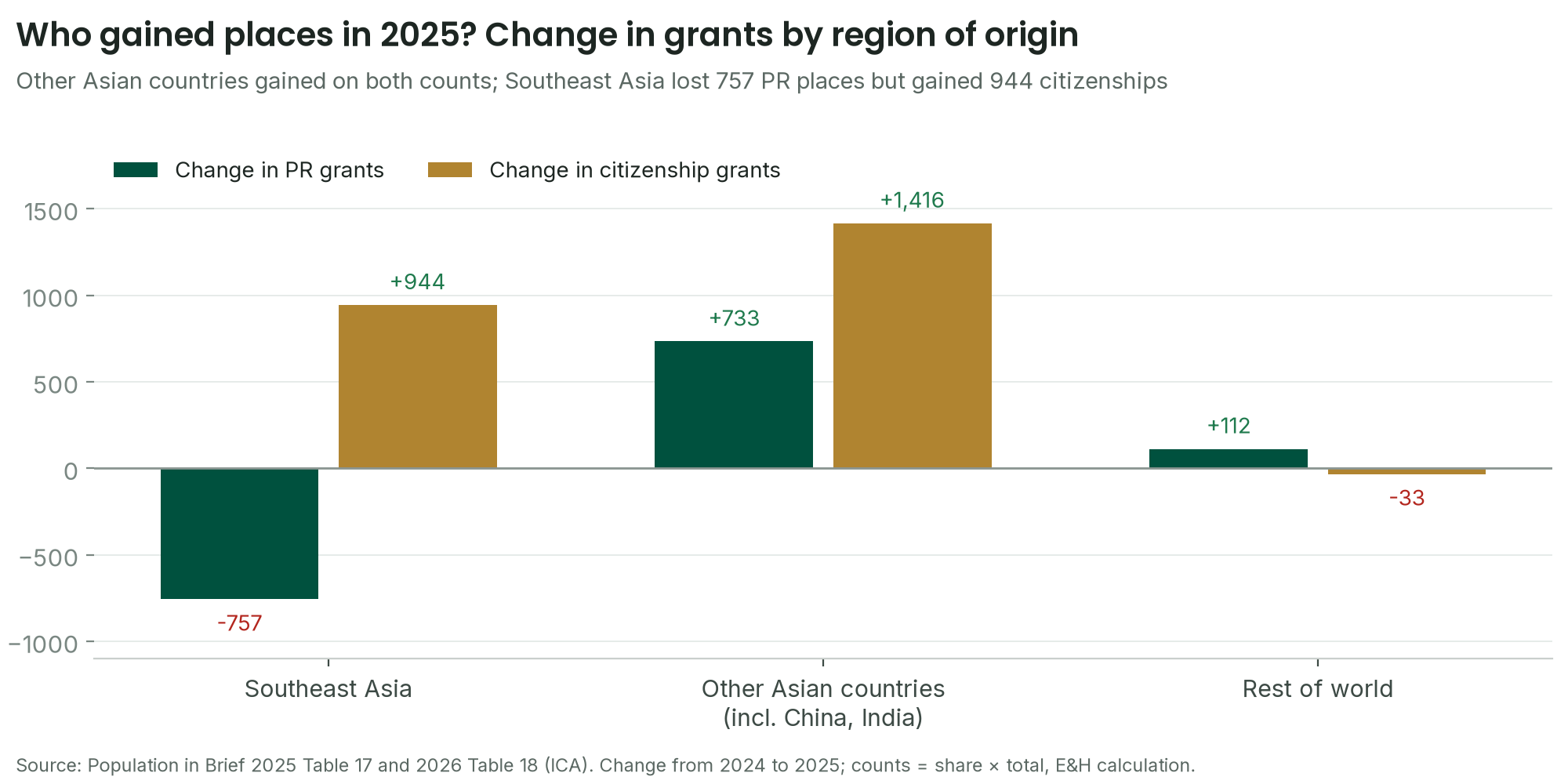
Other Asian countries include China, India, Hong Kong, Taiwan, Japan, South Korea and the rest of South Asia. The category records region of origin, not ethnicity, and is not a strict nationality classification.[1]
Other Asian countries were the clear gainers in 2025. The band’s share rose from 29.6% to 31.6% of PR grants and from 32.8% to 35.4% of citizenship grants.[1][2]
The change was a partial recovery rather than a boom. Other Asian PR grants reached 11,171 in 2025 but remained below the 12,348 granted in 2023.[1][3]
Southeast Asia remained the largest source region, with 61.6% of PR grants and 62.1% of citizenship grants in 2025.[1] Southeast Asia nevertheless received 757 fewer PR places than in 2024.[1][2]
The rest-of-world band received about 2,400 permanent residencies and about 630 citizenships in 2025.[1] Western and other non-Asian applicants therefore competed within a much smaller regional band.
Western PRs rarely go on to become citizens. In 2025 the rest-of-world band received 2,404 PR grants but only 627 citizenships, about 26 citizenships for every 100 PR grants.[1]
| Region of origin | PR grants 2025 | Citizenships 2025 | Citizenships per 100 PR grants |
|---|---|---|---|
| Other Asian countries | 11,171 | 8,883 | ~80 [1] |
| Southeast Asia | 21,777 | 15,583 | ~72 [1] |
| Rest of world | 2,404 | 627 | ~26 [1] |
Most people granted citizenship in 2025 became PRs in earlier years, so the ratio is only a rough guide. The gap is too large to be explained by timing alone.
Why the difference? For many Western PRs, citizenship is a much smaller step up than it is for Indian and Chinese PRs.
- Income at home. GDP per person in 2025 was about US$90,000 in the United States, US$65,000 in Australia and US$58,000 in the United Kingdom, close to Singapore’s US$99,000. China’s figure was about US$13,900 and India’s about US$2,700.[7]
- Passport strength. Singapore’s passport ranked first in the Henley Passport Index in January 2026, and the US and UK passports were also in the top 10. China’s passport ranked around 60th and India’s around 80th.[8]
- No dual citizenship. Singapore does not allow dual citizenship, so becoming a citizen means giving up your original nationality.[9] For an Indian or Chinese PR, that trade usually brings a large gain in mobility. For a US, UK or Australian PR, it means giving up a passport that is already one of the world’s strongest.
E&H Immigration sees this, rather than any rule against Western applicants, as the main reason Western conversion is low.
China and India convert the most. Other Asian countries made up 31.6% of new PRs but 35.4% of new citizens in 2025.[1] PRs from these countries are the most likely to follow through to citizenship, which fits the Government’s stated aim of admitting people who are "committed to making Singapore their home".[1]
What this means for you:
- Western applicants: Western PRs so rarely take up citizenship that a Western PR application should show clearly why you plan to stay for the long term. Evidence can include family here, children in local schools, property, years of residence and community ties.
- Indian and Chinese applicants: your group is the most likely to go on to citizenship. Make that long-term intention visible in your PR application too.
Birth rates are reshaping Singapore’s ethnic mix, and immigration balances it rather than capping any group
Birth rates, not immigration, are the biggest force changing Singapore’s ethnic mix. Immigration is used to balance it, not to cap any one group, and Indian and Others citizens have grown fastest. ICA does not publish grants by ethnicity, so the group-level figures below are E&H Immigration estimates built from official population data.[1][4] CMIO means Chinese, Malay, Indian and Others. The following table compares resident counts from the Department of Statistics Singapore, or DOS, with citizen counts in Population in Brief. E&H Immigration calculates the estimated PR stock by subtracting citizens from residents.[1][4]
| Ethnic group | Residents 2024 | Residents 2026 | Two-year change | Citizens 2024 | Citizens 2026 | Two-year change | Estimated PRs 2024 | Estimated PRs 2026 | Two-year change |
|---|---|---|---|---|---|---|---|---|---|
| Chinese | 3,093,412 | 3,126,446 | +1.1% (+33,034) |
2,748,600 | 2,778,600 | +1.1% (+30,000) |
~344,800 | ~347,800 | +3,000 [1][4] |
| Malays | 565,405 | 572,788 | +1.3% (+7,383) |
549,100 | 556,000 | +1.3% (+6,900) |
~16,300 | ~16,800 | +500 [1][4] |
| Indians | 377,973 | 381,873 | +1.0% (+3,900) |
274,800 | 282,200 | +2.7% (+7,400) |
~103,200 | ~99,700 | −3,500 [1][4] |
| Others | 144,078 | 150,417 | +4.4% (+6,339) |
63,400 | 68,000 | +7.3% (+4,600) |
~80,700 | ~82,400 | +1,700 [1][4] |
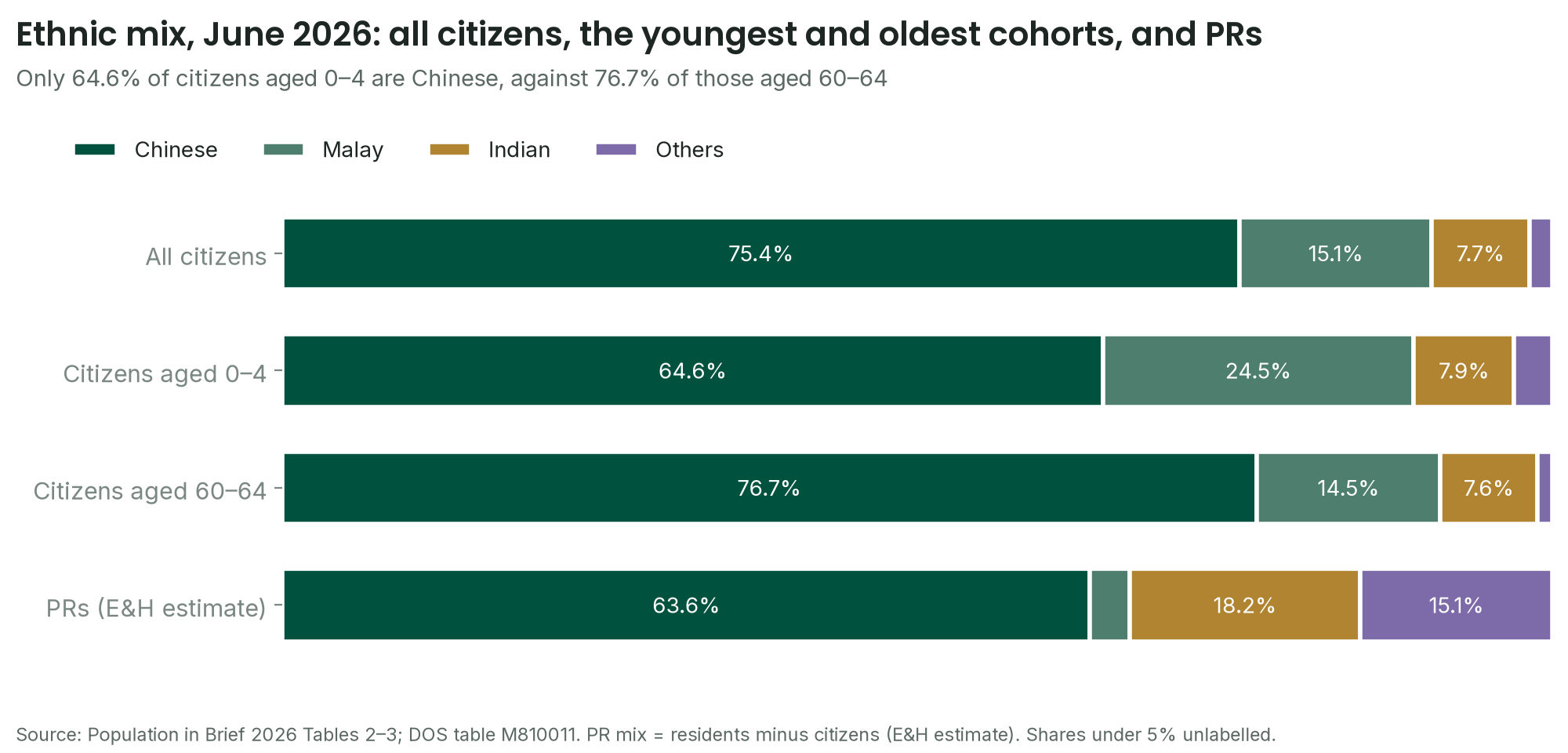
The estimates reproduce the published total PR population within about 150 people.[1][4] Estimated PR stock shares in June 2026 were 63.6% Chinese, 3.1% Malay, 18.2% Indian and 15.1% Others, compared with 63.3%, 3.0%, 18.9% and 14.8% in June 2024.[1][4]
Singapore’s citizen population changed from 76.1% Chinese, 15.0% Malay, 7.4% Indian and 1.5% Others in 2016 to 75.4% Chinese, 15.1% Malay, 7.7% Indian and 1.8% Others in 2026.[1] Deputy Prime Minister Gan Kim Yong said the Government would maintain the broad ethnic balance of the citizen population and carefully manage immigration’s effect on population composition.[6]
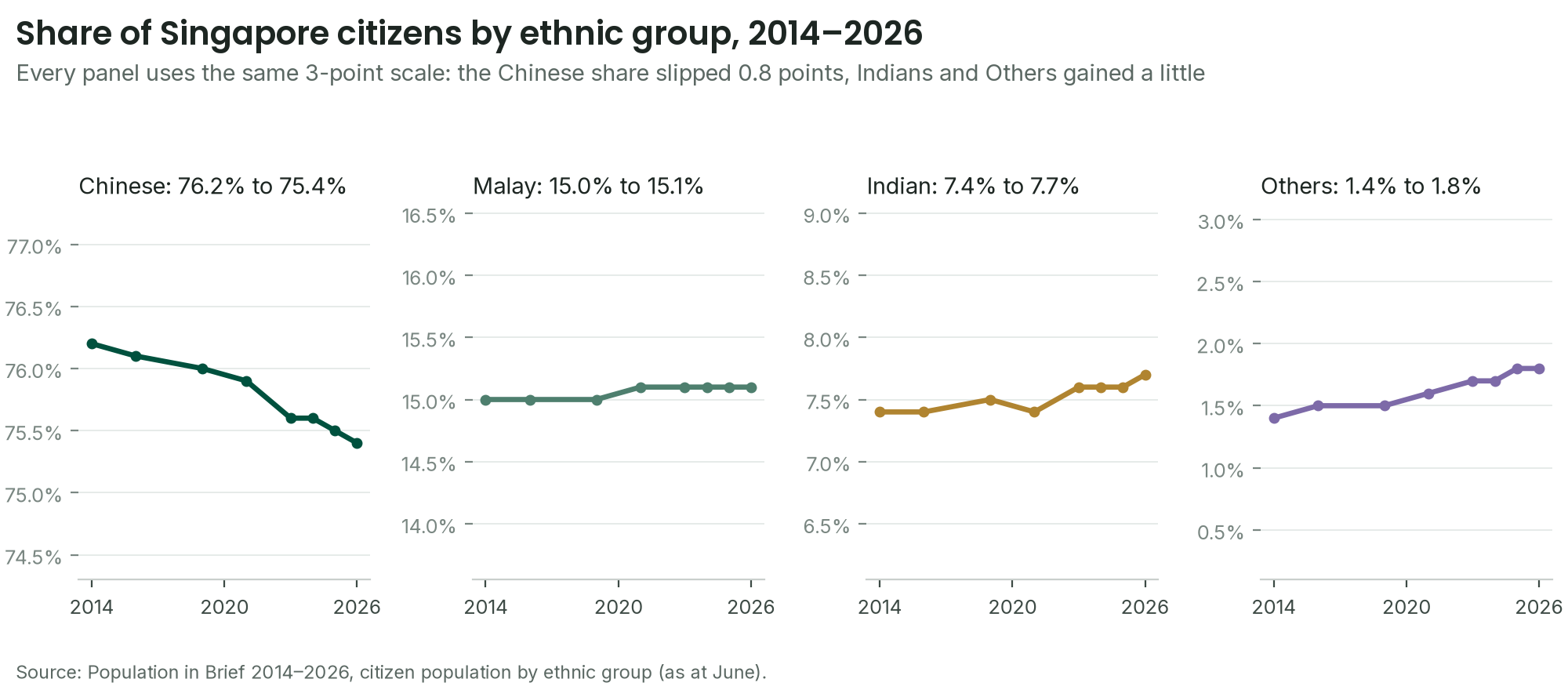
Chinese applicants: Chinese citizens recorded the largest absolute increase, gaining 30,000 over two years.[1] The Chinese share of citizens still slipped from 76.1% in 2016 to 75.4% in 2026, mainly because the Chinese resident fertility rate was only 0.70 in 2025.[1] The PR population is about 63.6% Chinese, below the 75.4% citizen average and close to the 64.6% among the youngest citizens, so immigration does not reverse this slide.[1][4] Chinese applicants, including ethnic Chinese Malaysians, remain by far the largest group in the PR pool.
Malay applicants: Malay citizens increased by 6,900 over two years, while the estimated Malay PR stock increased by about 500.[1][4] The Malay resident total fertility rate was 1.53 in 2025, compared with 0.87 for all residents.[1] E&H Immigration reads the results as less immigration-driven than the other groups, but ICA does not publish ethnic grant flows.
Indian applicants: Indian citizens increased by 7,400, or 2.7%, from 2024 to 2026, while the estimated ethnic Indian PR stock fell by about 3,500.[1][4] The Indian share of citizens also rose from 7.4% in 2016 to 7.7% in 2026.[1] E&H Immigration infers that Indian PRs were converting to citizenship faster than new ethnic Indian PRs were entering the stock. The data are encouraging for Indian PRs considering citizenship, but the data also indicate a tight PR stage.
Applicants classified as Others: Residents classified as Others increased by 4.4%, and citizens classified as Others increased by 7.3%, over two years.[1][4] The group’s citizen share rose from 1.5% in 2016 to 1.8% in 2026.[1] The classification includes many Asian-origin communities, such as Filipino, Eurasian, Japanese, Korean and Arab residents. The classification should not be treated as another name for Western applicants.
The youngest citizens show why. Only 64.6% of citizens aged 0–4 are Chinese, against 76.7% of those aged 60–64, because Chinese fertility (0.70) is less than half the Malay rate (1.53).[1] Immigration works as a balancing tool rather than a quota. The PR population is about 18% Indian and 15% Others but only 3% Malay, which is why the Indian and Others shares of citizens are rising slowly while the Malay share stays flat.[1][4]
What this means for you:
- The Government manages the overall balance, not a quota for each race. It has said it will keep the broad ethnic balance of citizens stable.[6] The data show this is done by offsetting birth-rate differences over time.
- Indian and Others applicants: your groups’ shares of citizens have been allowed to rise, so the data give no sign of a hard ceiling. Indian PRs have been converting to citizenship faster than new ones arrive, which is good news at the citizenship stage and a sign of a tight entry stage.
- Chinese applicants: you remain the largest group of PRs, and nothing in the data points to a squeeze.
- Malay applicants: Malay citizen numbers grow mainly through births, so relatively few Malay applicants enter through immigration.
Malaysians likely win the most PR places: our estimates for your nationality
ICA does not publish grants by nationality, so no one can tell you exactly how many Malaysians, Chinese or Indians received PR. Using Census data as a guide, Malaysians most likely took the largest share, at roughly 15,900 to 19,400 PR grants in 2025.[1][5] E&H Immigration uses the country-of-birth mix of foreign-born residents in the 2020 Census as a proxy for dividing the regional grant bands.[5] Place of birth is not nationality. A resident stock built over decades is not the same as one year’s grant flow. The following ranges are illustrations, not estimates of actual grants.
| Origin | 2025 regional PR band | Proxy share | Illustrative annual PR range at 2025 levels | Illustrative annual PR range at a 40,000 target |
|---|---|---|---|---|
| Malaysia | Southeast Asia: 21,777 | 73%–89% | ~15,900–19,400 | ~18,000–22,000 [1][5][6] |
| Indonesia | Southeast Asia: 21,777 | 9%–11% | ~1,900–2,400 | ~2,200–2,700 [1][5][6] |
| Philippines, Vietnam, Myanmar, Thailand and others | Southeast Asia: 21,777 | 0%–18% | 0–~3,900 | Not separately illustrated [1][5] |
| Mainland China | Other Asia: 11,171 | 43%–60% | ~4,800–6,700 | ~5,400–7,600 [1][5][6] |
| India | Other Asia: 11,171 | 28%–40% | ~3,200–4,450 | ~3,600–5,000 [1][5][6] |
| Europe | Rest of world: 2,404 | 46% | ~1,100 | ~1,250 [1][5][6] |
| United States and Canada | Rest of world: 2,404 | 24% | ~570 | ~640 [1][5][6] |
| Australia and New Zealand | Rest of world: 2,404 | 16% | ~390 | ~440 [1][5][6] |
The 40,000 scenario scales the 2025 regional mix proportionately to about 24,640 grants from Southeast Asia, 12,640 from Other Asia and 2,720 from the rest of the world.[1][6] Actual policy may produce a different regional distribution.
Malaysians: Malaysians have the largest established foreign-born resident base. The 2020 Census recorded 459,732 foreign-born residents born in Malaysia, including 415,594 ethnic Chinese residents.[5] The illustration produces roughly 15,900–19,400 Malaysian-born PR grants at 2025 intake levels and 18,000–22,000 at a 40,000 total.[1][5][6]
Chinese nationals: Mainland China sits within the Other Asian regional band, which gained 733 PR places and 1,416 citizenship places in 2025.[1] The illustrative range is about 4,800–6,700 PR grants at 2025 levels and about 5,400–7,600 at a 40,000 total.[1][5][6] The range does not establish the number of grants to Chinese nationals.
Indian nationals: India also sits within the Other Asian band. The illustrative range is about 3,200–4,450 PR grants at 2025 levels and about 3,600–5,000 at a 40,000 total.[1][5][6] E&H Immigration’s separate Indian-national analysis explains the wider ethnic-Indian method, including Malaysian and other ethnic Indian residents.
Indonesians, Filipinos and other Southeast Asians: Indonesian-born applicants have an illustrative range of about 1,900–2,400 PR grants at 2025 levels.[1][5] The available Census category combines the Philippines, Vietnam, Myanmar, Thailand and other places across Southeast and non-Southeast Asia, so a reliable country-level split cannot be produced.[5]
Western expatriates: Europe, the United States, Canada, Australia and New Zealand together form most of the small rest-of-world band in this proxy method.[5] The illustrations produce about 1,100 grants for Europe, 570 for the United States and Canada, and 390 for Australia and New Zealand at 2025 levels.[1][5] The equivalent combined citizenship illustration for these Western regions is about 540 in 2025.[1][5]
Citizenship illustrations using the same method are about 11,400–13,900 for Malaysia, 3,800–5,300 for Mainland China and 2,500–3,500 for India.[1][5] These figures remain proxy illustrations rather than published grant counts.
More than one in five citizens is now 65 or older, which is why Singapore is opening the door wider
21.4% of citizens are now 65 or older, and the fertility rate fell to a record low of 0.87 in 2025. That is the main reason Singapore is raising intake, and why younger applicants and families fit what the country needs.[1]
The median age of citizens rose from 43.4 in 2024 to 43.7 in 2025 and 44.1 in 2026.[1][2][3] The resident median age rose from 42.8 to 43.2 and then 43.6 over the same period.[1][2][3]
Citizens aged 65 or older increased from 19.9% in 2024 to 20.7% in 2025 and 21.4% in 2026.[1][2][3] A population with at least 21% aged 65 or older is commonly described as super-aged, so Singapore’s citizen population has crossed that threshold.[1]
The share of citizens aged 65 or older is projected to reach 24.0% in 2030 and 26.1% in 2035.[1] Citizens aged 80 or older increased from 142,000 in 2024 to 145,000 in 2025 and 152,000 in 2026.[1][2][3]
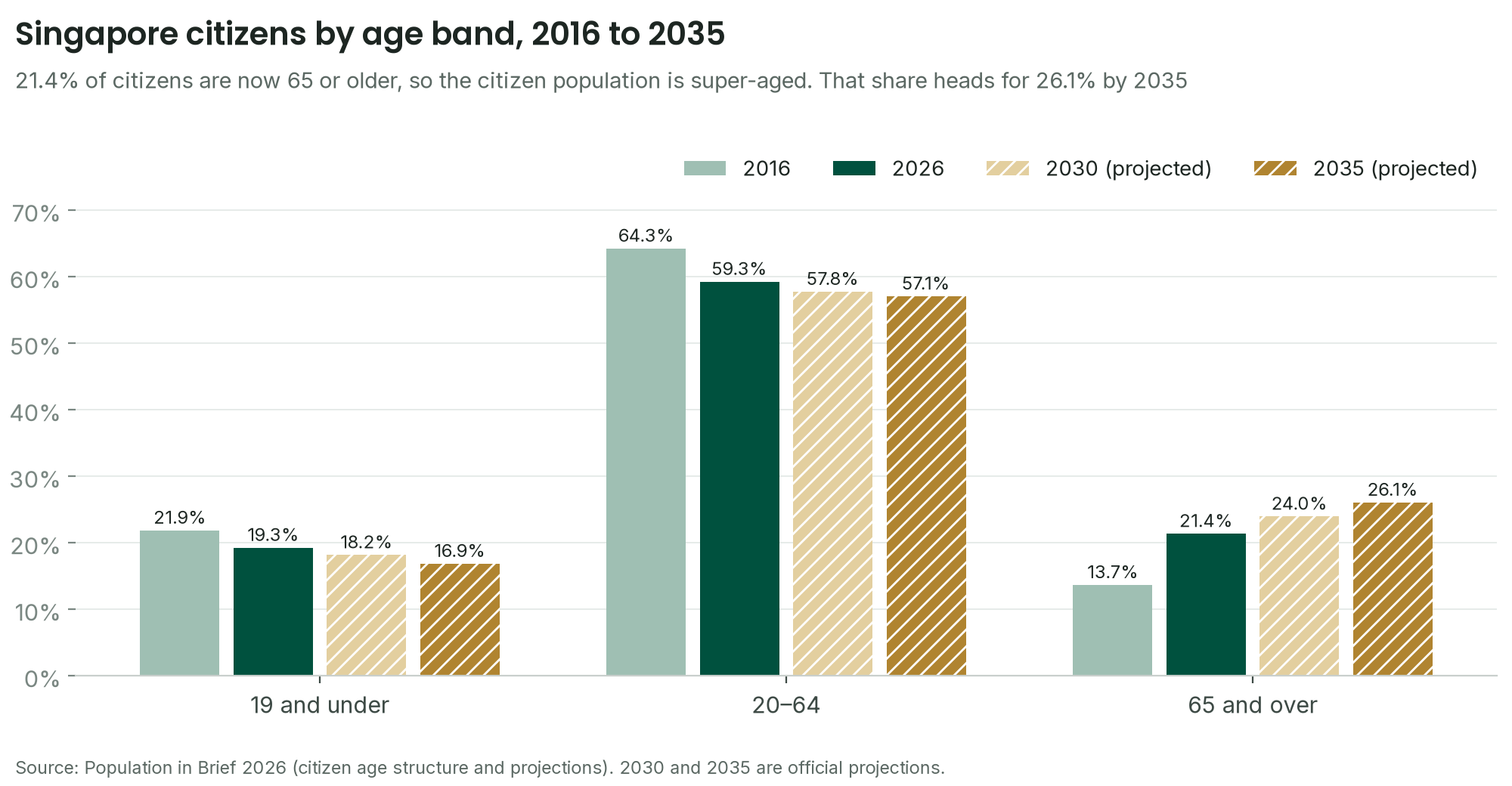
The citizen old-age support ratio measures people aged 20–64 for each person aged 65 or older. The ratio fell from 3.0 in 2024 to 2.9 in 2025 and 2.8 in 2026, and it is projected to fall to 2.4 in 2030 and 2.2 in 2035.[1][2][3] The resident ratio uses a different population base and stood at 3.2 in 2026.[1]
The resident total fertility rate, or TFR, fell from 0.97 in 2024 to 0.87 in 2025.[1][2] The Chinese TFR was 0.70, the Malay TFR was 1.53 and the Indian TFR was 0.92 in 2025.[1]
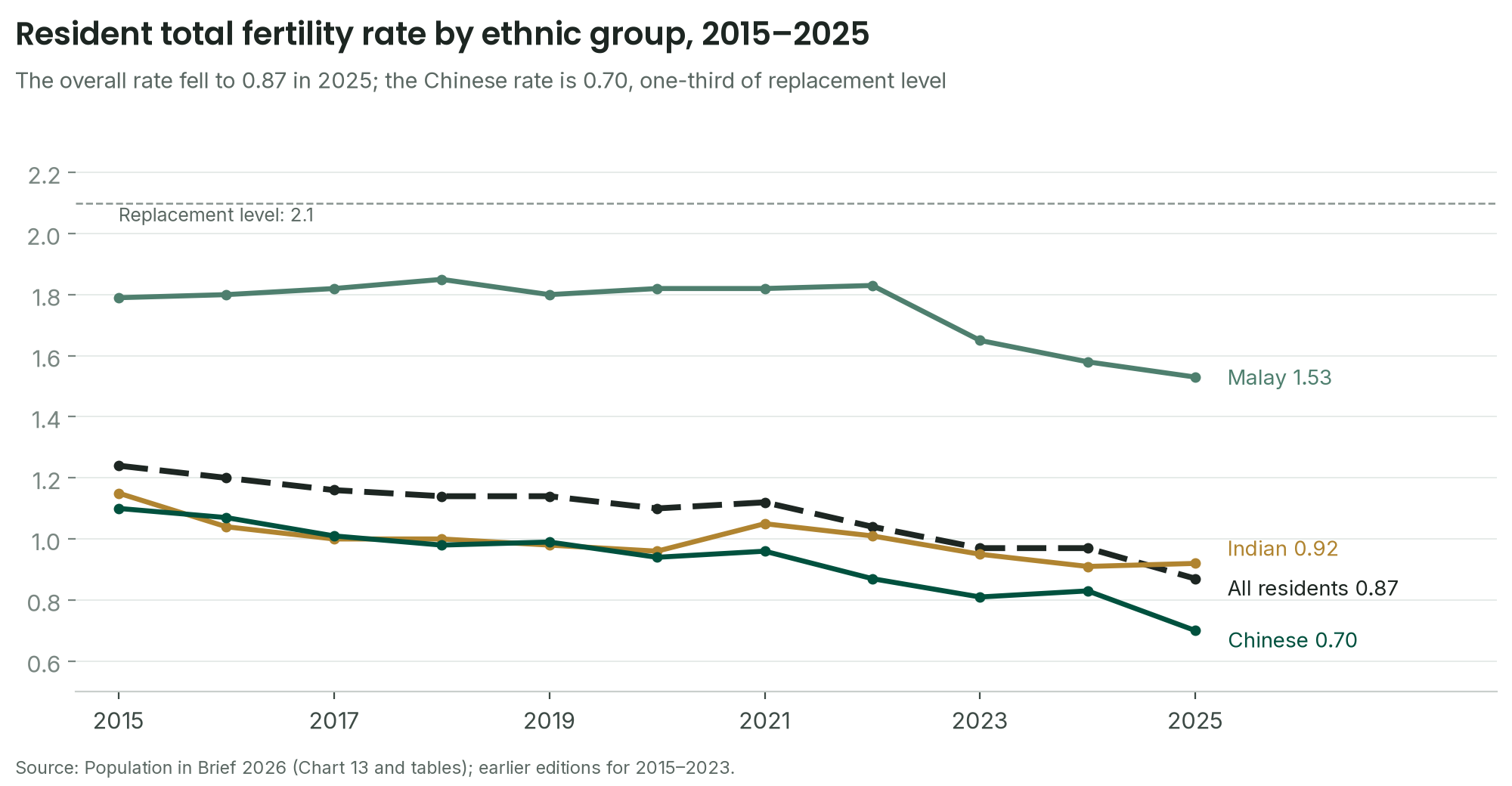
Population in Brief 2026 says the share of citizens aged 20–64 is expected to remain broadly stable between 2030 and 2035 because smaller cohorts will age past 64 while younger cohorts enter the working-age band, including through “managed immigration inflows”.[1] New permanent residents are concentrated between ages 25 and 59, which matches this demographic need.[1]
Almost half of citizen men aged 30 to 34 are single, so foreign spouses and their children are central to intake
Singlehood is rising and citizen marriages are falling, so foreign spouses and their children now make up a large part of Singapore’s families. In 2025, 37% of citizen marriages were to a non-citizen, which is why family applications are a normal route to PR.[1]
Never-married shares rose across several age groups between 2015 and 2025. Among citizens aged 25–29, the share rose from 82.6% to 86.4% for men and from 69.0% to 73.4% for women.[1] Among citizens aged 30–34, the share rose from 43.4% to 49.1% for men and from 31.4% to 35.6% for women.[1]
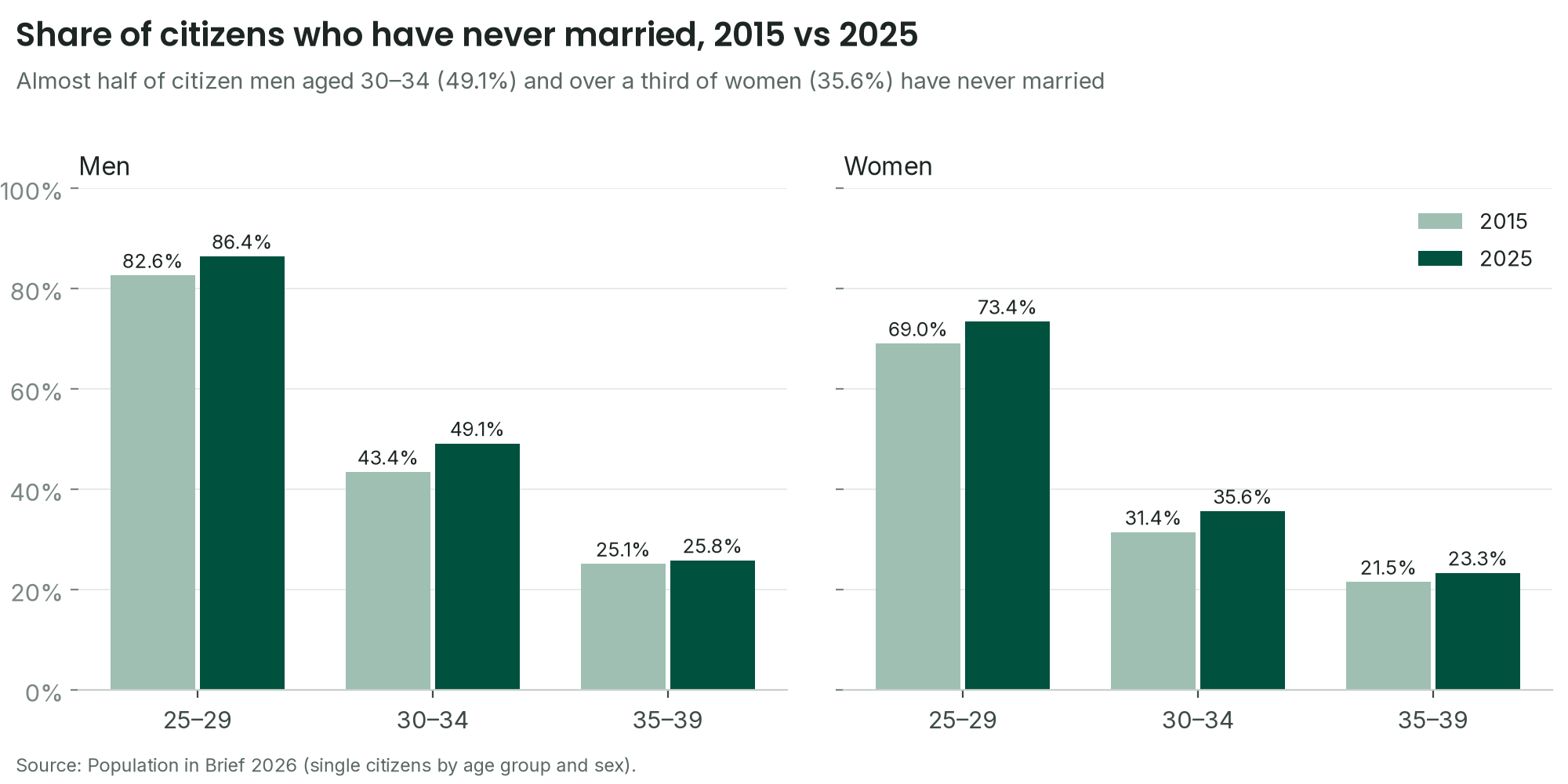
Citizen marriages fell from 24,355 in 2023 to 22,955 in 2024 and 21,671 in 2025.[1][2][3] The 2025 result was 5.6% below 2024.[1] Median age at first marriage was 30.8 for grooms and 29.1 for brides in 2025.[1]
Transnational marriages between a citizen and a non-citizen accounted for 37% of citizen marriages in both 2024 and 2025, up from 36% in 2023.[1][2][3] Singapore recorded 7,931 citizen–non-citizen marriages in 2025.[1]
Singapore had 176,900 citizens married to non-citizen spouses as at June 2023.[3] More than one in four citizen births in 2023 were to citizen–non-citizen couples.[3]
Citizen births were 28,877 in 2023 and 29,237 in 2024, then fell to 26,071 in 2025.[1][2][3] The 2025 total was 10.8% below 2024.[1] Among ever-married citizen women aged 30–39, 28.4% had no children in 2025.[1]
Children are already central to immigration intake. People aged 20 or under received 24.5% of new permanent residencies and 28.3% of citizenships in 2025.[1] The pattern shows that family applications are a normal part of Singapore’s grant profile rather than a marginal category.
Families move through the system together. Children aged 20 or under received 24.5% of new PRs but a larger 28.3% of new citizenships in 2025.[1] E&H Immigration reads this as parents bringing their children with them at each stage, first to PR and later to citizenship. Applying as a family is normal at both stages, and the official report notes that many new citizens and PRs have family ties with Singaporeans.[1]
Seven moves that strengthen a PR or citizenship application in 2026
You cannot control the intake numbers, but you can control the strength of your file. Show long-term contribution, integration, commitment and family stability. If you are younger, avoid unnecessary delay, although age alone does not decide an application.[1]
- Apply before 40 where practical. Over-40 applicants received 10.9% of PR grants in 2025, down from 12.5% in 2023.[1][3] E&H Immigration reads this as evidence of a tighter age profile, not a formal Singapore PR age limit.
- Include the family where the facts support a family application. Children received about one in four PR grants in 2025, and the official report says many new citizens and permanent residents have family ties with Singaporeans.[1]
- Document a genuine Singapore history. Population in Brief 2026 says many recipients have studied, worked or lived in Singapore for some time.[1] Applicants should support length of stay, education, employment and community connections with consistent records.
- Show contribution and integration together. Singapore says it grants citizenship and permanent residence to “assimilable individuals who can contribute to Singapore, integrate well, and are committed to making Singapore their home”.[1] The word “assimilable” did not appear in Population in Brief 2024 or 2025, making it a notable addition in the 2026 wording.[1][2][3]
- Treat a foreign-spouse application as a family case. Transnational marriages represented 37% of citizen marriages in 2025, and Singapore recorded 7,931 citizen–non-citizen marriages that year.[1] Marriage supports the family connection, but marriage does not guarantee approval.
- Use nationality ranges only for context. ICA does not publish nationality-level grants, application counts or approval rates. Applicants should not treat proxy ranges or advertised approval percentages as personal odds.
- Prepare separately for the citizenship stage. Citizenship recipients have a different age profile from new permanent residents, and all new adult citizens come from the PR pool.[1] Existing PRs should present their record since obtaining PR rather than repeat the earlier PR application.
What this data can and cannot tell you about your own chances
Population in Brief 2026 shows the direction of Singapore’s population policy, but it does not reveal any individual applicant’s approval probability.
ICA does not publish PR or citizenship application counts, approval rates, grants by nationality, grants by ethnicity or grants by marital status. Regional grant data, population composition and resident-stock changes can reveal broad patterns, but they cannot prove that a particular group receives a fixed allocation.
E&H Immigration labels calculations as estimates or illustrations wherever official sources do not publish the requested breakdown. Population-stock calculations combine official citizen and resident counts, while nationality illustrations use place of birth as a proxy.[1][4][5]
No official PR or citizenship quota by ethnicity or nationality is published. The Government has stated that it will maintain the broad ethnic balance of the citizen population, but that policy statement is not a published quota table.[6]
Approval is not guaranteed. Every application depends on the applicant’s complete circumstances and ICA’s assessment at the time of decision.
Read next: related E&H Immigration guides
The related guides explain ethnic balance, nationality-specific patterns, intake targets, eligibility and the move from PR to citizenship.
- Is there an ethnic quota for PR and citizenship in Singapore?
- Singapore PR for Indian nationals: approval odds and strategy for 2026
- Singapore PR for Western expats
- What Minister Gan’s 2026 population speech means for PR and citizenship applicants
- The Singapore PR approval-rate myth
- PR requirements in Singapore for 2026
- Singapore citizenship requirements: the complete ICA eligibility guide
The official sources behind these numbers
E&H Immigration based this analysis on Population in Brief 2024–2026, official Department of Statistics tables and Deputy Prime Minister Gan Kim Yong’s 2026 speech.
Population in Brief 2026 supplies the latest population, grant, age, origin, education, marriage, birth and fertility figures.[1] Population in Brief 2025 and Population in Brief 2024 provide the comparable earlier-year data and explain the change in citizenship reporting.[2][3]
Department of Statistics table M810011 supplies resident counts by age, ethnic group and sex.[4] Census of Population 2020 table 17402 supplies foreign-born resident counts by place of birth and ethnic group.[5]
Deputy Prime Minister Gan Kim Yong’s Committee of Supply Debate 2026 speech supplies the five-year intake guidance and the statement about maintaining Singapore’s broad citizen ethnic balance.[6]
The World Bank’s GDP per capita series supplies the 2025 income comparison.[7] The Henley Passport Index for January 2026 supplies the passport rankings.[8] The Immigration & Checkpoints Authority confirms that Singapore does not allow dual citizenship.[9]
Get a data-led review of your 2026 application
Planning a Singapore PR or citizenship application? E&H Immigration can review your age, family profile, Singapore history, career evidence and integration record against the latest population-policy signals. A data-led review can identify weak evidence and unrealistic assumptions before submission.
This article provides general information, not legal advice or a promise of approval. ICA assesses every application individually, and processing times and outcomes vary.
Not sure where you stand?
Get a personalised assessment of your Singapore PR, citizenship, or work pass options from E&H Immigration’s specialists.
What are the frequently asked questions about Population in Brief 2026?
How many PRs did Singapore grant in 2025?
Singapore granted 35,352 new permanent residencies in 2025, up 0.2% from 35,264 in 2024.[1]
How many new citizens did Singapore approve in 2025?
Singapore granted 25,094 citizenships excluding citizenship by descent in 2025, an increase of 10.2% from 2024.[1] Singapore separately granted citizenship by descent to 1,646 children born overseas to Singaporean parents.[1]
Is there a Singapore PR quota by nationality?
No published Singapore PR quota by nationality exists. ICA releases grant data by broad region of origin but does not publish nationality-level grant or approval figures.[1]
Is there a Singapore PR ethnic quota in 2026?
No official ethnic quota table is published. The Government says it will maintain the broad ethnic balance of the citizen population, while ICA does not publish PR or citizenship grants by ethnicity.[6]
Is it harder to get Singapore PR after 40?
Applicants over 40 received a smaller share of PR grants in each year from 2023 to 2025, falling from 12.5% and 4,311 grants to 10.9% and 3,853 grants.[1][3] The figures indicate a tighter age profile, but Singapore has no published general PR age limit. Age matters much less at the citizenship stage: people over 40 received 26.7% of new citizenships in 2025.[1]
Which nationalities get the most Singapore PRs?
ICA does not publish PR grants by nationality. Southeast Asian origins received 61.6% of PR grants in 2025, but exact figures for Malaysians, Indonesians, Filipinos or other nationalities are unavailable.[1]
Will Singapore grant more PRs from 2026 onward?
Singapore expects to grant about 40,000 permanent residencies annually over the next five years, compared with 35,352 in 2025.[1][6] The target is about 13% above the 2025 intake.[1][6]
Who gets Singapore PR under the latest data?
Applicants aged 21–40 received 64.7% of PR grants in 2025, children aged 20 or under received 24.5%, and 84.7% of adult recipients had post-secondary education or higher.[1] ICA still assesses complete individual and family circumstances, and approval is not guaranteed.
What do the 2026 CMIO population figures suggest about Chinese, Malay, Indian and Others applicants?
The citizen mix barely moved in ten years: 75.4% Chinese, 15.1% Malay, 7.7% Indian and 1.8% Others in June 2026.[1] Birth rates are the biggest force changing the mix: only 64.6% of citizens aged 0–4 are Chinese, because Chinese fertility (0.70) is less than half the Malay rate (1.53).[1] Immigration balances this rather than capping any group. The PR population is about 18% Indian and 15% Others but only 3% Malay, so the Indian and Others citizen shares are rising slowly while the Malay share stays flat.[1][4] ICA does not publish grants by ethnicity, so these are population-level patterns, not approval odds.
What does Population in Brief 2026 mean for Malaysian, Chinese, Indian, Indonesian, Filipino and Western applicants?
ICA publishes grants only by region. Southeast Asia took 61.6% of new PRs in 2025, Other Asian countries 31.6% and the rest of the world 6.8%.[1] Using the 2020 Census country-of-birth mix as a proxy, E&H Immigration’s illustrative ranges are about 15,900–19,400 PRs a year for Malaysian-born applicants, 4,800–6,700 for Mainland China, 3,200–4,450 for India, 1,900–2,400 for Indonesia and about 2,100 combined for Europe, North America and Australia–New Zealand.[1][5] Filipinos cannot be split out from the Census category. The ranges are illustrations, not counts of actual grants.
Who got Singapore PR in 2025 by age, region and education?
Adults aged 21 to 40 received 64.7% of new PRs in 2025, children aged 20 or under received 24.5% and people over 40 received 10.9%.[1] By region of origin, 61.6% came from Southeast Asia, 31.6% from Other Asian countries and 6.8% from the rest of the world.[1] Among new PRs aged 20 or older, 84.7% had post-secondary education or higher.[1]
Which regions gained or lost Singapore PR and citizenship places in 2025?
Other Asian countries gained 733 PR places and 1,416 citizenships compared with 2024. Southeast Asia lost 757 PR places but gained 944 citizenships. The rest-of-world band gained 112 PR places and lost 33 citizenships.[1][2]
Why are ageing and falling births pushing Singapore’s immigration intake higher?
In June 2026, 21.4% of citizens were aged 65 or older, and the resident fertility rate fell to 0.87 in 2025.[1] Population in Brief 2026 says the working-age share will be held broadly steady partly through "managed immigration inflows".[1]
Why do marriage patterns, foreign spouses and children matter to Singapore immigration policy?
In 2025, 37% of citizen marriages, or 7,931 marriages, were between a citizen and a non-citizen.[1] Children aged 20 or under received 24.5% of new PRs and 28.3% of new citizenships, so family applications are a large part of the intake.[1]
Is now a good time to apply for Singapore citizenship?
For PRs who already meet the criteria, the signs are favourable. Citizenship grants rose 10.2% to 25,094 in 2025, and the Government’s target of 25,000 to 30,000 a year leaves room for up to about 4,900 more grants a year.[1][6] ICA assesses each case on its merits, so a rising intake does not guarantee approval.
Does Singapore allow dual citizenship?
No. Singapore does not allow dual citizenship, so new citizens must give up their previous nationality.[9]
Why do so few Western PRs become Singapore citizens?
In 2025 the rest-of-world band received about 26 citizenships for every 100 PR grants, against about 80 for Other Asian countries and 72 for Southeast Asia.[1] E&H Immigration’s reading is that citizenship is a smaller step up for Western PRs: incomes in the US, UK and Australia are close to Singapore’s, their passports already rank in the global top 10, and becoming a Singapore citizen means giving up that nationality.[7][8][9]
What should Singapore PR and citizenship applicants do in 2026?
Apply with a file that shows contribution, integration, commitment and family stability. Apply before 40 where that is practical, include family members where the facts support it, and document your Singapore history consistently. Do not treat nationality estimates or advertised approval rates as your personal odds.
Sources & References
- Population in Brief 2026 — National Population and Talent Division, Strategy Group, Prime Minister’s Office
- Population in Brief 2025 — National Population and Talent Division, Strategy Group, Prime Minister’s Office
- Population in Brief 2024 — National Population and Talent Division, Strategy Group, Prime Minister’s Office
- Singapore Residents by Age Group, Ethnic Group and Sex (End June), M810011 — Department of Statistics Singapore
- Census of Population 2020: Resident Population by Place of Birth, Ethnic Group and Sex, Table 17402 — Department of Statistics Singapore
- Speech by Deputy Prime Minister Gan Kim Yong at Committee of Supply Debate 2026 — National Population and Talent Division
- GDP per capita (current US$), NY.GDP.PCAP.CD — World Bank
- Henley Passport Index, January 2026 — Henley & Partners
- ICA response on dual citizenship (The Straits Times, 12 Feb 2013) — Immigration & Checkpoints Authority