
An Older, Smaller Singapore: Why Work Passes and PR Will Remain Essential
Singapore is ageing and households are shrinking. The result is continued immigration need, but more selective work pass and PR standards.
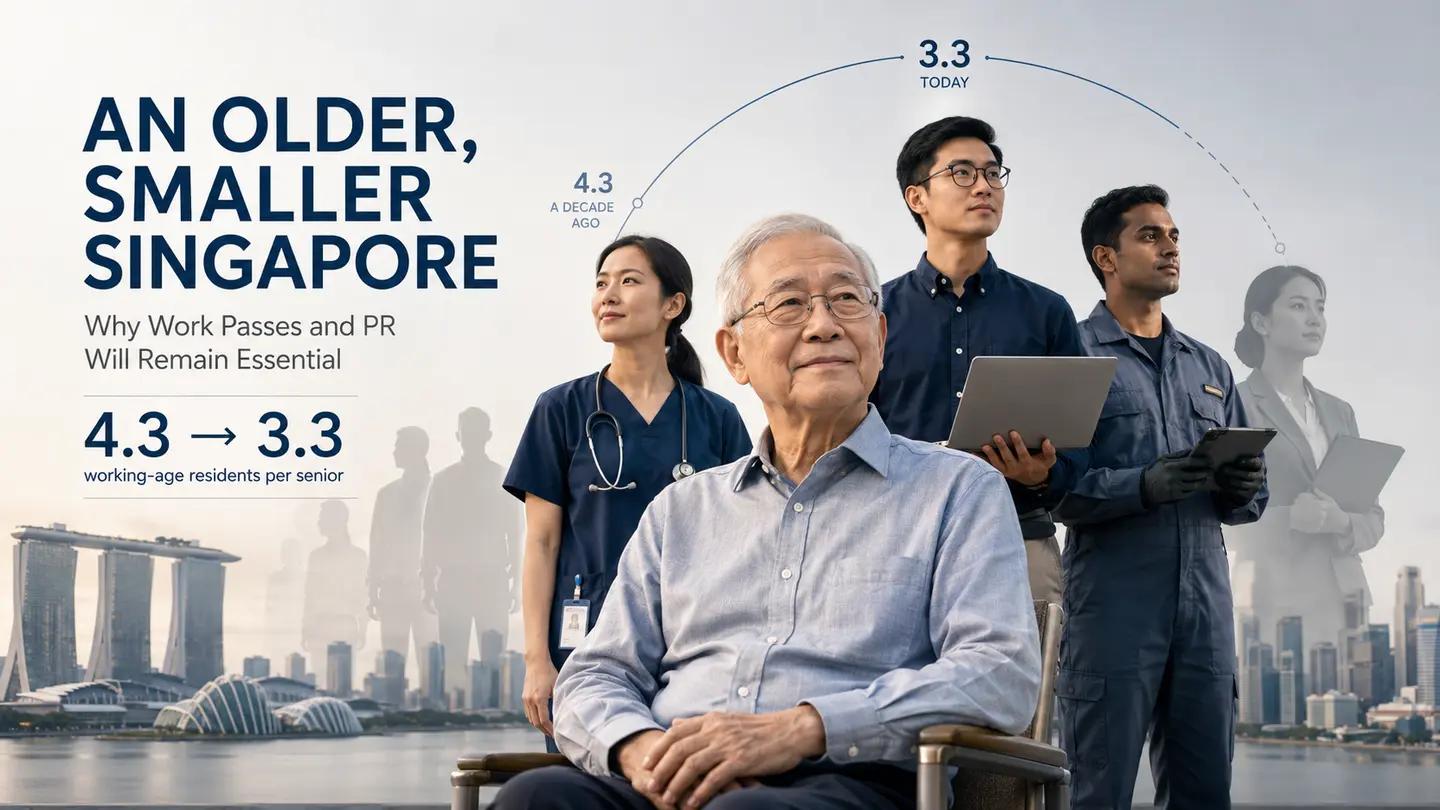
Singapore expects to grant around 40,000 permanent residencies annually over the next five years, up from approximately 35,000 in 2025. Yet Employment Pass salary thresholds will rise again,COMPASS scoring will remain in force, and selection standards show no sign of loosening.
This is not a contradiction. It is the logical response to what Singapore's newest population data reveals.
Quick summary
What this article says in plain English
The General Household Survey 2025, released by the Department of Statistics on 30 June 2026, shows a resident population that is ageing rapidly, forming smaller households and having fewer children - while also becoming markedly better educated and more affluent. The first set of trends explains why Singapore needs continuedimmigration through work passes and long-term settlement pathways. The second explains why that immigration will become more selective, not easier.
Between 2020 and 2025, Singapore's resident population grew from approximately 4.04 million to 4.20 million. Over the same period, the median age rose from 41.5 to 43.2 years, and the proportion of residents aged 65 and above increased from 15.2% to 18.8%.
Singapore's demographic pressure, in one number
The most telling figure in the survey is the old-age support ratio - the number of residents aged 20 to 64 for every resident aged 65 or older. It fell from 4.3 in 2020 to 3.3 in 2025: a decline of roughly 23% in just five years.
Source: DOS General Household Survey 2025
Importantly, this is happening even though residents are working more, not less. The proportion of married couples where both spouses were employed rose from 52.5% to 56.6%, and among married couples aged 65 and above, the share with at least one working spouse increased from 50.6% to 55.4%.
Singapore's continued need for foreign manpower therefore does not arise because residents are withdrawing from work. The local workforce is already being drawn on deeply - and the support ratio is still falling.
Smaller families mean fewer future workers
The ageing trend is being reinforced by changes in family formation. Among ever-married resident women aged 40 to 49, the average number of children born declined from 1.76 to 1.67. Singlehood rose among younger residents: among women aged 25 to 29, from 69.0% to 73.4%; among men aged 30 to 34, from 41.9% to 47.6%.
Down 0.09
Up 4.4 pts
Up 5.7 pts
Source: DOS General Household Survey 2025
These figures are not Singapore's annual total fertility rate, but they point in the same direction: smaller families today will produce smaller cohorts of workers two decades from now. A child not born this year cannot be recruited in 2046 - which is why immigration planning operates over decades, not economic cycles.
Permanent residents are already part of Singapore's resident core
Of Singapore's 4.20 million residents in 2025, approximately 540,000 - roughly one in eight - were permanent residents.PR is therefore not a marginal programme sitting outside Singapore's population strategy.
Source: DOS General Household Survey 2025; MOM foreign workforce data, Dec 2025
As at December 2025, Singapore's foreign workforce comprised approximately 203,300 Employment Pass holders, 178,900 S Pass holders and 1,222,700 Work Permit holders, with the remaining 35,100 in other pass categories. EP and S Pass professionals represent under a quarter of the total. An ageing Singapore needs biomedical researchers, but it equally needs the workers who build hospitals, staff nursing homes and provide domestic care.
Why 40,000 PRs a year is an expectation, not a quota
The Government's projected intake of around 40,000 PRs annually is explicitly conditional - adjusted according to demographic trends, applicant suitability, and Singapore's infrastructural and social capacity.
Source: DOS General Household Survey 2025
Between 2020 and 2025, the resident population grew by about 4%, but the number of resident households grew by more than 8% as average household size fell from 3.2 to 3.1 people. When households shrink, demand for homes, schools and infrastructure rises faster than population numbers alone suggest.
Why demographic need won't make Employment Passes easier
If Singapore needs workers, why do EP requirements keep rising? Because Singapore is not trying to maximise foreign worker numbers. It is trying to admit workers who complement an increasingly qualified local workforce.
Among residents aged 25 and above, the proportion with post-secondary or higher qualifications rose from 58.3% to 64.8%. The largest gains were not among fresh graduates but among mid-career residents: for those aged 45 to 54, the proportion jumped from 64.8% to 78.2% in five years.
Source: DOS General Household Survey 2025
Foreign professionals are therefore not competing only with young Singaporean graduates. The experienced local talent pool is also becoming substantially better qualified, which is precisely why a generic degree and a salary slightly above the minimum no longer differentiate a candidate.
The EP minimum is an entry floor, not a competitiveness benchmark
Most EP applications must pass two stages: an age-adjusted qualifying salary, then at least 40 points under COMPASS. The headline S$5,600 minimum applies only to candidates aged 23 and below in non-financial services. From 1 January 2027, the base rises to S$6,000, reaching S$11,500 for the oldest bracket.
| Age | Current non-FS | From Jan 2027 non-FS |
|---|---|---|
| 23 and below | S$5,600 | S$6,000 |
| 30 | S$7,223 | S$7,750 |
| 35 | S$8,382 | S$9,000 |
| 40 | S$9,541 | S$10,250 |
| 45 and above | S$10,700 | S$11,500 |
Source: MOM EP qualifying salary schedules, current and from Jan 2027
Even after clearing this floor, a candidate can score zero COMPASS salary points. Under the C1 criterion, salaries below the 65th percentile of local PMET salaries in the same sector earn no points; the 65th to 90th percentile earns 10; at or above the 90th earns 20. If you want to sanity-check market positioning rather than only the published floor, compare against our EP salary benchmarks.
Source: MOM COMPASS C1 salary scoring framework
The correct reading of the survey is therefore: Singapore will continue to need foreign talent, but the strongest demand will be for scarce skills, appropriate seniority, properly benchmarked salaries and genuine complementarity with the local workforce.
Wondering how your profile measures up?
E&H Immigration benchmarks your salary, COMPASS score and PR readiness against what Singapore actually expects today — then builds a plan to close the gaps.
Healthcare: where local supply and foreign recruitment must work together
No sector illustrates the survey's implications better than healthcare. Singapore is investing heavily in its domestic pipeline, but the scale of demand exceeds what local graduates alone can supply.
MOH projects the healthcare workforce will grow from 129,000 in 2024 to approximately 156,000 by 2030, with around 13,600 additional beds planned - including 10,600 nursing-home beds. MOH has estimated that roughly 6,000 nurses, allied health professionals and support-care staff must be recruited annually; by comparison, Singapore produced 2,166 nursing graduates and 376 allied-health graduates in 2024.
Local graduates fill about 42%. The remainder must come from mid-career conversion, retention and foreign recruitment.
Source: MOH healthcare workforce and graduate pipeline data, 2026
| Healthcare occupation | Main registration or qualification requirement |
|---|---|
| Registered nurse | Singapore Nursing Board registration |
| Physiotherapist | Allied Health Professions Council registration |
| Occupational therapist | Allied Health Professions Council registration |
| Diagnostic radiographer | Allied Health Professions Council registration |
| Clinical psychologist | Master's qualification plus MOH-recognised pathway |
| Medical social worker | Relevant social-work degree and employer requirements |
| Podiatrist | Podiatry degree and employer requirements |
Source: MOM Shortage Occupation List effective Jan 2026
Healthcare shows PR functioning not just as a population tool but as a workforce-anchoring tool. It also shows the model in miniature: build the local core, recruit foreigners for genuine shortages, and anchor the most valuable contributors long-term. No occupation, however, provides an automatic pathway.
PR selection will remain targeted
The expected rise in PR grants should not be read as relaxation. ICA assesses applicants on family ties to Singaporeans, economic contributions, qualifications, age, family profile, length of residence, ability to integrate and commitment to sinking roots. No salary level guarantees approval, and no number of years on an EP creates entitlement. For a deeper breakdown of how ICA tends to think about profile strength, see our guides to Singapore PR eligibility and what “adding value” means in practice.
- Married with children: 50.4% to 47.6%
- Married without children: 16.8% to 19.1%
- One-person: 16.0% to 16.7%
- Other households: remainder
Source: DOS General Household Survey 2025
Applicants should also not assume only traditional families succeed. Singapore's own household profile is diversifying. Married-couple-with-children households fell from 50.4% to 47.6% of all households, couples without children rose to 19.1%, and one- to three-person households now make up 63.1% of the total.
Dual-career families need a whole-household strategy
The rise of dual-career couples mirrors the profile of internationally mobile professionals themselves. Most families relocating to Singapore now involve two careers, not one.
A sound immigration plan therefore goes beyond the main applicant's pass: whether the spouse should hold an independent EP or S Pass, whether the main applicant earns enough to sponsor Dependant's Passes, application sequencing, children's schooling, and whether the family intends to pursue PR together. For many households this also overlaps with LTVP planning and, later, a shared PR strategy.
Singapore will remain open - on increasingly deliberate terms
The General Household Survey 2025 points to two conclusions. First, Singapore will continue to require foreign manpower. Its residents are older, its households smaller, its families having fewer children - and even with rising local workforce participation, the arithmetic does not close.
Second, need does not mean unrestricted entry. The same survey shows a local workforce that is better educated, more affluent and more fully employed than five years ago. Singapore's direction is managed, selective, contribution-focused immigration.
For foreign professionals and families, the opportunity is real. The task is to demonstrate not merely eligibility, but that your skills, salary, employer profile and long-term plans align with the country Singapore is becoming. If you want a fast sense check before making a move, start with our PR & Citizenship Chances Calculator and then compare this article with our wider 2026 to 2030 PR outlook.
Frequently asked questions
Will Singapore's ageing population make PR applications easier?
Not automatically. Singapore expects around 40,000 PR grants annually over the next five years, but actual intake depends on demographics, applicant suitability, infrastructure and social capacity.
Does meeting the minimum EP salary mean an application is strong?
No. The qualifying salary is only Stage 1. Most applicants must also score 40 COMPASS points, and a salary below the 65th percentile of local sector salaries earns zero salary points.
Are healthcare workers guaranteed work passes or PR?
No, but seven healthcare occupations are on the Shortage Occupation List. Registration, work-pass eligibility and PR assessment remain separate processes.
Why does Singapore need both work passes and PR?
Work passes meet immediate manpower needs. PR converts selected foreigners into long-term residents - a group that already makes up roughly one in eight of Singapore's resident population.
E&H Immigration Consultancy
Singapore's demographic direction may create long-term opportunities, but outcomes still depend on occupation, salary, employer profile, qualifications, family circumstances and record of contribution.
Speak with our team