
Living in JB, Working in Singapore: What It Could Cost Your PR
The RTS Link will make the commute five minutes. It will not change work pass rules, REP renewals, or what ICA looks for in long-term residency applications.
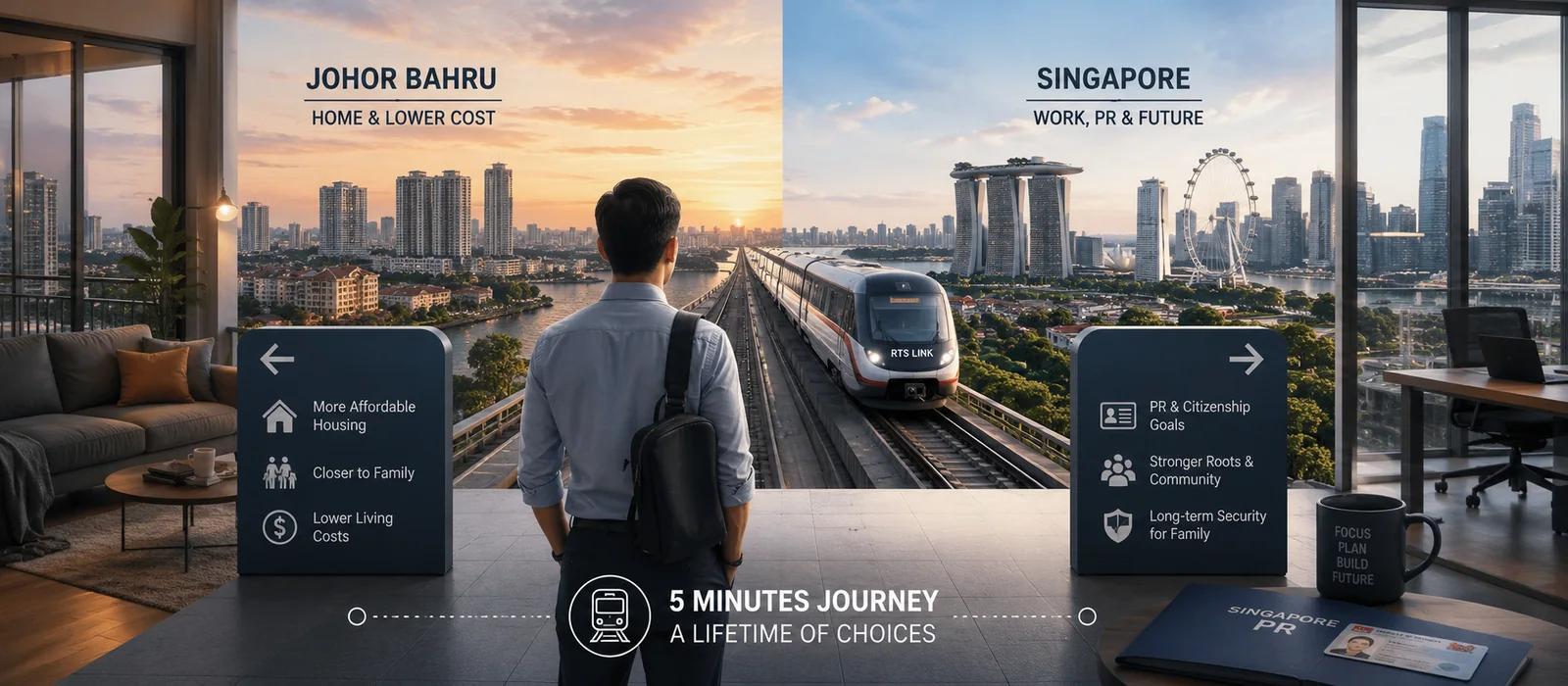
TL;DR
- The Johor Bahru–Singapore RTS Link is targeted to begin passenger service at the end of 2026. Journey time is about five minutes, with Singapore and Malaysia immigration cleared together at the departure station.
- A Singapore Business Federation study projects 39,700 additional cross-border trips a day at launch. This is a consumer spending forecast, not a worker forecast. Most of those trips are Singaporeans travelling to JB, not Malaysians taking up Singapore jobs.
- More Malaysians will commute to Singapore jobs. But work pass rules are unchanged by the RTS. EP and S Pass qualifying salaries rise again on 1 January 2027 — the same window the RTS opens.
- Singapore is very unlikely to introduce Malaysian-specific restrictions. Its controls are nationality-neutral by design: salary floors, COMPASS, quotas, levies. COMPASS already penalises nationality concentration in any company, including Malaysian concentration.
- Long-term residency is where the real risk sits. Under ICA’s framework from 1 December 2025, a PR who is outside Singapore without a valid Re-Entry Permit and does not apply within the prescribed 180-day period loses PR status automatically. ICA states plainly that PRs must "display a commitment to continue contributing to Singapore" to be issued an REP.
- REP renewal is not binary, and this is what most people miss. An REP is not simply approved or refused. It can be issued for a shorter period than the usual five years. A shortened permit is most often granted for one year. We have seen it go as low as six months.
- The cost saving is real, but smaller and more lopsided than the headlines. Once Malaysia's RM1m foreign-buyer floor is accounted for, a JB condo is only about 1.5× cheaper per square foot than a Woodlands HDB flat — the big gap only shows against private condos. The saving for most movers is in quantum and rent, not psf, and income is lower in JB too. It lands mainly with Singapore-salaried professionals — who are also the likeliest PR holders.
- The housing rules push the newest PRs toward the border. PRs can't buy new BTO or EC, and can only buy HDB resale after both PR co-buyers have held status three years; single PRs can't buy HDB at all. So recent and single PRs are funnelled toward renting or costly private property — making a JB move most tempting exactly when their residency record is thinnest.
- The trade-off is the story. Living in JB can cut housing costs, but it quietly erodes the residency, integration and rootedness narrative ICA weighs for REP renewal, PR approval and citizenship — and losing PR forfeits real value, including the 5% (vs 60%) buyer's stamp duty rate.
- Absence is manageable — if you can explain it. Time outside Singapore is rarely the deciding factor on its own. But it is visible, it is on record, and an unexplained pattern is far more damaging than a documented one. We have seen shortened permits renewed for the full five years at the next cycle once the absences were properly documented and explained in advance.
- Enforcement is already tightening independently of the RTS. ICA refused entry to about 45,700 foreign visitors in 2025, up 38.3% on 2024, driven by data-led targeting — with illegal working and overstaying named as primary risk categories.
What does the SBF study actually say — and what does it not say?
It is a retail and food-and-beverage spending study. It makes no forecast about work passes, PR, or citizenship. Every immigration implication in this article is inference, not an SBF conclusion. For related guidance, see Singapore Citizenship: Pros and Cons Explained.
The study was commissioned by the Singapore Business Federation, the Singapore Retailers Association and the Restaurant Association of Singapore, with Mastercard as knowledge partner. Its base case:
| Metric | Base case projection |
|---|---|
| Additional daily cross-border trips | 39,700 (close to RTS's own 40,000 launch ridership projection) |
| Additional annual SG → JB round trips | 11.2 million (a 51% jump) |
| Additional annual JB → SG round trips | 3.3 million (a 31% jump) |
| Singapore consumer spending flowing to JB | S$1.05 billion a year |
| JB consumer spending flowing to Singapore | S$756 million a year |
| Net impact on Singapore retail and F&B | –S$290 million (0.4% of 2025 sales) |
Scenarios range from –S$2.5 billion (bear) to +S$650 million (bull).
That –0.4% figure matters. The RTS is not a national economic shock. The pain is concentrated in groceries, drugstores, dining and beauty services, and in heartland merchants outside the Central Region. Central is the only region projected to gain, at +S$25 million, capturing premium retail, entertainment, hotels and event-driven spending from JB visitors.
The one manpower signal in the report comes from industry focus groups, not the model: operators raised "foreign worker constraints, with Malaysian labour potentially shifting to JB post-RTS." Businesses are asking government for more manpower flexibility, not less.
Will more Malaysians come to work in Singapore?
Yes — but do not read RTS ridership as a headcount of new Singapore workers. The 39,700 figure is dominated by Singaporeans travelling the other way.
The trips break down into Singaporeans shopping and dining in JB, Malaysians visiting Singapore for events and retail, tourists, and existing cross-border workers switching from bus, motorcycle or car. Genuinely new Malaysian hires in Singapore are a fraction of it.
The increase in commuter workers will concentrate among Malaysians who:
- Already hold a valid Singapore work pass
- Currently rent in Singapore mainly because Causeway timing is unpredictable
- Work near the Thomson-East Coast Line or in northern Singapore
- Keep regular daytime office hours
- Can live near Bukit Chagar or a reliable feeder connection
The effect will be much weaker for people finishing shifts after midnight, healthcare and logistics workers on rotating rosters, anyone working far from Woodlands, and parents whose children attend school in Singapore. For related guidance, see How Much PR Saves on Singapore School Fees.
Expect gradual growth, not a flood.
Will the flow run the other way as well?
Yes, and this may prove the larger effect. The RTS arrives alongside the Johor–Singapore Special Economic Zone, which is explicitly designed to keep some jobs in Johor.
The JS-SEZ promotes a "twinning" model: Singapore for headquarters, R&D and high-value functions; Johor for cost-competitive skilled labour and space to scale. So the RTS may simultaneously:
- Increase Malaysians commuting into higher-paying Singapore jobs
- Increase Malaysians staying in JB for newly created, Singapore-linked jobs
- Pull some Malaysians who currently rent in Singapore back across the border
- Force Johor employers to compete harder for the same talent, lifting JB wages over time
Over a decade, rising Johor wages may erode part of the cost advantage that makes hiring Malaysians attractive today.
Will Singapore make work passes harder for Malaysians specifically?
Almost certainly not. Singapore's foreign manpower architecture is nationality-neutral by design, and tightening it against one nationality would break that design.
The S Pass is open to foreign employees of all nationalities. Employment Pass applicants must clear a qualifying salary and pass COMPASS unless exempted. Employers must satisfy the Fair Consideration Framework, which requires fair consideration of candidates without discrimination on nationality or race. For services-sector Work Permits, Malaysia is already an approved source country, subject to quotas and levies.
Singapore's levers are pass category, salary, occupation, skills shortage, sector dependency ratio and company workforce composition — not passport.
The safeguard that already exists
COMPASS awards diversity points based on how concentrated an applicant's nationality is within the employer's PMET workforce. For firms with at least 25 PMETs:
| Share of same nationality in PMET workforce | Diversity points |
|---|---|
| Below 5% | 20 |
| 5% to below 25% | 10 |
| 25% or above | 0 |
This applies to Malaysians exactly as it applies to everyone else. A Singapore company that builds an overwhelmingly Malaysian PMET workforce will find its next EP applications harder — without any Malaysian-specific rule ever being written.
General tightening is already scheduled — and lands in the RTS window
| Pass | Current floor (most sectors) | From 1 Jan 2027 (new applications) |
|---|---|---|
| Employment Pass | S$5,600 | S$6,000 (S$6,600 financial services) |
| S Pass | S$3,300 | S$3,600 (S$4,000 financial services) |
Age-progressive floors scale upward from these baselines. Renewals are assessed against the new thresholds from 1 January 2028.
These MOM salary changes are part of Singapore's long-running foreign manpower recalibration. It is not a response to the RTS. But it means a Malaysian worker planning their finances around a JB move should also be planning around a salary floor that moves under them.
Will PR and citizenship become harder for Malaysians?
There is no Malaysian-specific rule, and the overall intake is going up, not down. But the commuter lifestyle can weaken an individual application in ways that have nothing to do with nationality.
Singapore granted 35,264 PRs and 22,766 citizenships in 2024 — the highest PR figure since 2010. In his 2026 Committee of Supply speech, Deputy Prime Minister Gan Kim Yong announced planning estimates of approximately 40,000 PR grants and 25,000–30,000 citizenships a year over the next five years, citing a resident total fertility rate that fell to a record low of 0.87.
A higher target is not a lower bar. It means more applicants who clear the bar get through. ICA does not publish approval rates.
ICA assesses PR applications on factors including family ties to Singaporeans, economic contribution, qualifications, age, family profile, length of residency, ability to integrate, and commitment to sinking roots in Singapore. Citizenship applicants must generally hold PR first, with adults normally applying after at least two years, and ICA weighs the same rootedness factors again.
Read that list against the profile of a Malaysian who earns in Singapore but whose home, spouse, children, social life and long-term plans all sit in Johor Bahru.
Two profiles the RTS will pull apart
| The Singapore-based Malaysian | The cross-border commuter | |
|---|---|---|
| Residence | Singapore | Johor Bahru |
| Family | Settled in Singapore, children in local schools | In Malaysia |
| Economic contribution | Singapore salary and tax | Singapore salary and tax |
| Community integration | Local networks, grassroots, long tenure | Limited — hours in Singapore are working hours |
| Housing cost | Full Singapore rent or mortgage | Lower — but mainly on quantum and rent, not psf. A foreigner-accessible JB prime condo (~S$355 psf) is only ~1.5× below a Woodlands HDB flat per sq ft, though 3.5×+ below private condos; rent runs ~S$670–1,200 vs ~S$2,800–3,400 for a Woodlands HDB 4-room (see chart) |
| PR / citizenship narrative | Strong on every ICA factor | Strong on economics, thin on roots |
Both contribute economically. Only one of them is easy to describe to ICA as having made Singapore the permanent centre of their family's life.
This is the trade-off the RTS creates: the RTS may make Singapore employment more accessible while making Singapore settlement feel less necessary — and settlement is exactly what ICA is assessing.
The savings are real — but so is the wage gap
The size of the cost advantage is easy to overstate, so the figures are worth setting out carefully.
Living in Johor Bahru is cheaper — but the size of the saving, and even whether there is one, depends on what you own now and what you could buy there. Two things have to be pinned down first.
A Singaporean cannot buy the cheap Johor stock. Malaysia's foreign-buyer floor (generally RM1 million for strata property) pushes a Singapore buyer into JB's prime, RTS-adjacent tier at around S$355 per square foot — not the ~S$150 psf standard units locals can access. So the honest comparison is a Singaporean's home here against a JB private condo bought at that floor.
That means the comparison is cross-tenure for most people. Most Singapore residents live in HDB flats, so the realistic question is usually "my HDB flat versus a JB private condo," not condo-to-condo. Here is the full tenure ladder, 2025–26, in Singapore dollars, with JB shown at the prime tier a foreign buyer is actually held to:
| Price per sq ft (SGD) | JB private condo (RTS zone, prime) | Woodlands | Singapore overall |
|---|---|---|---|
| HDB resale (4-room) | not available to foreigners | ~S$500–550 | ~S$610–650 |
| Executive condo (EC), resale | not available to foreigners | ~S$980–1,150 | — |
| Private condo, resale | ~S$355 | ~S$1,100–1,350 | ~S$1,650–2,100 |
| Private condo, new launch | ~S$355 | ~S$2,000–2,100 | ~S$2,200–2,750 |
With the tenure made explicit, the gap narrows sharply: against a Woodlands HDB resale flat, a JB prime condo is only about 1.5× cheaper per square foot (~S$355 vs ~S$525) — barely a discount on a psf basis. The larger gap — 3.5× and up — only appears against private condominiums, a different product most HDB dwellers were never buying.
So where does the saving actually come from for the typical mover? Total quantum and monthly rent, not price per square foot. A JB unit's smaller absolute price and much lower rent — a 2-bed near the RTS rents for ~S$670–1,200 against ~S$2,800–3,400 for a Woodlands HDB 4-room or ~S$3,500–4,500 for a Woodlands private condo — are the real economies. On a per-square-foot basis, once the RM1m floor is accounted for, JB is much closer to Singapore's cheapest housing than the "5-to-8-times-cheaper" headlines suggest.
And income runs the same way: Johor's mean household income in 2024 was about RM 9,500 (~S$3,000) against a Singapore median of about S$10,000 — roughly three times higher.
The housing rules quietly push new PRs toward the border
There is a regulatory twist here that matters more for this article than the raw prices, because it funnels a specific group toward exactly the decision that carries immigration risk.
A Permanent Resident cannot buy public housing freely. PRs cannot buy new BTO flats or new executive condominiums at all. They can only buy HDB resale flats — and only under the Public or Spouse Scheme with another PR or a citizen. If both co-buyers are PRs, both must have held PR status for at least three consecutive years before they can buy. A single PR cannot buy an HDB flat alone. For related guidance, see 5 Ways to Become a Singapore Permanent Resident.
The effect is a fork by seniority. An established PR family, three-plus years in, can buy a Woodlands resale flat at ~S$500–550 psf and a modest total quantum — the cheapest settled-housing route in Singapore. But a recently approved PR, or a single PR, is shut out of that route entirely. Their options are to rent, or to buy private at S$1,650 psf and up. That is precisely the person for whom Johor's ~S$355 psf and low rents look most attractive.
So the housing system nudges the newest, least-rooted PRs — the ones with the shortest Singapore track record — toward the border, at the very moment their residency profile is thinnest. The cost saving is real for them. So is the risk: a recent PR who relocates to JB to escape Singapore rents is building the JB life, and thinning the Singapore record, exactly when the next REP renewal and any future citizenship application will be scrutinising it. The people most financially pushed toward JB are the people who can least afford the rootedness cost of going.
It is worth remembering what PR status is worth on the Singapore side of this ledger, too. Under the current IRAS ABSD schedule, a PR pays 5% Additional Buyer's Stamp Duty on a first residential property; a foreigner pays 60%. Losing PR status does not just end the right to live and work here — it forfeits that stamp-duty position and, with it, realistic access to the Singapore property market. The convenience of a JB base is weighed against a status that has concrete financial value, not just sentimental or legal value.
Who this actually benefits — and it is not who you would guess
A striking point from the transport economics of the RTS itself: the commuter model favours mid-to-high earners, not the lowest-paid. The fare the operator has proposed to the two transport ministries runs about S$5–7 each way, or S$10–14 a day round-trip. For a lower-wage daily worker, that is a meaningful cost against a cheap cross-border bus or a motorcycle, and it eats into the JB cost saving. For a higher earner or business traveller, it is trivial against the one to three hours of causeway queuing it removes.
It is worth being clear about what the RTS does and does not fix, because it shapes who actually commutes. With capacity of about 10,000 passengers an hour each way — roughly 140,000 a day, close to the entire current cross-border bus ridership — the RTS is built to clear the bus and pedestrian bottleneck, not the roughly 90,000 daily vehicle trips clogging the Causeway. Car and motorcycle congestion will largely remain unless drivers choose to switch. So the realistic RTS commuter is someone travelling on foot to the train, on a predictable daytime schedule, who values time over the fare — which again describes a professional, not a shift worker.
That inverts the usual assumption. The people best placed to capture the JB cost arbitrage — professionals on Singapore salaries who can absorb the fare and value the time — are precisely the ones with the most to lose on the immigration side, because they are the likeliest PR holders and PR and citizenship aspirants. The person for whom living in JB makes the most financial sense is often the person for whom the rootedness trade-off matters most.
Two points follow from this. First, part of what looks like "JB is cheaper than Singapore" is really "Woodlands is the cheap end of Singapore," and part of it dissolves entirely once the RM1m floor and tenure are accounted for. Second, the saving that remains is real — but it accrues most to exactly the people whose long-term residency is most exposed.
The distinction that matters for this article is whose income you are spending. A Malaysian who earns a Singapore salary and lives in Johor captures the full arbitrage — Singapore wages against Johor housing costs. That is a genuine and substantial saving, and it is exactly why the commuter model is attractive. But for someone whose income is also Johor-based, much of the housing saving is offset by lower pay; the cost of living is lower because the economy is lower-waged. For related guidance, see Singapore PR Minimum Salary: Why Income Trajectory Matters.
So the financial case for a Singapore work-pass holder to live in JB is strong. The point of this article is that the financial case and the immigration case pull against each other: the same move that maximises take-home pay is the one that thins out the residency and integration record ICA weighs for REP renewal, PR and citizenship.
What is the risk to existing PRs who move their lives to Johor Bahru?
This is the most under-appreciated risk in the whole RTS conversation, and the rules changed on 1 December 2025.
A Singapore PR needs a valid Re-Entry Permit to leave Singapore and return with PR status intact. That has always been true. What changed is what happens when the REP lapses.
The 1 December 2025 REP framework
| Before 1 Dec 2025 | From 1 Dec 2025 | |
|---|---|---|
| PR outside Singapore when REP expires | PR status lost immediately; one-month grace period to apply for reinstatement | PR status retained for 180 days from the first day physically outside Singapore without a valid REP |
| Failure to apply within the window | Reinstatement possible at ICA's discretion | PR status lost automatically. "No appeals will be accepted." |
| Unsuccessful REP application | Reinstatement route existed | PR status lost the day after the outcome is sent. Only route back is a fresh PR application from scratch. |
Three points deserve emphasis:
- Returning to Singapore within the 180 days does not save you. ICA is explicit: you lose PR status if you do not apply for a new REP within the period, "even if you return to Singapore within this period."
- The reinstatement route is gone. If the 180 days lapse, or the REP application is refused, the only path back to PR is a completely new PR application.
- REP issuance is not automatic. ICA's own guidance states: "Having a valid REP whilst abroad is an indication by the PR that he/she intends to return to Singapore. PRs are required to display a commitment to continue contributing to Singapore, in order to be issued an REP."
What this actually means for a JB-based PR
Be clear about what is and is not a problem:
- Daily commuting on a valid REP is legal and safe. A PR who sleeps in JB and works in Singapore every day is physically in Singapore constantly. The 180-day rule does not bite.
- There is no published minimum stay requirement for REP renewal. ICA does not publish a days-in-Singapore threshold.
- But REP renewal is a discretionary assessment, not a formality. ICA can renew for less than the usual five years, or decline. The factors that build a strong renewal file are the same ones a JB relocation quietly erodes: continuous residence, family settled in Singapore, CPF and tax record, property or long-term tenancy, community involvement.
- The danger case is the drift. A PR moves the family to JB "to save on rent." Later, a job change, a posting, a parent's illness or a business venture keeps them out of Singapore. The 180-day clock is now running against a person whose Singapore ties have already thinned. That is when a discretionary decision goes the wrong way, and there is no appeal.
Commuting from JB does not break your PR. What it removes is the buffer that would have protected it if anything else went wrong.
Does time spent outside Singapore affect a Re-Entry Permit renewal?
Yes — and not in the way most PRs expect. The most common outcome is not refusal. It is a shorter permit.
This is the single most misunderstood part of the REP framework, and it is worth being precise about.
An REP is typically issued for five years. But ICA can issue one for a shorter period, and the shorter validity is itself the signal.
A shortened re-entry permit is most often issued for one year. We have seen it go as low as six months.
Some context on how we see these cases, because it matters for how you read what follows. Most PRs renew their re-entry permit themselves, and for most it is straightforward. The matters that reach us are disproportionately the ones where something has already gone wrong — a permit granted for one year instead of five, or an application refused. We are therefore not in a position to say how common shortened permits are across Singapore's PR population, and neither is anyone else: ICA does not publish validity-period statistics. What we can say is that within the cases we see, shortened validity attaches to a recognisable pattern — frequent travel and extended periods outside Singapore.
None of these were refusals. None came with a warning. The permit was simply granted for a fraction of the usual term.
Why a shortened REP matters more than it looks
ICA does not explain the decision, which is exactly what makes it difficult to act on. You are told the outcome and nothing else.
What is clear is the practical effect. Instead of five years to demonstrate that Singapore is still your base, you have one — or less. And every renewal is another point at which the 180-day rule can catch you if you happen to be abroad when the permit lapses.
| What a shortened REP does | Practical consequence |
|---|---|
| Compresses the review cycle | You are back in front of ICA within a year — sometimes sooner — instead of five, with the same thin residency record |
| Creates a recurring exposure window | Every expiry is a fresh opportunity for the 180-day rule to catch you if you happen to be abroad |
| Removes planning certainty | Difficult to commit to a mortgage, a school placement, or an overseas posting |
| Reads as a signal | Our working interpretation is that a shortened REP reflects ICA's assessment of demonstrated commitment. It is a soft flag, not a formal warning |
| Carries forward | The same residency pattern is visible when the family later applies for citizenship |
A shortened REP is best understood as a question, not a penalty. The question is whether Singapore is still where your life is based. You should treat it as an invitation to answer that question properly at the next renewal.
The same pattern appears in PR and citizenship assessments
We have seen the equivalent effect on the application side. Applicants for PR and for citizenship with long or frequent absences from Singapore encounter more difficulty than comparable applicants with continuous residence, even where salary, qualifications, tax record and family profile are otherwise similar. The same caveat applies as above — we see a selected set of cases, not a representative sample.
Two things must be said clearly about this.
First, absence is not the deciding factor. ICA assesses a holistic profile — family ties, economic contribution, qualifications, age, family profile, length of residency, integration and commitment to sinking roots. Time outside Singapore is one input among many. We have seen applicants with significant travel succeed and applicants with unbroken residence be unsuccessful. Anyone who tells you days-in-country is the lever is selling you something.
Second, it should not be taken lightly. It is one of the few factors that is objectively recorded, easily checked, and entirely visible to ICA without you volunteering anything. You do not get to characterise it. The record characterises it for you — unless you characterise it first.
Why the RTS makes this more urgent, not less
Every element of the commuter arrangement the RTS enables pushes in the same direction:
- Your home address moves to Malaysia
- Your family may follow
- Your children's schooling shifts across the border
- Your social and community footprint in Singapore contracts to working hours
- Your property or tenancy tie to Singapore ends
Individually, each is a rational cost decision. Cumulatively, they reconstruct your profile from "Malaysian who has built a life in Singapore" into "Malaysian who earns in Singapore." The commute stays legal throughout. The narrative does not stay intact.
Absence is defensible — if you handle it properly
Here is the part that matters commercially and practically: a pattern of absence is far more manageable than most people assume, provided it is explained rather than left to be inferred.
Absences that are readily explicable and well-evidenced include:
- Employer-directed travel or overseas posting — particularly where the Singapore employment relationship, salary and CPF contributions continue throughout
- Regional roles where travel is intrinsic to the job rather than a lifestyle choice
- Caring for an ill or elderly parent overseas, with medical documentation
- Medical treatment for the PR or an immediate family member
- Study undertaken abroad, especially where it strengthens the applicant's economic contribution on return
- Time-limited business establishment overseas where the Singapore base is retained
What makes these defensible is not the reason alone. It is the combination of a clear reason, contemporaneous documentation, and evidence that the Singapore base was maintained throughout — continuous CPF contributions, tax filings, retained property or tenancy, family remaining in Singapore, and a demonstrable pattern of return.
What does not work is presenting a bare travel history and hoping the reason is inferred, or offering an explanation for the first time only after an unfavourable outcome.
What this looks like in practice
What we can claim here is limited, because ICA does not give reasons and we will not pretend otherwise.
We have handled cases where a client's re-entry permit was renewed for a shortened period after a stretch of significant time abroad. ICA did not state why. But the pattern was familiar from other matters we had seen, and our strong assessment was that the absences were the driver.
Where those clients faced a further period away, we documented the circumstances properly and in advance — the reason for the travel, the continuing Singapore employment and CPF contributions, the retained home, the family ties that remained here — and set that record out clearly for ICA. In those cases, the permit was subsequently renewed for the full five years.
Two things must be said plainly about that:
- We cannot and do not claim credit for ICA's decision. ICA assesses each case on its own facts and gives no reasons. What we can say is that a well-documented, well-explained absence gives ICA what it needs to see the continuing commitment; a bare travel history does not.
- The timing is everything. The record that made the difference was built while the absence was happening and presented before the renewal, not assembled after a shortened permit had already been issued. By the time an unfavourable outcome lands, the easiest evidence to gather is already historical.
The practical rule: build the explanation while the absence is happening, not after ICA has already formed a view.
Will housing demand in Singapore weaken?
Not materially at the national level. Specific rental segments in the north are genuinely exposed.
Singapore's foreign workforce excluding domestic workers numbers well over a million. The RTS's projected 39,700 daily trips include leisure travel in both directions. The arithmetic does not support a broad decline in Singapore rents or prices.
Exposed segments:
- Room rentals occupied by Malaysian workers
- Budget accommodation in Woodlands, Marsiling, Sembawang and Yishun
- Workers who only rented in Singapore because the Causeway was unpredictable
Limiting factors:
- Bukit Chagar to a workplace outside the north can still be a long journey
- RTS fares (indicatively S$5–7 one way, roughly S$215–300 a month) plus feeder costs
- Shift workers cannot use a fixed-schedule train conveniently
- Families with children in Singapore schools will not move
- Some employers prefer locally resident staff for operational reliability
Meanwhile, Woodlands is being developed as the Woodlands Regional Centre under the URA Master Plan, and JB property near Bukit Chagar is already seeing strong rental growth — which will erode the cost gap over time.
Our conservative forecast: a shift of some rental demand from northern Singapore to central JB, not a weakening of Singapore-wide housing demand.
Will Singapore companies hire more Malaysians who stay in JB?
Yes. And this is where most of the compliance risk sits for employers.
There are three legally distinct models, and companies routinely blur them.
| Model | What it is | What it requires |
|---|---|---|
| A. Lives in JB, works in Singapore | Daily commuter, physically working on Singapore soil | A valid Singapore work pass. Malaysian residence does not substitute for one. |
| B. Lives and works in Malaysia | Malaysia-based employment for a Singapore-linked business | Correct Malaysian employment structure: subsidiary, branch, EOR, JV, or genuine contractor. Malaysian payroll, tax, EPF/SOCSO. Watch permanent establishment exposure. |
| C. JB-based, occasionally enters Singapore | Attends meetings, retreats, conferences | MOM permits genuine business visits without work pass notification. A Short-Term Visit Pass does not permit business, professional or paid employment activities. |
Model C is where companies get into trouble. "Meeting visits" that are actually regular operational work performed in Singapore are an Employment of Foreign Manpower Act problem for the employer, not just the individual.
Functions likely to move or expand in Johor
Shared services and back office · customer support · finance and administrative processing · software support and digital production · procurement and supply-chain coordination · warehousing and fulfilment · central kitchens and food production · manufacturing and engineering support · selected design, marketing and content work.
Functions likely to stay in Singapore
Headquarters and senior management · regulated and licensed activities · sensitive customer-facing work · high-value R&D · anything requiring proximity to Singapore clients, regulators or capital markets.
Note the constraint on the Johor side: businesses in the zone report real difficulty sourcing high-level technical talent locally. The twinning model is not frictionless.
Will there be more denials of entry at the border?
Denials are already rising sharply — but because of better detection, not because of the RTS.
ICA's 2025 annual statistics: about 45,700 foreign visitors refused entry, up 38.3% from around 33,100 in 2024. ICA attributed the increase to its Integrated Targeting Centre, which uses advance passenger information and data analytics for pre-arrival risk assessment, and to officers redeployed from manual counter duties to profiling and investigative interviewing under the New Clearance Concept. The named risk categories include overstaying and working illegally.
For context: ICA cleared over 245 million travellers in 2025, with land checkpoints accounting for about 76% of volume and a single-day record of close to 589,000 land crossings.
Terminology matters
Ordinary Malaysian passport holders are not on Singapore's visa-required list. So "visa problems" is the wrong frame. The real issues are:
- Permission to enter (always discretionary, even visa-free)
- Short-Term Visit Pass conditions
- Work pass validity
- SG Arrival Card submission where required
- Passport validity
- Overstaying
- Customs declarations
Frequent crossing is not evidence of wrongdoing. Thousands of valid pass holders will lawfully cross daily. The risk arises when the crossing pattern is inconsistent with declared status:
- Entering as a visitor while actually working
- Performing operational work under a "business meeting" cover
- Continuing to work after a pass is cancelled or expires
- Repeated discrepancies between stated purpose and actual activity
A more accurate line than "be careful with your visa": your entry status must match what you are actually doing in Singapore. Visa-free is not work-authorised.
The RTS removes five kilometres of friction. It does not remove the checkpoint, and it does not remove the legal distinction between a visitor and a worker.
Has this happened anywhere else?
Yes. The closest analogy is Copenhagen–Malmö, and it tells you exactly what to expect — with one crucial difference.
The Øresund Bridge opened in 2000 between Denmark and Sweden. Cross-border employment grew from roughly 2,800 people in 1999 to around 20,500 by 2023, of whom about 19,000 lived in Sweden and worked in Denmark. Higher wages on one side, cheaper housing on the other, improved transport, one-way commuter flow, residential demand growing on the cheaper side. Every element maps onto Singapore–Johor.
The difference is decisive: Denmark and Sweden operate inside European free movement. Singapore and Malaysia do not. Work pass controls mean the Singapore labour response will be smaller, slower and far more selective than the Øresund response. Øresund also showed the fragility of integration — border controls reintroduced in 2015/2016 disrupted daily commuters overnight. For related guidance, see An Older, Smaller Singapore: Why Work Passes and PR Will Remain Essential.
Luxembourg makes the same point at larger scale: a small, expensive, high-income economy sustaining a very large cross-border workforce living in France, Belgium and Germany. Again, free movement is doing the work.
Hong Kong–Shenzhen, which the SBF study uses, is a good consumer spending analogy — the study found clear outbound shifts in drugstore and beauty spending after the Express Rail Link — but a poor labour and immigration analogy, given a completely different permit framework and years of disruption from protests and pandemic closures.
What else changes for immigration?
1. A new "immigration-light" worker category. Workers economically tied to Singapore — employed, taxed, physically present during working hours — but residentially and socially rooted in Malaysia. That is a sharp break from traditional expatriate migration, where a Singapore job usually meant moving the household.
2. Employment can rise without settlement rising. Singapore gains labour without the corresponding residential population, school demand, family pass demand and long-term housing demand. From a policy perspective that is arguably attractive: labour flexibility with social costs borne in Johor.
3. Dependants stay in Malaysia. Lower demand for Dependant's Passes and relocation support. Higher demand for cross-border tax advice, work pass renewal support, and PR strategy for families deciding whether to relocate.
4. PR strategy becomes a genuine financial decision. Save materially on housing by living in JB, or spend more to build the residency and integration profile that ICA actually assesses. There is no rule forcing the choice. There is a real trade-off, and it compounds over years.
5. Corporate immigration advisory expands. Companies operating across both jurisdictions must distinguish who is employed where, who needs which authorisation, what a visitor may lawfully do, and where payroll, tax and social security obligations arise.
The bottom line
When the RTS opens, Johor Bahru and Singapore will be five minutes apart. Economically, the two cities move closer. Legally, they remain two labour markets and two immigration systems.
More Malaysians will work in Singapore while living in JB. More Singapore companies will locate jobs in Johor. But every worker still needs the correct authorisation, and everyone seeking long-term residency still has to demonstrate something the RTS cannot deliver: that Singapore is where their life is, not just where their income is.
The cheaper option and the stronger residency profile are pulling in opposite directions. That is the decision the RTS forces, and it is worth making deliberately rather than by drift.
Talk to us before you make the move
If you are weighing a JB relocation against a PR or citizenship application — or if your company is structuring roles across the corridor — the sequencing matters more than the individual decisions. For related guidance, see PR or Citizenship Rejected? What to Do Next.
E&H Immigration Consultancy has advised on over 1,000 applications across 40+ nationalities, with more than 30 years of combined experience. We assess your specific profile against how ICA actually weighs residency, integration and rootedness, and we tell you honestly where a cost-saving move will cost you elsewhere.
If your concern is specifically an expiring or shortened permit, see our REP renewal service and our detailed guide to one-year and shortened REP renewals.
Refused entry to Singapore? E&H can review the circumstances, supporting records and available next steps for an entry appeal. Learn about our Appeal for Entry service →
Frequently asked questions
Can a Singapore PR live in Johor Bahru and commute daily?
Yes, provided the Re-Entry Permit remains valid. Daily commuting means you are physically in Singapore constantly, so the 180-day rule does not apply. The longer-term consideration is whether relocating your home and family to JB weakens the profile ICA assesses at REP renewal and at citizenship application.
How long can a Singapore PR stay outside Singapore?
From 1 December 2025, a PR outside Singapore without a valid REP has 180 days from the first day physically outside Singapore to apply for a new REP. Miss that window and PR status is lost automatically, with no appeals accepted. Returning to Singapore within the period does not preserve status if no application was made.
Is there a minimum number of days a PR must spend in Singapore to renew an REP?
ICA does not publish a minimum stay threshold. REP issuance is a discretionary assessment, and ICA states that PRs must display a commitment to continue contributing to Singapore. Extended absences without strong justification can affect the outcome, and ICA may issue an REP for a shorter period than the usual five years.
Why was my Re-Entry Permit renewed for one year instead of five?
ICA does not give reasons for the validity period it grants, and does not publish statistics on it. In our experience, shortened re-entry permits are most often issued for one year — we have seen them go as low as six months — and are typically associated with holders who have travelled frequently or spent extended periods outside Singapore. The practical effect is that your renewal comes up again quickly, so the shortened period is best treated as a prompt to strengthen and document your Singapore ties before the next application rather than as a formality to repeat.
Does frequent travel automatically hurt a PR or citizenship application?
No. ICA assesses a holistic profile, and time outside Singapore is one factor among many — not the deciding one. But it is objectively recorded and fully visible to ICA, so an unexplained pattern of long absences is a weakness you cannot control. A well-documented one usually is manageable.
How do I explain long absences from Singapore to ICA?
With a clear reason and contemporaneous evidence, submitted proactively rather than in response to a poor outcome. Employer-directed travel, overseas postings, caring for an ill family member, medical treatment and study abroad are all readily explicable. What strengthens the explanation is proof that your Singapore base was maintained throughout — continuous CPF contributions, tax filings, retained property or tenancy, family remaining in Singapore, and a consistent pattern of return.
Can a shortened re-entry permit go back to five years at the next renewal?
It can. We have handled cases where a permit was renewed for a shortened period after significant time abroad, and where — after the circumstances were documented and explained properly and in advance — the following renewal was for the full five years. We cannot claim credit for ICA's decision, since ICA assesses each case on its own facts and gives no reasons. What we can say is that a shortened permit is not necessarily permanent, and that a clearly documented, well-evidenced absence gives ICA what it needs to see continuing commitment. The key is to build that record before the next renewal, not after.
What happens if my REP application is rejected?
You lose PR status the day after the outcome is sent to you. Since 1 December 2025 there is no reinstatement route. The only way back is a fresh PR application assessed from scratch.
Will the RTS Link make it easier to get a Singapore work pass?
No. The RTS changes how you travel, not whether you qualify. EP and S Pass qualifying salaries, COMPASS and the Fair Consideration Framework are unchanged by it — and the salary floors rise on 1 January 2027.
Can a Malaysian work in Singapore on a visit pass because the commute is short?
No. A Short-Term Visit Pass does not permit business, professional or paid employment activities. Working without a valid pass is an offence under the Employment of Foreign Manpower Act, for the individual and the employer. ICA's 2025 statistics show entry refusals up 38.3%, with illegal working among the named risk categories.
Will Singapore introduce restrictions targeting Malaysians?
There is no indication of this and it would be inconsistent with how Singapore's system works. Controls operate through salary floors, COMPASS, quotas and levies, which apply regardless of nationality. COMPASS already reduces diversity points for any nationality that dominates a company's PMET workforce.
Can a Singapore company employ someone who lives and works in Johor Bahru?
Yes, but it is a Malaysia-based employment arrangement, not a Singapore one. A Singapore work pass does not authorise work performed in Malaysia. The company needs a proper Malaysian structure — subsidiary, branch, employer of record, joint venture or genuine contractor arrangement — with correct payroll, tax and social security treatment, and should assess permanent establishment exposure.
Does living in JB affect a Singapore citizenship application?
There is no rule barring it. But ICA weighs length of residency, family profile, integration and commitment to sinking roots. An applicant whose home, spouse, children and social life are all in Malaysia has a materially thinner case on those factors than one whose family is settled in Singapore, even with identical income and tax contributions.
Official sources and further reading
- LTA: Johor Bahru–Singapore RTS Link
- SBF: Impact of the RTS Link on Singapore retail and F&B
- MOM: 2027 EP and S Pass qualifying salary changes
- ICA: REP validity and the 180-day framework
- Population.gov.sg: 2026 population and immigration planning estimates
Immigration outcomes depend on individual circumstances and ICA or MOM discretion. This article provides general information, not a guarantee of any application or renewal outcome.