
Inside Singapore’s World-Class Education System: 2026 Update
Inside Singapore’s education system: the 2026 update with PISA 2025 results, school pathways, costs, and guidance for international families.

TL;DR
- Singapore ranked first in Reading and second in Mathematics, Science, and Computational Problem Solving in PISA 2025.
- Singapore’s PISA 2025 mean scores were 535 in Reading, 563 in Mathematics, 560 in Science, and 563 in Computational Problem Solving.
- Compared with PISA 2022, Singapore’s comparable changes were Reading -8, Mathematics -12, and Science -2; public sources do not establish one Singapore-specific cause.
- See the updated Singapore school-system charts for the new Science and Computational Problem Solving datasets.
Welcome to Singapore’s Amazing Schools
Imagine a school system where students are excited to learn, teachers are respected as heroes, and the whole country works together to help every child succeed. That’s what Singapore’s education system is all about!
What Minister Gan’s 2026 Population Speech Means for Singapore PR and Citizenship Applicants
Singapore’s schools are famous around the world for being some of the best. In the 2023 Trends in International Mathematics and Science Study (TIMSS), Singapore’s 4th and 8th graders scored higher than students from any other country in math and science. In PISA 2025, Singapore ranked first in reading and second in mathematics and science; the new Computational Problem Solving domain also placed Singapore second. Creative Thinking was a separate PISA 2022 optional assessment.
But it’s not just about primary and secondary schools. Singapore’s universities are also amazing. The National University of Singapore (NUS) is ranked 8th in the world, and Nanyang Technological University (NTU) is 15th, according to the QS World University Rankings 2025. Singapore’s Population Cools in 2025: Deeper Insights for Residency Applicants
Here are some other rankings where Singapore does really well:
-
Times Higher Education World University Rankings: NUS and NTU are in the top 50 universities.
-
Financial Times Global MBA Rankings: Singapore Management University (SMU) and INSEAD’s Singapore campus are among the best places in the world to study business.
-
QS Executive MBA Rankings: INSEAD Singapore (9th spot), NUS (14th), Nanyang Business school (24th), SMU (27th).
-
QS MBA Rankings: NUS (25th spot), Nanyang Business School (36th).
-
Graduate Employability Rankings: NUS ranked 17th spot in QS and 9th in the Times Higher Education.
These results are even more noteworthy when you consider that the little island state is home to only 6 million people.
In this article, we’ll take a closer look at why Singapore’s schools are so successful. We’ll explore how the system works, its history, and what makes it different from other countries. We’ll also learn about the opportunities available for students in Singapore, whether they’re from Singapore or another country.
Get ready to discover the secrets of Singapore’s amazing education system!
Singapore’s School System: Its Ethos, Values, and Features
Singapore wants every child to be the best they can be. Their education system is built on important values and principles that make it special and successful.
Key Values
-
Meritocracy: This means everyone has the same chance to do well in school, no matter where they come from or what their family is like. It’s all about how hard you work and what you can do!
-
Bilingualism: In Singapore, students learn in English, but they also learn their mother tongue, like Mandarin, Malay, or Tamil. This helps them understand different cultures in Singapore’s multi-racial/ethnic society and talk to people from all over the world.
-
Holistic Education: Singapore’s schools don’t just care about grades. They want students to grow as whole people, learning important values and life skills. They also encourage students to join clubs, play sports, and pursue more artistic fields.
-
Adaptability and Innovation: The world is changing quickly, so Singapore’s schools are always updating what they teach. They want students to be creative, solve problems, and think critically.
-
High Standards and Expectations: Singapore sets high goals for students and teachers. They want everyone to always try their best and keep learning and growing.
Distinctive Features
-
Streaming: Students are placed in different groups based on how they’re doing in school. This helps teachers give them the right level of help and support.
-
Emphasis on Teacher Quality: Singapore knows that great teachers are a key asset in a student’s development. They train their teachers really well and make sure they have everything they need to help students succeed.
-
Strong Partnerships: Schools work closely with parents and the community to create a supportive environment where everyone feels connected and cared for.
What Sets It Apart
Singapore’s education system is different from many other countries because it:
-
Focuses on bilingualism: Students learn two languages, which helps them connect with more people and cultures.
-
Emphasizes holistic development: Schools care about more than just grades, focusing on character, values, and life skills.
-
Is committed to meritocracy: Everyone has an equal chance to succeed, no matter what their background is.
All these things make Singapore’s education system one of the best in the world, helping students become well-rounded, adaptable, and ready for the future!
Historical Context with Timeline of Major Changes
Singapore’s education system has a rich history, with its roots tracing back to the British colonial era. However, it has undergone significant transformations since Singapore’s independence in 1965, evolving to meet the nation’s changing needs and aspirations.
Here’s a timeline highlighting major changes over the past 10 years:
-
2014: Shifting from a single PSLE score to wider scoring bands to reduce fine differentiation and encourage holistic development.
-
2017: Introduction of Subject-Based Banding in secondary schools, allowing students to take subjects at different levels based on their strengths.
-
2018: Launch of the Learning for Life Programme to emphasize 21st-century competencies and character development.
-
2019: Introduction of the Edusave Character Award to recognize students’ positive character and values.
-
2020: Widespread adoption of Home-Based Learning during the COVID-19 pandemic, accelerating the integration of technology in education.
-
2021: Expansion of Full Subject-Based Banding to all secondary schools, providing greater flexibility and customization in subject selection.
-
2023: Announcement of further changes to the PSLE scoring system to reduce academic stress and promote student well-being.
-
2024: Implementation of the new PSLE scoring system. Gifted Education Programme (GEP) in primary schools will be revamped, with high-ability programmes in all schools to be opened up to more students.
These changes reflect Singapore’s ongoing commitment to refining its education system, ensuring it remains relevant, responsive, and prepares students for the challenges and opportunities of the future
What is the Current System?
Singapore’s schools are always changing and improving to stay up-to-date. They want to make sure students are learning the right things and are happy and healthy while they learn.
Recent Changes and Their Rationale:
-
PSLE Scoring Changes: The Primary School Leaving Examination (PSLE) is a big test that students take at the end of primary school. Singapore changed how they score the PSLE to make it less stressful for students. They want students to focus on learning and not just worry about getting one perfect score.
-
Full Subject-Based Banding (Full SBB): In secondary school, students can now choose the difficulty level of their subjects. This is called Full SBB, and it helps students learn at their own pace and focus on things they’re good at.
-
Learning for Life Programme (LLP): This program helps students learn important skills for the future, like how to work with others, solve problems, and be creative.
Technical Aspects:
-
Edusave: This is a national savings scheme that provides every Singaporean child with an Edusave account. The government contributes funds to these accounts, which can be used for approved educational purposes, such as enrichment programs or school fees. As of the end of December 2024, primary school students receive S$230, and secondary school students receive S$290 each year in their Edusave account. Students in schools funded by the Ministry of Education (MOE) receive these contributions from the start of primary school until the end of secondary school, while those in schools not funded by MOE receive them between the ages of 7 and 16. “Adding Value” to Singapore: What ICA Looks For (and How You Can Show It)
-
Child Development Account (CDA): This is a separate savings account for children aged 0-6, with government contributions and matching. Some of these funds can be transferred to the Edusave account when the child reaches 7 years old.
-
Independent Schools: These are publicly-funded schools with greater autonomy in their curriculum and operations. They often have specialized programs and cater to students with specific talents or interests.
-
Integrated Programme (IP): This is a 6-year program offered by some schools that allows academically strong students to bypass the O-Level examinations and proceed directly to pre-university education. It offers a more flexible and less structured learning approach.
-
Direct School Admission (DSA): This exercise allows students to seek admission to secondary schools based on their talents and achievements in areas beyond academics, such as sports, arts, and leadership.
These are some of the important parts of Singapore’s education system that help make it so successful.
Levels of Schooling: Navigating the Pathways
Singapore’s education system offers a structured yet flexible pathway for students, catering to diverse interests and learning styles. Here’s a glimpse into the different levels of schooling:
-
Preschool: While optional, preschool education is highly encouraged. It provides a foundation for social, emotional, and cognitive development.
-
Primary School (6 years of schooling): Compulsory education begins at age 7. Students undergo a holistic curriculum, building a strong foundation in literacy, numeracy, and character development. The Primary School Leaving Examination (PSLE) at the end of Primary 6 assesses students’ readiness for secondary education.
-
Secondary School (4-5 years schooling): Students are streamed into different tracks based on their PSLE results: Express, Normal (Academic), or Normal (Technical). This allows for tailored instruction and pacing. Students can pursue the GCE O-Level or N-Level examinations depending on their track.
-
Post-Secondary Education (2-3 years schooling): Options include Junior Colleges (JC) for pre-university education leading to the GCE A-Level examinations, Polytechnics for practice-oriented diploma courses, and the Institute of Technical Education (ITE) for vocational training.
-
Tertiary Education: Singapore boasts world-class universities like NUS, NTU, SMU, SUTD, SIT, and SUSS, offering a wide range of undergraduate and postgraduate programs.
As a side note, students presently studying in Singapore and have passed at least one national exam in Singapore either in PSLE, GCE ‘N’/’O’/’A’ levels, or are in the Integrated Programme (IP) are eligible to apply for a Singapore Permanent Resident visa.
Public vs. Private Schools:
-
Public Schools: These form the backbone of the education system, offering subsidized education to citizens and permanent residents. They are known for their high standards and multicultural environment.
-
Private Schools: These include international schools and cater primarily to expatriates or those seeking alternative curricula like the International Baccalaureate (IB) or the International General Certificate of Secondary Education (IGCSE).
Singapore’s education system provides a diverse range of options for students, ensuring that they can find a pathway that suits their individual needs and aspirations.
Costs and Benefits of Education in Singapore
Costs:
Education in Singapore represents a significant investment, but the costs vary depending on the student’s nationality and the type of school.
-
Citizens: Singaporean citizens enjoy the lowest fees for public schools due to substantial government subsidies.
-
Permanent Residents (PRs): PRs pay higher fees than citizens but still benefit from government subsidies.
-
International Students: International students face the highest tuition costs in public schools. Private schools, including international schools, are generally the most expensive option for all nationalities.
If you are comparing specific schools, our sister site SG Best ranks the best international schools in Singapore for expat families and explains international vs local schools.
For a clearer picture, let’s look at the monthly school fees for primary and secondary schools as of 2023, according to the Ministry of Education (MOE):
Monthly School Fees
| School Type | Singapore Citizens (SGD) | Permanent Residents (SGD) | International Students (ASEAN) (SGD) | International Students (Non-ASEAN) (SGD) |
|---|---|---|---|---|
| Primary Schools | 13 | 293 to 343 | 559.17 to 609.17 | 949.17 to 1,049.17 |
| Secondary Schools | 25 | 580 to 700 | 991.80 to 1,111.80 | 1,931.80 to 2,211.80 |
| Junior Colleges and Millennia Institute | 33 | 667 to 787 | 1,199.43 to 1,319.43 | 2,289.43 to 2,569.43 |
Source: Singapore Ministry of Education
Benefits:
The benefits of investing in education in Singapore extend beyond the monetary aspect:
-
High-Quality Education: Singapore’s education system is globally recognized for its rigor, high standards, and excellent results in international assessments.
-
Strong Focus on STEM and Bilingualism: The curriculum emphasizes science, technology, engineering, and mathematics (STEM) subjects, equipping students with essential skills for the future. Bilingualism fosters broader communication skills and cultural understanding.
-
Safe and Structured Learning Environment: Singapore offers a safe and conducive learning environment with a strong emphasis on discipline and character development.
-
Access to World-Class Universities: Graduates gain access to prestigious universities in Singapore and abroad, opening doors to further education and career opportunities.
-
Enhanced Employability: Singaporean graduates are highly sought after by employers, both locally and internationally, due to their strong foundational skills and global outlook.
While the costs of education in Singapore can be significant, especially for international students, the long-term benefits in terms of personal and professional development make it a worthwhile investment.
Performance of Singapore Students and Schools: A Global Comparison
Singapore’s education system consistently shines in international assessments, showcasing the exceptional performance of its students and schools. Let’s delve into the data:
PISA 2025 results and the latest charts
Singapore remains one of the world’s strongest education systems, but the latest PISA cycle needs a more precise description than older summaries. In PISA 2025, Singapore ranked first in Reading and second in Mathematics, Science, and the new Computational Problem Solving domain. The results below report mean scores for participating education systems, not school grades or a complete measure of education quality.
What do the PISA 2025 results show about Singapore?
PISA 2025 placed Singapore first in Reading and second in Mathematics and Science among the participating education systems listed in the OECD results.
Singapore Reading 535 (highest, ahead of China 527).
Singapore Mathematics 563 (second behind China 612).
Singapore Science 560 (second behind B-S-J-Z (China) 597).
The OECD averages were Reading 461, Mathematics 463, and Science 482. Singapore therefore remained substantially above the OECD average in all three established domains, even after its scores declined from PISA 2022.
How does Singapore compare across the main PISA domains?
Singapore led Reading and placed second in Mathematics, Science, and Computational Problem Solving in PISA 2025.
| PISA 2025 domain | Singapore mean score | OECD average | Singapore’s position in the stated comparison |
|---|---|---|---|
| Reading | 535 | 461 | Highest; China scored 527 |
| Mathematics | 563 | 463 | Second; China scored 612 |
| Science | 560 | 482 | Second; B-S-J-Z (China) scored 597 |
| Computational Problem Solving | 563 | 500 | Second; Macao (China) scored 572 |
The table reports mean scores rather than percentages or examination grades. PISA comparisons provide evidence about the assessed capabilities of 15-year-olds, but the results do not measure every aspect of teaching quality, student wellbeing, curriculum fit, or school suitability.
Which education systems led PISA 2025 Science?
Singapore recorded a mean Science score of 560, second behind B-S-J-Z (China) at 597.
| PISA 2025 Science participant | Mean score |
|---|---|
| B-S-J-Z (China) | 597 |
| Singapore | 560 |
| Macao (China) | 541 |
| Chinese Taipei | 540 |
| Japan | 538 |
| Estonia | 527 |
| Korea | 526 |
| OECD average | 482 |
Mean score; higher is better. Source: OECD PISA 2025.
The Singapore PISA Science score remained well above the OECD average, but Singapore did not lead the Science domain in 2025. Descriptions claiming that Singapore topped every PISA domain are therefore inaccurate for the 2025 cycle.
What is PISA Computational Problem Solving?
Computational Problem Solving is PISA’s new 2025 assessment of how 15-year-olds use computational tools and practices such as modelling, programming, experiments, data analysis, and debugging to solve problems.
Computational Problem Solving assesses the application of computational practices to real-world problems rather than treating the domain as a conventional school programming examination. Singapore achieved a mean score of 563, compared with the OECD average of 500.
The new domain is separate from the established Reading, Mathematics, and Science assessments. The domain is also separate from PISA 2022 Creative Thinking, which was an optional assessment from the earlier cycle.
Which education systems led Computational Problem Solving?
Singapore placed second in Computational Problem Solving with a mean score of 563, behind Macao (China) at 572.
| PISA 2025 Computational Problem Solving participant | Mean score |
|---|---|
| Macao (China) | 572 |
| Singapore | 563 |
| B-S-J-Z (China) | 560 |
| Japan | 557 |
| Chinese Taipei | 551 |
| Hong Kong (China) | 545 |
| Estonia | 541 |
| Korea | 538 |
| OECD average | 500 |
Mean score; higher is better. Source: OECD PISA 2025.
Singapore Computational Problem Solving 563 (second behind Macao (China) 572; China 560; Japan 557; Chinese Taipei 551; Hong Kong 545; Estonia 541; Korea 538).
How did Singapore’s scores change from PISA 2022?
Singapore’s mean scores were lower in Reading, Mathematics, and Science in PISA 2025 than in PISA 2022. PISA 2022 Singapore means were Reading 543, Mathematics 575, Science 561. The comparable 2025 changes are Reading -8, Mathematics -12, Science -2.
| Domain | PISA 2022 mean | PISA 2025 mean | OECD-reported comparable change |
|---|---|---|---|
| Reading | 543 | 535 | -8 |
| Mathematics | 575 | 563 | -12 |
| Science | 561 | 560 | -2 |
China did not participate in PISA 2022, so rank movement from first to second in Mathematics/Science is partly a changed comparison set, not evidence of a collapse. Score trends and rank changes should therefore be read separately.
Why did Singapore’s PISA scores decline?
No single proven causal explanation for Singapore’s score changes appears in the cited public sources.
The OECD reports broad international declines, with Reading showing the steepest long-term decline across participating systems. The international trend provides context, but the trend does not establish a Singapore-specific cause.
The Ministry of Education identifies areas for continued improvement and reports contextual findings alongside Singapore’s results. Lower reported family learning support is a contextual observation rather than demonstrated proof that family support caused the score changes.
Claims blaming COVID-19, tuition, phones, artificial intelligence, or social media would require stronger Singapore-specific causal evidence. PISA score movements alone cannot prove that any one of those factors caused the decline.
How should the PISA 2022 Creative Thinking results be understood?
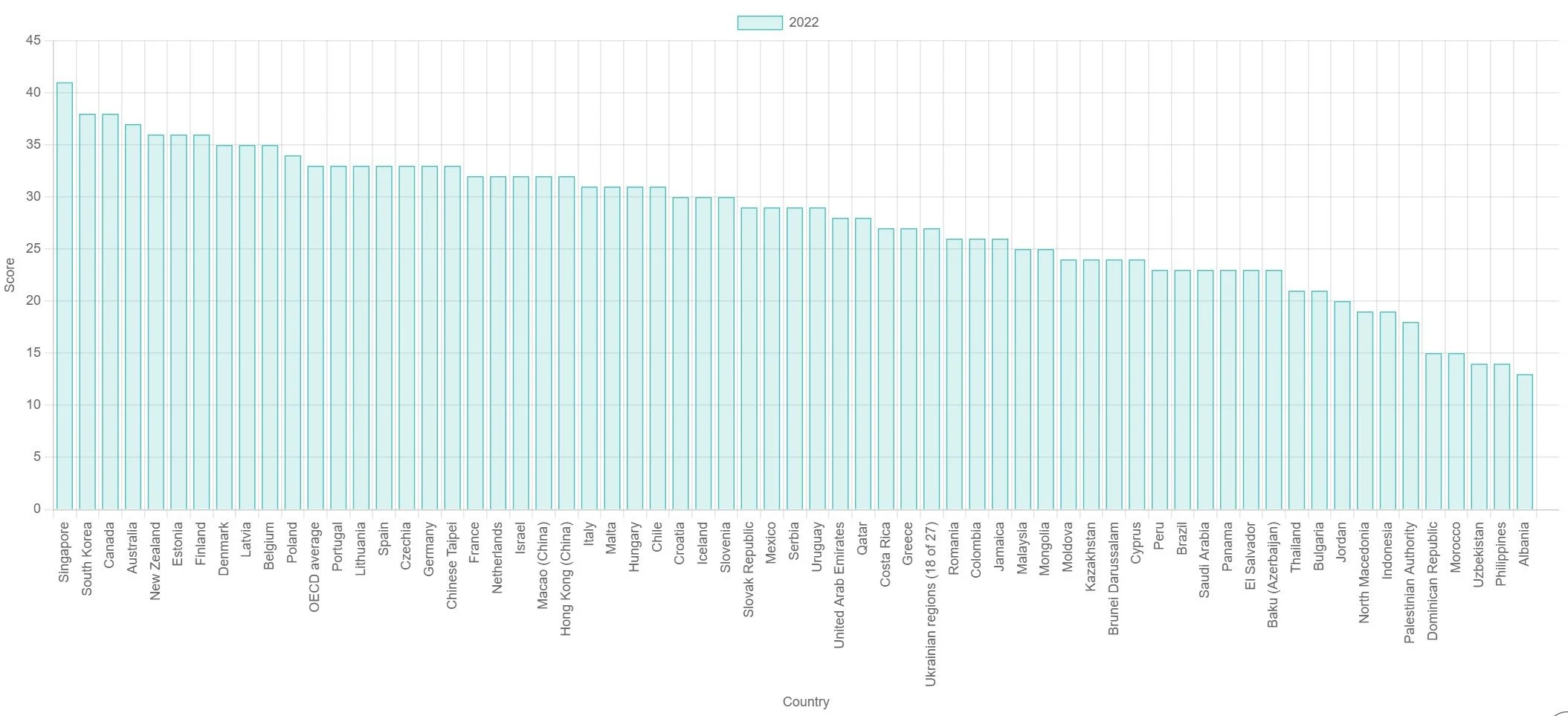
Creative Thinking was a separate PISA 2022 optional assessment and should not be presented as a PISA 2025 domain.
Any comparison of Singapore’s Creative Thinking performance belongs under a clear PISA 2022 label. Computational Problem Solving is the new PISA 2025 domain and measures a different set of tools and practices.
| Assessment | Correct cycle | Reader-facing description |
|---|---|---|
| Creative Thinking | PISA 2022 | Separate optional assessment from the 2022 cycle |
| Computational Problem Solving | PISA 2025 | Assessment involving modelling, programming, experiments, data analysis, and debugging |
The distinction prevents an older Creative Thinking chart from being mistaken for part of the latest results.
For the underlying comparison charts, see the Singapore school-system rankings page. The OECD PISA 2025 results, Singapore’s Ministry of Education release, and CNA’s reporting on Computational Problem Solving provide source context.
Primary and Secondary Schools:
-
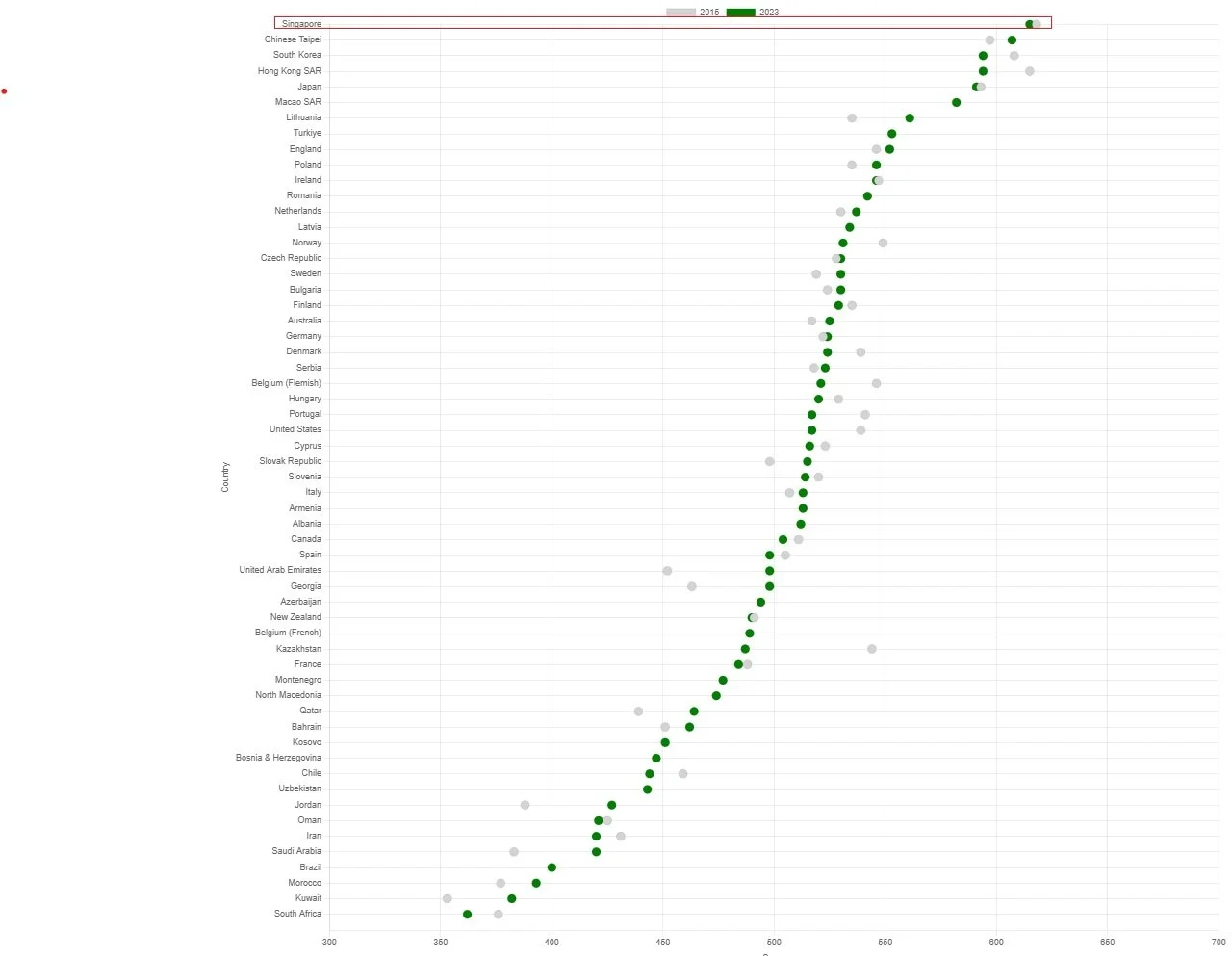
TIMSS: Singapore has for many years consistently topped the TIMSS rankings in mathematics and science for both 4th and 8th graders, demonstrating a strong foundation in these core subjects. Click here to view charts.
TIMSS 4th Grade Math Scores (2023 vs 2018, higher is better)
-
PISA: Singapore ranked first in Reading and second in Mathematics, Science, and Computational Problem Solving in PISA 2025. The new Computational Problem Solving assessment is explained below, while the older Creative Thinking chart is clearly labelled as a separate PISA 2022 assessment. Click here to view the updated charts.
PISA Creative Thinking Scores (PISA 2022)
Tertiary Schools:
-
Overall School Rankings:
-
QS World University Rankings: NUS and NTU consistently rank among the top 20 universities worldwide, solidifying Singapore’s position as a global leader in higher education.
-
Times Higher Education World University Rankings: NUS and NTU also perform exceptionally well in these rankings, consistently placing within the top 50.
-
Updated education charts and data
The current interactive comparison charts are maintained on the Singapore school-system rankings page. It includes the latest TIMSS datasets and the new PISA 2025 Science and Computational Problem Solving charts.
Older NUS, NTU and international-student embeds on this article depended on third-party scripts and no longer render reliably. We have removed the empty chart panels and kept the live rankings link as the maintained source instead of showing stale or blank visualisations.
-
MBA and Executive MBA:
-
Financial Times Global MBA Rankings: NUS, SMU and INSEAD’s Singapore campus feature prominently in these rankings, showcasing the quality of business education in Singapore.
-
-
Employability Rankings:
-
Graduate Employability Rankings: NUS and NTU are recognized for producing highly employable graduates, highlighting the strong link between education and industry needs in Singapore. For example, graduates from NUS were ranked 9th in 2024 and 2025 in the Times Higher Education surveys. In the QS survey in 2022, NUS was ranked 17th, which was up from 24th in 2020. NTU graduates were ranked 33rd in 2025 and 35th in 2024.
-
These rankings and assessments demonstrate the comprehensive excellence of Singapore’s education system, from primary school to university level. The country’s commitment to high standards, rigorous curriculum, and holistic development produces well-rounded graduates who are equipped to succeed in a competitive global environment.
Opportunities for Foreign Students After Graduation
Singapore’s education system not only attracts international students but also provides them with opportunities to stay and contribute to the nation’s growth after graduation.
Breakdown of Nationalities:
International students form a significant part of Singapore’s vibrant educational landscape. Here’s a breakdown of the top 10 nationalities of international students enrolled in Singaporean universities in 2022:
International student data
The nationality breakdown below is a 2022 historical snapshot, not a current 2026 estimate. Families should confirm the latest enrolment and fee information with the institution and the Ministry of Education before relying on it.
Breakdown of international students in Singapore by nationality in 2022
| Nationality | Share of international students |
|---|---|
| China | 44.4% |
| India | 12.4% |
| Indonesia | 4.3% |
| Vietnam | 3.9% |
| Malaysia | 3.7% |
| South Korea | 2.4% |
| United States | 2.1% |
| Myanmar | 1.9% |
| France | 1.7% |
| Germany | 1.6% |
| All other nationalities | 21.6% |
Source: Singapore Ministry of Education. Percentages are the shares shown in the original 2022 snapshot; “All other nationalities” is the remainder after the top 10.
Post-Graduation Opportunities:
-
Long-Term Visit Pass (LTVP): Graduates can apply for a 1-year LTVP to remain in Singapore and seek employment.
-
Work Passes: Upon securing a job, employers will typically apply for a work pass on the graduate’s behalf, such as a Work Permit, S Pass, or Employment Pass, depending on their qualifications and salary.
-
Permanent Residency (PR): After working in Singapore for a period and making significant contributions to the economy, foreign graduates can apply for PR, offering them the right to live and work in Singapore indefinitely.
-
Singapore Citizenship: PRs who have resided in Singapore for a qualifying period and meet certain criteria can apply for Singapore citizenship, granting them full rights and privileges as citizens.
Singapore’s welcoming policies and diverse opportunities make it an attractive destination for international students seeking to build their careers and futures.
Long-Term Visit Pass (LTVP) for Parents and Grandparents Supporting Children in Singapore
Parents and grandparents may want to stay in Singapore to support a child studying, working or raising a family. A Long-Term Visit Pass (LTVP) may be available, but the correct route depends on the child’s immigration status and the relationship. An LTVP is not a blanket family-reunification pass and approval is not automatic.
Parent or grandparent of a child studying on a Student’s Pass
ICA has a specific route for the parent or grandparent of a child or grandchild studying in Singapore on a Student’s Pass. Only one applicant—either the parent or the grandparent—may apply for that student. A Singapore citizen or permanent resident aged 21 or above must act as the local sponsor through ICA’s e-Service. ICA may require the student’s birth and family documents and a letter from the school, and says applications are generally processed within six weeks when the documents are complete. See the ICA parent or grandparent LTVP requirements.
Parent of a Singapore citizen or permanent resident
Parents of a Singapore citizen or Singapore permanent resident can use ICA’s parent LTVP route. If the Singapore citizen or PR child is aged 21 or above, that child must sponsor the application through Singpass. The relationship, documents, financial circumstances and other facts are assessed; being a parent does not guarantee approval. Read the ICA parent of a Singapore citizen or PR guidance.
Parent of an Employment Pass or S Pass holder
MOM’s work-pass LTVP route is separate from ICA’s family and student routes. An eligible Employment Pass or S Pass holder may sponsor a parent only when the main pass holder earns a fixed monthly salary of at least S$12,000, and the employer normally submits the application. MOM’s listed parent category does not automatically extend to grandparents. Check the MOM LTVP eligibility rules before making travel plans.
What an LTVP does—and does not—provide
- An LTVP allows an approved family member to stay for the period granted; it does not guarantee permanent residence, citizenship, school admission or a future renewal.
- An LTVP does not automatically grant work rights. A parent accompanying a child studying in Singapore is not allowed to work during the first year under the relevant ICA arrangement; later work requires the appropriate work pass and employer application.
- For families planning childcare or preschool, the child’s pass and citizenship or PR status can affect enrolment documents, fees and subsidy assumptions.
Preschool fees and immigration status
If a parent or grandparent is helping a family settle in Singapore, preschool planning should be handled alongside immigration planning. Fees vary by centre, programme and the child’s citizenship or PR status; an LTVP alone does not automatically create a preschool subsidy. For a practical overview of fee questions, pass status and documents, read What Are Singapore Preschool Fees for Foreigners in 2026?.
The Future of Singapore’s Education System
Singapore’s education system is not static; it’s constantly evolving to meet the challenges and opportunities of a rapidly changing world. Here are some key trends and initiatives shaping the future of education in Singapore:
-
Digital Transformation: The integration of technology and artificial intelligence (AI) in classrooms is accelerating. This includes personalized learning platforms, adaptive assessments, and the use of AI tutors to enhance the learning experience.
-
Focus on SkillsFuture: The SkillsFuture movement continues to gain momentum, emphasizing lifelong learning and skills mastery. This initiative provides Singaporeans with opportunities to upskill and reskill throughout their lives, ensuring they remain competitive in the future economy.
-
Emphasis on Well-being: While maintaining high standards, there’s a growing focus on student well-being and mental health. Initiatives are being implemented to reduce academic stress, promote holistic development, and create a more supportive learning environment.
-
Global Citizenship and Sustainability: The curriculum is being updated to incorporate global citizenship education and sustainability concepts. This aims to develop students’ awareness of global issues, intercultural understanding, and responsible citizenship.
-
Flexible Pathways and Personalized Learning: The education system is moving towards more flexible pathways and personalized learning experiences. This includes greater use of technology, adaptive assessments, and customized learning plans to cater to individual needs and aspirations. Short Guide for Indians Moving to Singapore: Company Incorporation, Employment Pass, PR, and CECA Benefits Incorporating a Company in Singapore and Obtaining an Employment Pass (EP): Your Step-by-Step Guide
Singapore: Your Gateway to Educational Excellence
Singapore’s education system stands as a shining example of how a country can invest in its people and create a world-class learning environment. By focusing on both academic success and personal growth, Singapore’s schools prepare students to thrive in a constantly changing world.
Whether you’re a student in Singapore or dreaming of studying there, the opportunities are endless. From primary school to university, Singapore offers a path for everyone to reach their full potential.
E&H Immigration Consultancy: Your Partner in Education
Moving to a new country for school can be tough, but E&H Immigration Consultancy is here to help! We’re experts in helping students and families relocate to Singapore. We can assist with:
-
Student Passes: Getting the right visa for your studies.
-
Long-Term Visit Passes (LTVPs): Bringing your family to Singapore with you.
-
Permanent Residency (PR): Making Singapore your permanent home.
-
Citizenship: Becoming a citizen of Singapore.
-
Relocation of Families: Finding a place to live, schools for your kids, and everything else you need to feel settled in Singapore.
Contact E&H Immigration Consultancy today, and let us help you achieve your educational dreams in Singapore!
FAQ
Can a parent or grandparent apply for an LTVP to support a child studying in Singapore?
Yes, ICA has a route for a parent or grandparent of a child or grandchild studying in Singapore on a Student’s Pass. Only one applicant may apply for that student, and a Singapore citizen or PR aged 21 or above must act as local sponsor. Approval depends on the application and supporting documents.
Can both the parent and grandparent hold an LTVP for the same student?
Under this specific student-support route, only one applicant—either the parent or the grandparent—may apply. Families should not assume that two LTVPs will be granted for the same student.
Can a Singapore citizen or PR sponsor a parent for an LTVP?
A Singapore citizen or PR may sponsor a parent through ICA’s parent LTVP route, subject to the applicable relationship, sponsorship and assessment requirements. Sponsorship is not an automatic approval.
Can an Employment Pass holder bring a parent to Singapore?
An eligible EP or S Pass holder may sponsor a parent through MOM’s LTVP route when the main pass holder earns a fixed monthly salary of at least S$12,000 and the employer submits the application. Grandparents are not automatically included in this MOM parent category.
Can an LTVP holder work in Singapore?
Not automatically. The holder must meet the requirements for the relevant work pass. A parent accompanying a child studying in Singapore cannot work during the first year under the applicable arrangement; any later work still requires employer sponsorship and approval.
Does an LTVP automatically reduce preschool fees?
No. Preschool fees and subsidies depend on the centre, programme and the child’s status and scheme eligibility. See the Singapore preschool fees guide for foreign families and confirm the current position with the centre and relevant authority.
Need help mapping the family’s pass, school and caregiving plan? E&H Immigration can help organise the relevant questions and documents, but families should confirm time-sensitive requirements with ICA, MOM, MOE or ECDA before applying.
Related reading
Not sure where you stand?
Get a personalised assessment of your Singapore PR, citizenship, or work pass options from E&H Immigration’s specialists.