
Best Universities in Singapore 2027 for International Families
Compare the best universities in Singapore for 2027, including NUS and NTU rankings, course fit, costs, international study and PR planning for families.

TLDR:
- NUS ranks 10th and NTU ranks 12th in the QS World University Rankings 2027.
- NUS offers the strongest all-round choice, while NTU is especially compelling for engineering, science and technology.
- SMU, SUTD, SIT and SUSS can be better choices when programme fit matters more than overall global rank.
- University admission does not automatically provide Singapore PR or citizenship.
- International families should compare degree content, total cost and post-graduation work-pass feasibility before choosing.
The best universities in Singapore for 2027 are the National University of Singapore (NUS) and Nanyang Technological University (NTU) for global academic breadth, with NUS ranked 10th and NTU ranked 12th in the QS World University Rankings 2027.[1] Singapore’s NUS (#10) and NTU (#12) remain top 15, but the best university for an individual student may instead be SMU, SUTD, SIT or SUSS when the intended degree, learning style and career pathway receive greater weight. International families should treat university choice as an education decision first and an immigration-planning factor second because enrolment or graduation alone does not confer Singapore PR.
Which Singapore universities rank highest in the QS World University Rankings 2027?
NUS ranks first in Singapore at 10th globally, while NTU ranks second in Singapore at 12th globally. QS published the QS World University Rankings 2027 on 18 June 2026 and featured 1,504 institutions.[2] The Singapore results show two globally prominent comprehensive universities and two smaller specialised universities in the published table.[1]
| Singapore university | QS 2027 rank | QS 2026 rank | Movement | Practical reading |
|---|---|---|---|---|
| National University of Singapore (NUS) | 10 [1] | 8 [1] | Down 2 | Strongest all-round choice for families seeking broad subject coverage and global recognition |
| Nanyang Technological University, Singapore (NTU Singapore) | 12 [1] | 12 [1] | No change | Leading alternative for engineering, technology, science, business and interdisciplinary study |
| Singapore University of Technology and Design (SUTD) | 266 [1] | 519 [1] | Up 253 | Specialised option whose design-led model requires programme-level comparison |
| Singapore Management University (SMU) | 411 [1] | 511 [1] | Up 100 | Specialised city university suited to business, law, economics, computing and social sciences |
SIT and SUSS do not appear in this QS 2027 overall table, but absence from an overall ranking does not establish weak teaching or poor career fit. Overall rankings favour institutions with research scale, international visibility and broad institutional data, while applied universities may deliver value through specialised programmes and workplace-oriented education.
Readers comparing universities beyond Singapore can consult the QS World University Rankings 2027 full dataset, which contains the complete 1,504-institution results.
Is NUS or NTU the better university in 2027?
NUS is the stronger default for maximum academic breadth, while NTU is often the sharper choice for engineering, science and technology. The two-place difference between NUS and NTU is too small to replace a programme-level comparison. Families should compare the curriculum, faculty, laboratories, internships, exchange opportunities, campus environment and graduate destinations for the exact course under consideration.
| Decision factor | NUS | NTU |
|---|---|---|
| Overall QS 2027 position | 10th globally [1] | 12th globally [1] |
| Institutional profile | Comprehensive and research-intensive, with multidisciplinary and cross-faculty programmes [3] | Comprehensive and research-intensive, with a strong focus on engineering, science and technology [3] |
| Best starting point for | Students who want maximum subject breadth or flexibility across disciplines | Students with a defined interest in engineering, technology, science or related interdisciplinary fields |
| Campus experience | Large university ecosystem with several academic and residential settings | Integrated campus environment with major science and engineering facilities |
| Comparison priority | Department strength and degree structure | Department strength and degree structure |
NUS moving from eighth to 10th does not prove that its teaching or graduate prospects deteriorated. A world ranking records relative institutional performance under a particular methodology, so movement can also reflect changes at competing universities.
NTU holding 12th place confirms strong global positioning, but the unchanged rank does not make every NTU programme equivalent to its NUS counterpart. A student choosing between the two should compare the actual modules and opportunities attached to the intended major.
Which university is best for each type of student?
Singapore’s six Autonomous Universities serve different academic and career objectives, so the best choice depends on the student’s intended field and preferred learning model. MOE identifies NUS, NTU, SMU, SUTD, SIT and SUSS as Singapore’s Autonomous Universities and describes distinct roles for each institution.[3]
| University | Best suited to students seeking | Distinguishing academic profile |
|---|---|---|
| NUS | Broad academic choice, research depth and interdisciplinary flexibility | NUS is a comprehensive university with a globally oriented approach to education, research and entrepreneurship.[3] |
| NTU | Engineering, science, technology, business, humanities, education or medicine | NTU is a comprehensive university with major education and research institutes.[3] |
| SMU | Business, accountancy, economics, law, computing or social sciences in an interactive environment | SMU is a specialised university whose pedagogy includes collaborative and real-world industry work.[3] |
| SUTD | Architecture, engineering, design, artificial intelligence and interdisciplinary problem-solving | SUTD uses an interdisciplinary, design-focused curriculum grounded in STEM.[3] |
| SIT | Applied degrees, industry integration and workplace-based learning | SIT is Singapore’s first university of applied learning.[3] |
| SUSS | Social sciences, human development, community-focused disciplines or flexible applied study | SUSS provides applied education for school leavers and adult learners.[3] |
A student targeting investment banking may reasonably prefer an appropriate SMU programme over a higher-ranked institution. A student seeking structured workplace learning may find SIT more aligned with the intended career than either NUS or NTU.
A student focused on design-led engineering should compare SUTD directly with the relevant NUS and NTU degrees. A student balancing education with adult responsibilities should examine SUSS programme formats and entry requirements rather than relying on an overall ranking.
Why is Singapore gaining attention from international students in 2027?
Singapore combines two top-15 universities with improving international-student representation at a time of policy pressure in several traditional study destinations.
QS reports that the United States, United Kingdom, Australia and Canada have introduced combinations of student caps, international student levies or graduate-work-visa restrictions. QS also reports that Singapore, Hong Kong, Malaysia and South Korea improved their mean average International Student Ratio while many of those four traditional destinations recorded year-on-year declines.[2]
The shift strengthens Singapore’s comparative position, but families should distinguish a national trend from an individual admissions outcome. NUS and NTU remain highly selective, and admission outcomes vary by programme and applicant profile.
Singapore’s advantage is especially relevant to families already living in the country. Local residence can simplify campus visits, family support and evaluation of graduate opportunities, but immigration status still determines the documents and permissions a student needs.
What should international families compare before applying?
International families should compare programme fit, admissions eligibility, total cost, immigration status and post-graduation feasibility in that order.
- Define the intended academic outcome. Identify the preferred field, acceptable alternative majors and whether the student wants research intensity, professional accreditation, applied learning or interdisciplinary flexibility.
- Check qualification-specific admission rules. Compare the university’s current requirements for the student’s exact school-leaving qualification. Published minimums should be treated as eligibility thresholds rather than promises of admission.
- Compare the degree rather than the university name. Review compulsory modules, specialisations, internships, exchange options, teaching format and assessment methods for each shortlisted programme.
- Calculate the complete financial commitment. Include tuition, accommodation, meals, transport, insurance, travel and contingency funding. International students should also compare subsidised and non-subsidised fee structures where available.
- Read every grant or scholarship obligation. NUS states that international students receive a limited number of MOE Tuition Grants on a competitive basis and that recipients must work for a Singapore entity for three years after graduation.[5] Families should verify the current terms for the specific university and programme before accepting financial support.
- Confirm the required immigration status. ICA states that a foreigner accepted for full-time study generally needs a Student’s Pass unless the student holds a valid exempting status, such as a Dependant’s Pass or Long-Term Visit Pass under the stated conditions.[4]
- Build a balanced application portfolio. Include ambitious, realistic and lower-risk programme choices. An overall university rank should never be the sole basis for the portfolio.
Does studying at a top Singapore university improve the path to Singapore PR?
A Singapore university degree can support a graduate’s professional profile, but admission, enrolment and graduation do not automatically create eligibility for Singapore PR or citizenship.
ICA’s student category covers a student studying in Singapore who has passed at least one national examination—PSLE, GCE ‘N’, ‘O’ or ‘A’ Levels—or who is in the Integrated Programme.[7] University attendance by itself does not satisfy that published student-category condition.
A foreign graduate who later holds an Employment Pass or S Pass falls within a separately listed category of foreigners who may apply for Singapore PR.[7] ICA assesses factors including family ties to Singaporeans, economic contributions, qualifications, age, family profile and length of residency when considering the applicant’s ability to contribute, integrate and demonstrate commitment to sinking roots.[7] Approval is not guaranteed.
MOM requires Employment Pass candidates to meet the qualifying salary and, unless exempted, pass the points-based Complementarity Assessment Framework, or COMPASS.[6] For new applications from 1 January 2027, the minimum qualifying salary starts at S$6,000 outside financial services and S$6,600 in financial services, with higher age-adjusted thresholds.[6]
MOM awards 20 COMPASS qualification points for degree-equivalent qualifications from top-100 QS universities, Singapore’s Autonomous Universities and certain other recognised institutions.[6] A qualifying degree can therefore matter within one component of an Employment Pass assessment, but the candidate and employer must still satisfy the full work-pass framework.
Male students and their families must consider National Service before pursuing Singapore PR. ICA states that male applicants granted Singapore PR as foreign students or under their parents’ sponsorship are liable for National Service, and MINDEF does not grant deferment for university studies.[7]
E&H Immigration recommends separating three questions: whether the student can enter the preferred university, whether the graduate can secure qualifying employment, and whether a later Singapore PR application presents a well-supported record. A favourable answer to one question does not determine the others.
How important is education for an Employment Pass, PR or citizenship in Singapore?
Education now carries measurable weight at every stage of the Singapore immigration journey.
An Employment Pass is points-based: on top of the qualifying salary, candidates must pass COMPASS (the Complementarity Assessment Framework). Its C2 Qualifications criterion alone awards up to 20 points — the full 20 for a bachelor’s degree or above from an eligible top-tier institution (the QS top 100 universities, Singapore’s Autonomous Universities, and certain field-recognised institutions), and 10 for other degree-equivalent qualifications.[6] An application needs 40 points across the four foundational criteria to pass, so a strong qualification can be decisive — and a degree from NUS or NTU sits squarely inside the 20-point tier.
The trend points the same way for permanent residency and citizenship. Singapore does not publish a points test for PR, and ICA weighs the ability to contribute, integrate and sink roots rather than a single score.[7] But the Government’s own data shows how educated the successful cohort already is: in Population in Brief 2025 (Table 17), 85.5% of new permanent residents and 81.1% of new citizens aged 20 and over held post-secondary qualifications in 2024, while only 14.5% of new PRs and 18.9% of new citizens had secondary education or below.[8] The resident population has also been steadily upskilling, with university-qualified residents rising year on year.
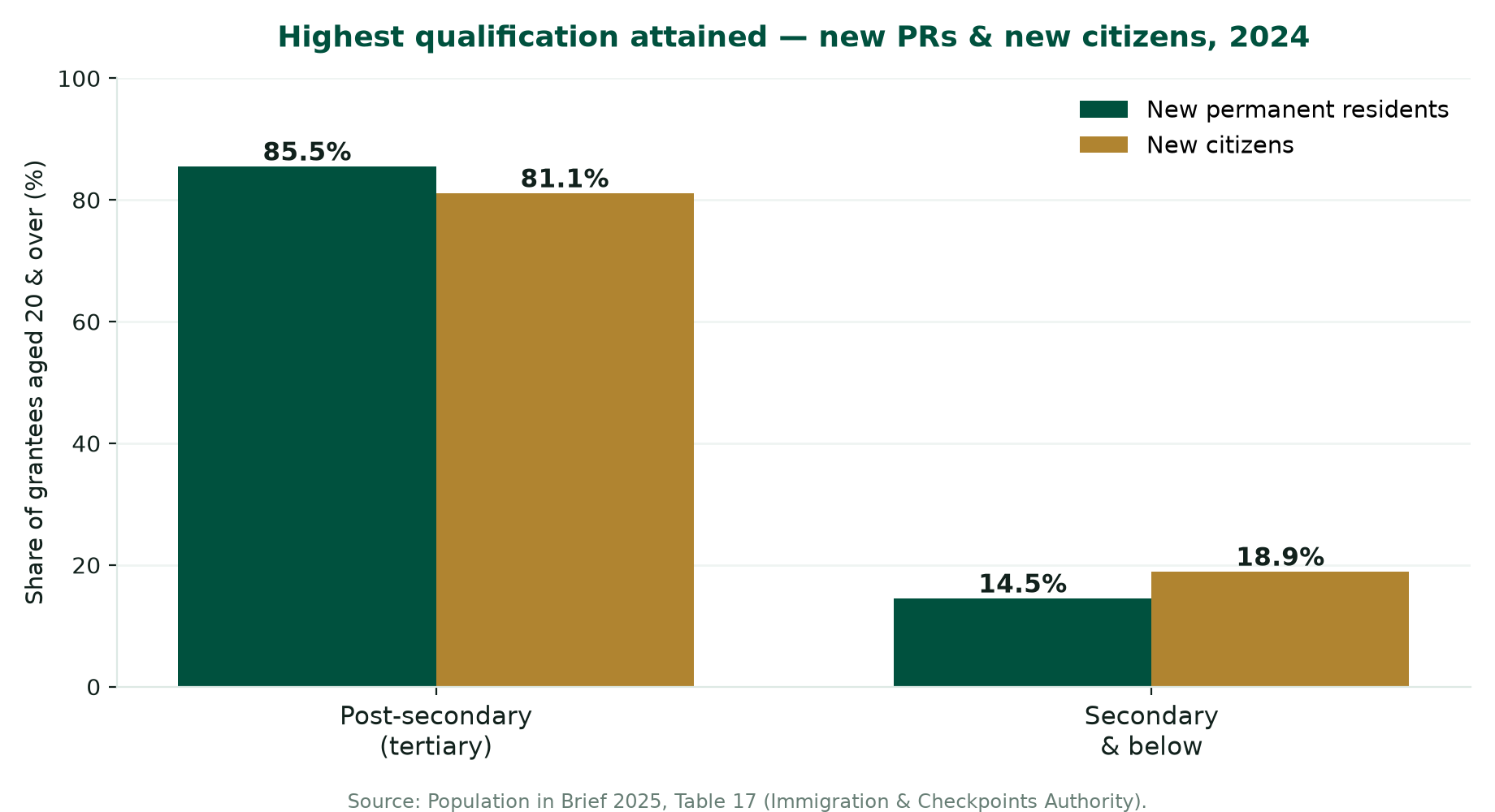 Source: Population in Brief 2025, Table 17 (Immigration & Checkpoints Authority).
The practical message for families choosing a university is that the decision reaches further than the lecture hall: the institution and qualification a graduate holds feed directly into the COMPASS points behind their Employment Pass and, over time, into the profile Singapore assesses for PR and citizenship.
How might two international families make different choices?
Two students with similar grades can reasonably select different universities because subject fit and immigration circumstances change the decision.
Composite case study 1: engineering student already living in Singapore
An international family compares NUS engineering, NTU engineering and SUTD for a child who prefers project-based technical work. The family initially favours NUS because it ranks 10th globally, but the student prefers the curriculum and design emphasis of another shortlisted programme. The family selects the course after comparing modules, facilities, internship structures and total cost, while treating future Singapore PR as a separate matter.
Composite case study 2: business student moving from overseas
An overseas family compares NUS, NTU and SMU for a child interested in finance and entrepreneurship. The family places SMU on equal footing because the programme content, city setting and interactive teaching model match the student’s goals. The family also checks Student’s Pass requirements, funding conditions and the 2027 Employment Pass thresholds before estimating whether a post-graduation career in Singapore is realistic.
Both examples are anonymised composites for illustration. Neither example predicts admission, employment-pass approval or Singapore PR approval.
How should families make the final university decision?
Families should use rankings to form a shortlist and programme evidence to make the final choice.
- Start with field of study. Remove universities that do not offer the required programme or specialisation.
- Score programme fit. Rate curriculum, teaching style, internships, exchange options, campus environment and career alignment on a consistent scale.
- Model the full cost. Compare tuition and living expenses under realistic housing and funding scenarios.
- Review grant obligations. Record every service requirement, scholarship condition and repayment risk before accepting an award.
- Test post-graduation assumptions. Compare likely entry-level roles with prevailing MOM work-pass requirements without assuming that a future job or pass will be approved.
- Review family immigration consequences. Examine the student’s present pass, possible future work-pass category, Singapore PR eligibility route and any National Service implications.
- Choose the strongest complete fit. Select the university that best combines academic suitability, affordability and a credible personal plan.
Families seeking broader context can read Inside Singapore’s World-Class Education System and the Singapore education system guide alongside the ranking data.
Planning support from E&H Immigration: University selection can affect a family’s residence, employment and long-term planning, but education and immigration decisions operate under different rules. E&H Immigration can assess the family’s current status, explain the relevant Singapore PR pathways and identify immigration assumptions that should be resolved before enrolment.
What do families ask about Singapore universities in 2027?
Which university is number one in Singapore in 2027?
NUS is Singapore’s highest-ranked university at 10th in the QS World University Rankings 2027.[1]
What is the NTU world ranking for 2027?
NTU ranks 12th in the QS World University Rankings 2027.[1]
Is NUS always better than NTU?
NUS is higher in the overall QS 2027 ranking, but programme content, subject strength, teaching style and career fit can make NTU the better choice for an individual student.
Are SMU and SUTD good universities despite lower overall rankings?
SMU and SUTD are specialised Autonomous Universities with distinct academic models, so families should judge their relevant programmes rather than compare overall ranks alone.[3]
Are SIT and SUSS included in the QS World University Rankings 2027?
SIT and SUSS do not appear in the published QS 2027 overall table used for this comparison.[1] Ranking absence does not establish programme quality or graduate suitability.
Does a Singapore university degree guarantee an Employment Pass?
A Singapore university degree does not guarantee an Employment Pass. MOM requires candidates to meet the qualifying salary and, unless exempted, pass COMPASS.[6]
Can an international university student apply for Singapore PR through the student route?
ICA’s published student category requires study in Singapore plus at least one specified national examination or participation in the Integrated Programme.[7] University enrolment alone does not meet that stated condition.
Does graduating from NUS or NTU guarantee Singapore PR?
Graduation from NUS or NTU does not guarantee Singapore PR. ICA assesses each eligible application using factors that include economic contributions, qualifications, age, family profile, family ties and length of residency.[7]
Should families choose a university mainly for future Singapore PR prospects?
Families should choose the best educational and financial fit first. Singapore PR planning should evaluate the graduate’s later eligibility, employment record and wider profile as a separate process.
Sources & References
- QS World University Rankings 2027: Top Global Universities — QS Quacquarelli Symonds
- QS World University Rankings 2027 Results — QS Quacquarelli Symonds
- Education Statistics Digest 2024 — Ministry of Education, Singapore
- Becoming a Student’s Pass Holder — Immigration & Checkpoints Authority
- Undergraduate Fees and MOE Tuition Grant — National University of Singapore
- Eligibility for Employment Pass — Ministry of Manpower
- Becoming a Permanent Resident — Immigration & Checkpoints Authority
- Population in Brief 2025 — National Population and Talent Division, Singapore
Not sure where you stand?
Get a personalised assessment of your Singapore PR, citizenship, or work pass options from E&H Immigration’s specialists.