
TL;DR
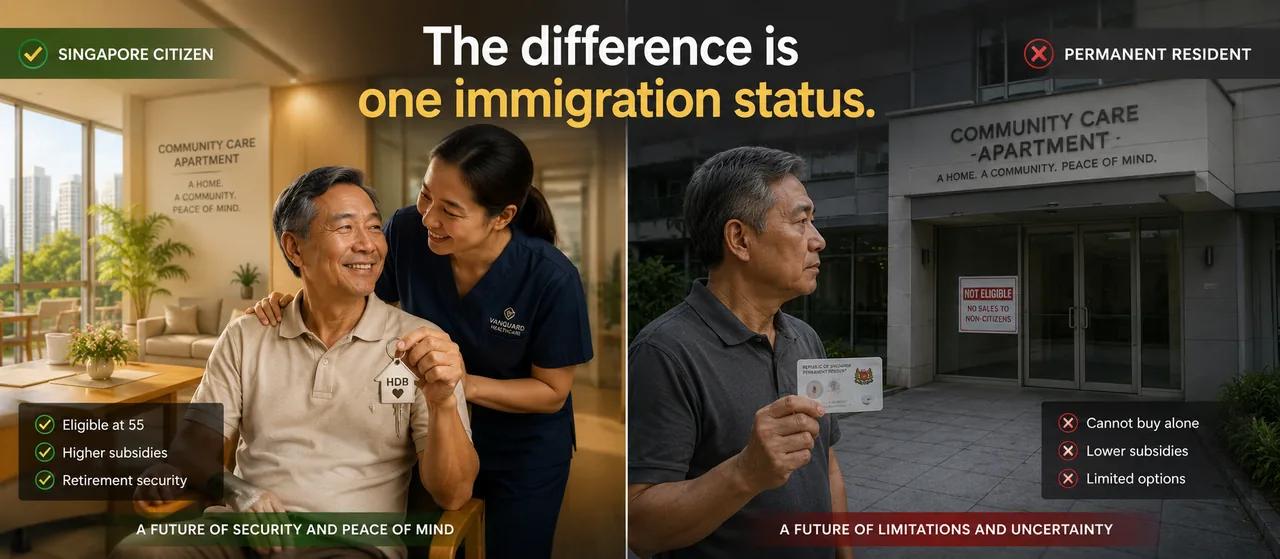
From the October 2026 BTO exercise, the minimum age to buy a Community Care Apartment (CCA) — Singapore’s assisted-living public housing — drops from 65 to 55. Monthly Basic Service Package (BSP) fees for existing projects will fall by 18% to 75% once new subsidies kick in from Q2 2027. But there is a detail most coverage skips: CCAs are only available to households with at least one Singapore citizen applicant, and singles must be citizens. A Permanent Resident cannot buy one alone — and even as a co-applicant spouse, a PR qualifies for a materially lower care subsidy (up to 55%) than a citizen (up to 80–95%). If you are a long-term foreign resident planning to age in Singapore, your immigration status is now, quite literally, your retirement housing plan.
What are Community Care Apartments?
Community Care Apartments (CCAs) are HDB flats that bundle senior-friendly housing with a mandatory care package — Singapore’s first assisted-living public housing, introduced in 2021.
Each unit comes with pre-installed senior-friendly fittings: easy-to-slide partitions separating living and bathroom spaces, built-in wardrobes and cabinets to reduce trip hazards, and wheelchair-accessible bathrooms with slip-resistant flooring and grab bars.
Every resident subscribes to a Basic Service Package (BSP), which covers a CCA staff member who assists with simple home fixes, letter-reading and bill interpretation, provides 24-hour emergency response, and helps residents arrange add-on services such as shared caregiving, day care and housekeeping (additional charges apply for add-ons).
CCAs are jointly run by the Ministry of Health (MOH), Ministry of National Development (MND) and HDB, with Vanguard Healthcare as the operator. Five projects have been launched to date — in Bukit Batok, Queenstown, Bedok, Geylang and Sengkang — with a sixth coming to Toa Payoh in October 2026, next to Caldecott MRT station.
What changed in July 2026?
Two things — the minimum age drops from 65 to 55 from the October 2026 BTO exercise, and BSP fees fall by 18–75% for existing projects through streamlining and new means-tested subsidies from Q2 2027.
1. Lower age eligibility. Currently, applicants and their spouse must both be at least 65. From the October 2026 BTO exercise, the threshold drops to 55, and the change also applies to CCAs offered at future Sale of Balance Flats exercises. Seniors turning 55 can now weigh CCAs alongside short-lease 2-room Flexi flats when right-sizing.
2. Cheaper Basic Service Package. The BSP scope is being streamlined for CCAs operating from 2026 onwards: social activities move to subsidised (mostly free) Active Ageing Centre touchpoints at or near the CCA, and the emergency alert device becomes optional — residents who skip it still get 24-hour emergency support through CCA staff. On top of streamlining, MOH will subsidise BSP components similar to those under national Long-Term Care schemes, subject to means-testing. Applicants must be assessed as unable to perform at least one Activity of Daily Living (ADL) to qualify for the subsidy.
The combined effect: residents of pre-2026 CCAs will see monthly BSP fees fall by 18% to 75%, with revised fees implemented from Q2 2027.
Who can buy a Community Care Apartment?
Only households with at least one Singapore citizen applicant. Single applicants must be citizens. A Permanent Resident cannot purchase a CCA on their own.
The full eligibility criteria:
| Criterion | Requirement |
|---|---|
| Age | Applicant(s) and spouse (if any) at least 55 from Oct 2026 BTO (currently 65), assessed at HFE letter application |
| Citizenship | Families: at least 1 Singapore citizen applicant. Singles: must be a Singapore citizen |
| Income ceiling | Average gross monthly household income ≤ S$14,000 |
| Property ownership | Owners of private residential property or an HDB flat (aged 65+, listed in the HFE application) must dispose of it within 6 months of key collection. Up to one non-residential property may be kept |
| Previous purchase | Not eligible if you have enjoyed 2+ housing subsidies, one of which was a Studio Apartment, short-lease 2-room Flexi flat or CCA |
| Lease length | 15–35 years (5-year increments), must cover all applicants and spouse to at least age 95 |
The citizenship line is the one that matters for immigration planning. Read it carefully:
- A Singapore citizen, single or married, can apply.
- A PR married to a citizen can be part of an eligible household — but only because the citizen spouse anchors the application.
- A single PR cannot buy a CCA. Full stop.
- A PR couple cannot buy a CCA.
- Foreigners (EP, S Pass, LTVP holders and others) have no access at all — consistent with the broader rule that non-PRs cannot buy HDB flats.
How much more does a citizen save on the care package?
At every income band, citizens receive higher BSP subsidies than PRs — up to 95% for citizens born in 1969 or earlier and up to 80% for younger citizens, versus a maximum of 55% for PRs.
The subsidy framework (Annex A of the MOH press release) is means-tested on Monthly Per Capita Household Income (PCHI), with Annual Value of home used where PCHI is $0:
| Monthly PCHI | SC born ≤1969 | SC born after 1969 | Permanent Resident |
|---|---|---|---|
| $0 (home AV ≤ $21k) | 95% | 80% | 55% |
| $900 and below | 95% | 80% | 55% |
| $901 – $1,500 | 95% | 80% | 55% |
| $1,501 – $2,300 | 85% | 70% | 45% |
| $2,301 – $2,600 | 75% | 60% | 35% |
| $2,601 – $3,600 | 55% | 40% | 20% |
| $3,601 – $4,800 | 35% | 20% | 10% |
| $4,801 and above | 0% | 0% | 0% |
Two observations:
The citizen–PR gap is 25–40 percentage points at every subsidised band. At the lowest income tier, an older citizen pays 5% of the subsidisable BSP cost; a PR in the same household circumstances pays 45% — nine times as much out of pocket.
The gap compounds over a 15–35 year lease. A subsidy difference that looks modest per month becomes a five-figure sum over the life of a CCA lease. The chart below illustrates the cumulative out-of-pocket BSP cost for a resident in the lowest income band, assuming an illustrative subsidisable BSP cost of S$500/month (actual fees vary by project and will be published at go.gov.sg/basicservicepackage):
This mirrors the structure of MediShield Life premiums, CHAS, subsidised long-term care and hospital ward subsidies: PR discounts exist, but citizens consistently sit one to two tiers above.
Why does this matter for immigration planning?
Because Singapore’s retirement infrastructure — subsidised assisted living, long-term care subsidies, healthcare tiers, CPF housing grants — is built around citizenship, and the gap between citizen and PR widens precisely when you can least afford to close it.
Most people evaluate PR or citizenship through the lens of their current life stage: job mobility, children’s school admissions, property stamp duty. Those are real considerations. But they systematically understate the value of status because the largest citizen-only and citizen-tiered benefits are back-loaded to old age.
Consider the trajectory of a foreign professional who arrives at 35, becomes a PR at 40, and stays on PR status indefinitely:
- At 45, the PR–citizen difference feels like ABSD rates and school balloting priority.
- At 55, it becomes the difference between being able to right-size into a CCA (if married to a citizen) or being locked out entirely (if single or married to another PR).
- At 65+, it is a permanent 25–40 point subsidy penalty on care services, layered on top of similar penalties across healthcare.
There is also a timing dimension that is easy to miss. Citizenship applications typically take 12–24 months to process, and ICA generally expects at least two years on PR before applying — often longer for a competitive profile. Someone who starts thinking about citizenship at 54 because they want CCA access at 55 has left it too late. The realistic runway is 5–10 years: strengthen the profile, apply, naturalise, and let the status season before the life stage where it pays off.
To see where your own profile stands today, try our Singapore citizenship chances calculator.
And the retirement-benefit gap only moves in one direction. The CCA age reduction, the new BSP subsidies and the Age Well Neighbourhoods roll-out all expand what citizens receive as Singapore’s population ages. Each new senior-support scheme is another line item on the citizen side of the ledger.
How does a CCA compare with private assisted living?
The private alternatives — the only assisted-living route open to households without a citizen — cost roughly S$2,000 to S$7,000 per month, before care escalation. A CCA resident pays a one-time subsidised flat price plus a Basic Service Package fee that, after the new subsidies, is a small fraction of that.
Because CCAs are closed to non-citizen households, the private market is not a “premium option” for a single PR or PR couple — it is the only residential assisted-living option. Here is what that market looks like:
| Option | Model | Indicative monthly cost | Open to |
|---|---|---|---|
| Community Care Apartment | Subsidised HDB purchase (15–35 yr lease) + BSP fee, means-tested subsidies up to 95% | BSP fee only; falling 18–75% for existing projects from Q2 2027 | Citizen households only |
| Red Crowns Senior Living | Private co-living in retrofitted HDB/condo units | ~S$2,000–5,000 | Anyone who can pay |
| St Bernadette Lifestyle Village | Private assisted living in landed homes | ~S$3,000–5,350 | Anyone who can pay |
| Allium Care Suites | Premium private care residence | ~S$3,500–7,000 (single occupancy) | Anyone who can pay |
| Premium private nursing care | Full nursing, private suites | ~S$5,500–12,000+ | Anyone who can pay |
Indicative published rates as at mid-2026; actual fees vary by room type, care level and location, and typically rise as care needs grow.
Run the arithmetic over a realistic horizon. Ten years of private assisted living at a mid-range S$3,500/month is S$420,000 — recurring, unrecoverable, and likely to escalate with care needs. Fifteen years is over S$600,000. A CCA household over the same period pays a one-time subsidised flat price (a capital outlay, on a lease sized to remaining lifespan) plus a heavily subsidised service fee. The private market is not just more expensive at the margin; it is a different order of magnitude of lifetime cost.
And private care costs move in one direction. Singapore’s 65-and-above population is growing faster than assisted-living supply, staffing costs are rising across the care sector, and premium operators price accordingly. The subsidised public option is the inflation hedge — and it sits behind a citizenship gate.
Why does this matter more if you have no children — or family overseas?
Because at 65, the average Singapore resident can now expect to live past 86 — and roughly the last decade of life is typically spent in declining health, needing exactly the kind of daily support that CCAs institutionalise and that family would otherwise provide.
Life expectancy at birth reached a record 83.9 years in 2025. More relevantly for anyone reading this at mid-career: a resident who reaches 65 can expect to live to about 86.6 on average — 84.9 for men, 88.1 for women — and a meaningful share will pass 90. At the same time, Singaporeans spend on average around 10 of those final years in less-than-full health.
Put those together and the planning question is not “will I live long?” but “who helps me through the last ten years?”
For most Singaporean families, the default answer has been children, extended family, or a live-in helper coordinated by family. But that default does not describe a large share of long-term foreign residents:
- No children, by choice or circumstance — no one to coordinate care, manage bills, or respond to a fall.
- Children abroad — raised in Singapore, now working in London, Sydney or New York. Willing to help, but eleven time zones away.
- Extended family in the home country — siblings and cousins who cannot realistically provide day-to-day support in Singapore.
This is precisely the gap the CCA model fills: a staff member who reads letters, interprets bills, arranges add-on care and responds to emergencies 24 hours a day — the functions adult children traditionally perform. It substitutes institutional support for family support, at a subsidised price.
Which makes the citizenship gate sharper still. The residents who most need a family-substitute care model — singles and couples ageing without local family — include exactly the single PRs and PR couples the scheme excludes. If that describes your likely future, the status question is not academic. It is the difference between a subsidised support system and self-funding S$400,000+ of private care — or leaving Singapore in your final decades after building your entire adult life here.
What about the single PR who has lived here for 30 years?
Under current rules, a single PR — regardless of how long they have lived, worked and paid taxes in Singapore — cannot buy a CCA, cannot buy a BTO flat, and can only buy resale HDB with another PR family member after 3 years of PR status. Their assisted-living options narrow to private alternatives.
This is the scenario worth sitting with, because it describes a large and growing cohort: professionals who arrived in the 1990s and 2000s, took PR, never naturalised (often to preserve a home-country passport or property rights), never married or married a fellow PR — and are now approaching the age where housing and care converge.
Their private-sector alternatives — private assisted-living developments, nursing homes at unsubsidised rates, or retirement abroad — cost multiples of a subsidised CCA. For this group, the question “should I convert to citizenship?” has quietly changed from a lifestyle preference to a financial-planning decision with a six-figure delta.
The honest counterweight: citizenship means renouncing your original nationality (Singapore does not permit dual citizenship for adults), and for families with sons, NS obligations apply to second-generation male PRs and citizens. These are serious trade-offs, and the right answer differs by family. The point is not that everyone should naturalise — it is that the decision should be made with the full retirement picture on the table, not just the mid-career picture.
How do I apply for a CCA in the October 2026 exercise?
You need a valid HDB Flat Eligibility (HFE) letter reflecting CCA eligibility before you submit your flat application — apply or re-apply for the HFE letter by 15 September 2026.
Three scenarios:
- No HFE letter yet: apply early and submit all required documents by 15 September 2026.
- Valid HFE letter, aged 55+ at the time you applied for it: HDB will update your letter automatically to reflect CCA eligibility.
- Valid HFE letter, but you were under 55 when you applied and will turn 55 before the October 2026 exercise: you must re-apply for a fresh HFE letter — do so by 15 September 2026.
Check your HFE letter from 1 October 2026; if CCA eligibility is missing when it should not be, write to HDB via their website.
Planning to retire in Singapore? Start with your status.
If you have built your career and family here and intend to grow old here, your immigration status determines your housing options, your care subsidies and your safety net at 55, 65 and 75 — not just your job flexibility today. E&H Immigration’s consultants have handled over 1,000 applications across PR, citizenship and complex cases. We can assess whether citizenship makes sense for your family’s long-term plan, and how to build a competitive profile years before you need the outcome.
Related Reading
- Singapore Retirement Age & Re-employment: PR vs EP
- Singapore PR Application Guide
- Bringing a Foreign Aged Parent to Singapore
- Comprehensive LTVP Guide
Planning your retirement status in Singapore?